




 All Earrings
 Stud Earrings
 Drop Earrings
 Solitaire
 Hoop Earrings
 Halo Earrings
 Vermeil Earrings
 Round
Round
 Oval
Oval
 Emerald
 Pear
Pear
 Princess
 Heart
Heart
 Marquise
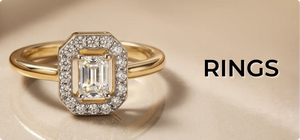
 All Rings
 Solitaire Rings
 Band Rings
 Halo Rings
 Cocktail Rings
 Eternity Rings
 Fashion Ring
 Stack Rings
 Men's Rings
 Vermeil Rings
 All Necklaces
 Necklet
 Mangalsutra
 Solitaire
 Tennis Necklace
 Statement Necklace
 Vermeil Necklace
 Alphabets
 Solitaire Pendant
 Halo Pendant
 Vermeil Pendants
 All Bracelets
 Solitaire Bracelet
 Tennis Bracelet
 Fashion Bracelet
 Mangalsutra
 Vermeil Bracelets
 All Vermeil
 Vermeil Earring
 Vermeil Pendant
 Vermeil Ring
 Vermeil Necklace
 Vermeil Mangalsutra
 Vermeil Bracelets
 Vermeil Bangles
 Vermeil Men’s
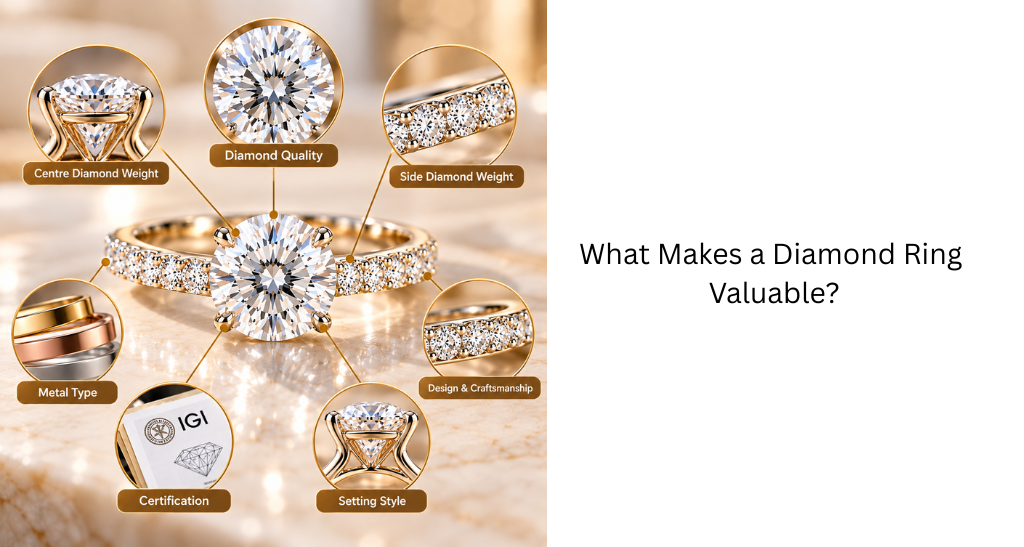
What Makes a Diamond Ring Valuable? A Practical Guide
Why can two diamond rings with the same total carat weight have different prices? The answer may be in the size of the centre diamond, its quality, the gold used or the work needed to make the ring.
Understanding these details helps you judge what you are paying for. It also helps you separate a ring’s purchase price from what you might receive if you sell it later.
What Does “Value” Mean for a Diamond Ring?
When buying a ring, it helps to think about value in three ways:
-
Purchase price: The amount on the bill.
-
Value for you: Whether you like the quality, design and comfort for that price.
-
Resale value: What a buyer or jeweller may offer for it later.
These amounts are not necessarily the same. Making charges and taxes, for example, form part of the purchase price but may not be recovered during resale.
1. Start With the Diamond’s Quality
A diamond’s quality is commonly described using the 4Cs: cut, colour, clarity and carat weight.
- Cut affects how the diamond handles light.
- Colour describes how much colour it shows.
- Clarity describes characteristics within or on the diamond.
- Carat measures its weight.
A larger diamond is not automatically the better purchase. Compare all four details and look at how the stone appears in the finished ring. Lukson’s guide to the 4Cs of diamond quality explains what each grade means.
Also check whether the diamond is natural or lab grown. Its origin should be clearly stated in the product details and applicable report, as it is another factor in the price.
2. Check the Centre Diamond and Total Carat Weight
1 carat ring can describe two different designs: a ring with one 1-carat diamond, or a ring whose diamonds add up to 1 carat.
Here is a simple comparison. The designs and gold weights are illustrative, not product listings.
| Detail | Ring A | Ring B |
|---|---|---|
| Centre diamond | 1.00 carat | 0.75 carat |
| Smaller diamonds | None | 0.25 carat combined |
| Total diamond weight | 1.00 carat | 1.00 carat |
| Gold weight | 3 grams | 4 grams |
| Design | Solitaire | Centre diamond with side stones |
Both rings contain 1 carat of diamonds in total. Ring A has the larger centre stone. Ring B uses more gold and has several diamonds to set. You cannot tell which ring should cost more from total carat weight alone. You would also need to compare diamond quality, gold purity and making charges.
When looking at a ring online, ask for the centre diamond weight and total diamond weight separately.
3. Look at the Gold as Carefully as the Diamond
Gold purity and weight both affect a ring’s price. Two rings can look alike in photographs but contain different amounts of gold.
Check the metal type, purity and net gold weight in the product details or invoice. For a gold ring sold with a BIS hallmark, check the purity mark and HUID as well. Lukson’s guide to BIS hallmarking in gold jewellery explains these markings.
Do not use the total weight of the finished ring as a substitute for its gold weight. The finished ring also contains the diamond and may include other stones.
4. Consider the Setting and Everyday Comfort
The setting holds the diamond in place. Its design can change how prominent the stone looks, how the ring feels on your hand and how practical it is for daily wear.
For example, a raised centre stone may stand out more, but it may also be easier to catch on clothing. A lower setting may feel more comfortable for someone who uses their hands throughout the day. Check the side view of the ring, the finish of the band and how securely the stones are held.
A more detailed design may cost more to make. That does not mean it will be the right ring for everyone.
5. Read the Full Price Breakup
A ring’s price includes more than its diamond. Ask for a breakup that shows the diamond, gold, making charges and applicable tax.
Here is a hypothetical example to show the calculation. These figures are not current prices or a Lukson quote.
| Price component | Example amount |
|---|---|
| Diamond | ₹40,000 |
| Gold | ₹30,000 |
| Making charges | ₹5,000 |
| Subtotal | ₹75,000 |
| Applicable tax | As shown on the invoice |
| Final price | ₹75,000 + applicable tax |
This breakup makes two quotes easier to compare. If one ring costs more, you can see whether the difference comes from the diamond, the gold or the work involved.
6. Verify the Report and Hallmark
A diamond grading report records details about the stone; it is not a certificate of what the complete ring will sell for later.
Before buying, take these steps:
-
Ask who issued the report and note its number. Where the grading laboratory offers an online lookup, enter the number on its official website. Compare the listed details, such as shape, weight and origin, with the diamond being sold.
-
Check the gold HUID. If the ring is BIS hallmarked, use the Verify HUID feature in the BIS Care app and compare the purity details with the ring and invoice.
-
Keep the documents. Save the itemised invoice, diamond report details and written return, exchange and buyback terms.
Reports can differ in the information they contain. Lukson’s guide to IGI, GIA and SGL diamond certification helps you understand what to look for.
7. Keep Resale Expectations Separate From the Purchase Price
A ring’s resale value depends on current market conditions, the buyer’s assessment and any applicable buyback or exchange policy. It should not be assumed to equal the original bill.
This matters when comparing lab grown diamond rings. Lukson’s guide to lab grown diamond resale value in India explains why a later offer can differ from the purchase price.
Read the written terms before buying. Check whether the ring is eligible, how its diamond and gold are valued, and which charges are excluded.
Questions to Ask Before You Buy
-
Is the stated carat weight for the centre stone or every diamond combined?
-
What are the diamond’s quality grades and origin?
-
What is the gold purity and net gold weight?
-
Can I check the diamond report number and gold HUID?
-
How much am I paying for the diamond, gold, making charges and tax?
-
Will the setting suit how often I plan to wear the ring?
-
What do the return, exchange and buyback terms say?
Frequently Asked Questions
Will a more detailed setting increase resale value?
It can increase the price you pay because the ring may require more work or additional stones. You should not assume that the full making charge will be recovered during resale. Check the buyer’s written valuation terms.
Which documents should I keep after buying a diamond ring?
Keep the itemised invoice, diamond report or its number, gold hallmark details and the written purchase and buyback terms. These records make it easier to check what you bought and discuss a future exchange or resale.
Final Thoughts
A diamond ring’s value is not decided by carat weight alone. Look at the centre stone, total diamond weight, quality grades, gold, setting and full price breakup together. Once you know what each detail means, you can compare lab grown diamond rings at Lukson with clearer expectations and choose one that suits your budget and daily life.


