





 All Earrings
 Stud Earrings
 Drop Earrings
 Solitaire
 Hoop Earrings
 Halo Earrings
 Vermeil Earrings
 Round
Round
 Oval
Oval
 Emerald
 Pear
Pear
 Princess
 Heart
Heart
 Marquise
 All Rings
 Solitaire Rings
 Band Rings
 Halo Rings
 Cocktail Rings
 Eternity Rings
 Fashion Ring
 Stack Rings
 Men's Rings
 Vermeil Rings
 All Necklaces
 Necklet
 Mangalsutra
 Solitaire
 Tennis Necklace
 Statement Necklace
 Vermeil Necklace
 Alphabets
 Solitaire Pendant
 Halo Pendant
 Vermeil Pendants
 All Bracelets
 Solitaire Bracelet
 Tennis Bracelet
 Fashion Bracelet
 Mangalsutra
 Vermeil Bracelets
 All Vermeil
 Vermeil Earring
 Vermeil Pendant
 Vermeil Ring
 Vermeil Necklace
 Vermeil Mangalsutra
 Vermeil Bracelets
 Vermeil Bangles
 Vermeil Men’s
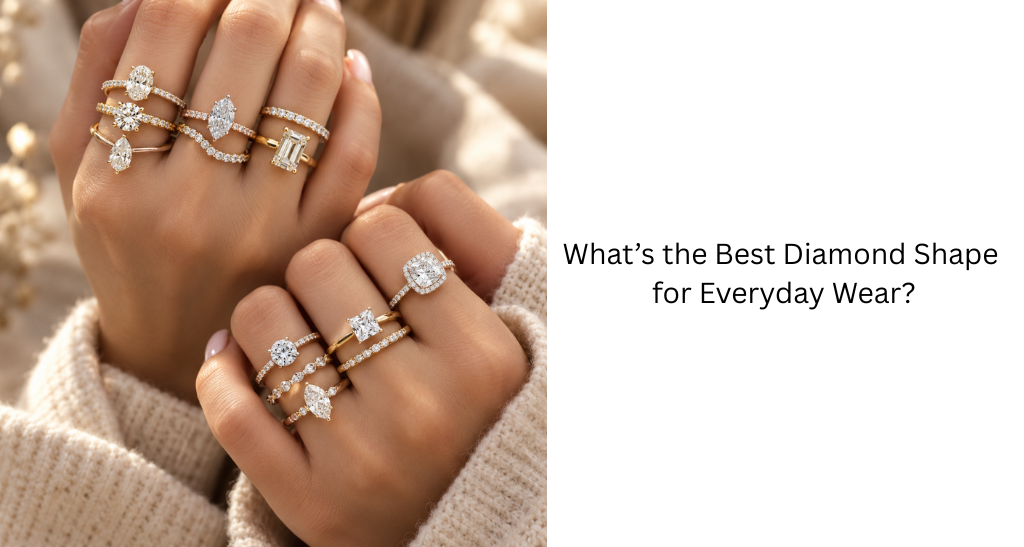
What’s the Best Diamond Shape for Everyday Wear?
If you plan to wear a diamond ring every day, round is usually the easiest shape to choose. It has no pointed tips or sharp corners that need extra protection. Oval and rounded-corner cushion diamonds are also practical choices.
You do not have to avoid pear, marquise, princess or heart diamonds. They can be worn regularly when their vulnerable points are protected. What matters is the complete ring: the diamond’s shape, its setting, how high it sits and how comfortably it fits.
Why Does Diamond Shape Matter for Daily Wear?
Diamonds resist scratches well, but a strong impact can still chip an exposed edge, point or corner. This applies to lab grown diamonds too.
Shape describes the diamond’s outline, such as round, oval or pear. Cut quality affects how the diamond reflects light. A shape you find practical will still need a secure setting, and a shape you find beautiful should also look good to you in normal lighting.
Which Shapes Are Easiest to Wear Every Day?
Round: A Practical All-Round Choice
A round diamond has no pointed ends or corners. Its smooth outline makes it a straightforward choice for a ring you expect to wear often.
Round diamonds work with many designs, from a simple solitaire to a setting that surrounds the stone with metal. Check the ring’s side view too: a round stone in a high, exposed setting can still be knocked.
Oval: An Elongated Shape Without Points
An oval diamond gives you a longer look across the finger without the pointed ends of a pear or marquise. It is a good option if you want an elongated diamond for regular wear.
Look at how the oval is held and how high it sits. A smooth diamond outline will not prevent the ring’s prongs or raised setting from catching on clothing.
Cushion: A Softer Square Look
A cushion diamond usually has a square or rectangular outline with rounded corners. It is worth considering if you like a square shape but prefer softer edges.
Cushion diamonds vary in their proportions and how rounded their corners appear. Check the actual ring photos to see how much of the stone’s edge is exposed.
What About Emerald, Radiant and Pointed Shapes?
Emerald: Clean Lines With Cut Corners
An emerald-cut diamond has a rectangular outline with corners that have been trimmed rather than left as sharp points. Its broad, step-like facets give it a quieter appearance than many diamonds with brilliant-style faceting.
The cut corners make it a reasonable option for daily wear, but they do not remove the need for protection. Check whether the setting holds the corners securely and whether a thin outer edge is exposed. A lower setting may also be more comfortable if you wear the ring throughout the day.
Radiant: A Geometric Shape With More Sparkle
A radiant diamond can be square or rectangular and generally has cut corners. It gives you a geometric outline with a different pattern of sparkle from an emerald cut.
Those trimmed corners are still part of the diamond’s outer edge. Check that the prongs sit securely and that the ring does not leave a very thin edge exposed. If you prefer an elongated radiant, also view the ring from the side to judge its height.
Princess: Protect All Four Corners
A princess-cut diamond has four pointed corners. They create its clear square look, but they also need attention in a ring worn often.
Look for metal that covers all four corners, such as properly placed V-shaped prongs or a bezel. Do not judge corner protection from a front-facing photo alone; a close-up side view is useful.
Pear: Check the Single Point
A pear-shaped diamond has one rounded end and one pointed tip. Its longer outline can look striking on the finger without requiring a larger carat weight.
For regular wear, check how the setting covers that single point. Also see how the ring sits on your hand, as the pear’s direction changes its overall look.
Marquise: Check Both Ends
A marquise diamond has a long outline with a point at each end. It can give more visible finger coverage than a round diamond of similar weight.
Both tips need suitable protection. View the ring from above and from the side to see whether the stone sits securely without its ends projecting too far beyond the setting.
Heart: Look Beyond the Front View
A heart-shaped diamond has two rounded upper curves, a dip between them and a point at the bottom. Its outline makes it easy to recognise, but a beautiful front view does not tell you how securely it is set.
Check that the bottom point is protected and that the prongs around the upper curves are neat and secure. A side view will also show whether the ring sits at a height you would be comfortable wearing regularly.
The Setting Can Change the Answer
A well-protected pointed diamond may suit your routine better than a round diamond set very high above the finger. This is why choosing by shape alone can be misleading.
Before buying, check these four details:
-
Edge protection: A bezel covers more of the diamond’s outer edge. Prongs leave more visible but should hold the stone firmly.
-
Setting height: A lower setting may be less likely to catch on clothes or other objects. Check the side-view photo rather than guessing from the front.
-
Point and corner coverage: Look closely at the vulnerable areas of princess, pear, marquise and heart diamonds.
-
Prong condition: If a prong looks damaged or the diamond moves, stop wearing the ring until a jeweller checks it.
A halo of smaller diamonds can make the centre look fuller, but it does not automatically protect the centre diamond’s edge. Check how that stone itself is held.
Which Shape Suits Your Routine?
If you mainly work at a desk, you have plenty of choice. Round, oval and cushion may feel straightforward, but an emerald, radiant or protected pointed shape can also work.
If you regularly use your hands around hard surfaces, pay particular attention to setting height and edge protection. A lower, more protective ring may be easier to manage. Remove any diamond ring before work where it could receive a hard knock.
If you love a pointed shape, you do not need to choose a different diamond just because you plan to wear the ring often. Choose a setting that protects its points and be comfortable with checking it from time to time.
What Should You Check When Buying Online?
Before ordering a diamond ring for daily wear, ask:
-
Can I see a clear side-view photo or video?
-
How high does the diamond sit above the finger?
-
Are its points, corners or thin edges exposed?
-
What is the band width, and which ring size should I choose?
-
What should I do if a prong becomes loose?
The diamond’s outer edge is called the girdle. If it is extremely thin in an exposed area, ask the jeweller how the chosen setting protects it.
How Should You Care for an Everyday Ring?
Take your ring off for heavy lifting, sport, gardening and tasks where it could strike a hard surface. Clean it gently when everyday oils and dirt build up.
Check the setting occasionally. If the diamond moves or a prong looks damaged, have the ring inspected before wearing it again. These habits matter whatever diamond shape you choose.
Frequently Asked Questions
Which diamond shape is least likely to chip?
Round, oval and rounded-corner cushion diamonds have no exposed points. That makes their outlines practical, but no diamond is immune to damage after a hard impact.
Do I need a bezel setting for everyday wear?
No. A well-made prong setting can also be suitable. A bezel covers more of the outer edge and may appeal to you if you want additional protection or a smoother ring profile.
Can a lab grown diamond ring be worn every day?
Yes. Lab grown diamonds have essentially the same physical properties as natural diamonds. Choose a secure setting, check it regularly and remove the ring for activities that could damage it.
Final Thoughts
Round is the simplest all-round choice for everyday wear. Oval and rounded-corner cushion are good alternatives if you prefer their appearance. Emerald and radiant offer geometric looks, while princess, pear, marquise and heart can also work when their vulnerable areas are protected.
Choose the ring that fits your routine and feels comfortable on your hand. The setting and side profile deserve as much attention as the diamond’s shape.


