




 All Earrings
 Stud Earrings
 Drop Earrings
 Solitaire
 Hoop Earrings
 Halo Earrings
 Vermeil Earrings
 Round
Round
 Oval
Oval
 Emerald
 Pear
Pear
 Princess
 Heart
Heart
 Marquise
 All Rings
 Solitaire Rings
 Band Rings
 Halo Rings
 Cocktail Rings
 Eternity Rings
 Fashion Ring
 Stack Rings
 Men's Rings
 Vermeil Rings
 All Necklaces
 Necklet
 Mangalsutra
 Solitaire
 Tennis Necklace
 Statement Necklace
 Vermeil Necklace
 Alphabets
 Solitaire Pendant
 Halo Pendant
 Vermeil Pendants
 All Bracelets
 Solitaire Bracelet
 Tennis Bracelet
 Fashion Bracelet
 Mangalsutra
 Vermeil Bracelets
 All Vermeil
 Vermeil Earring
 Vermeil Pendant
 Vermeil Ring
 Vermeil Necklace
 Vermeil Mangalsutra
 Vermeil Bracelets
 Vermeil Bangles
 Vermeil Men’s
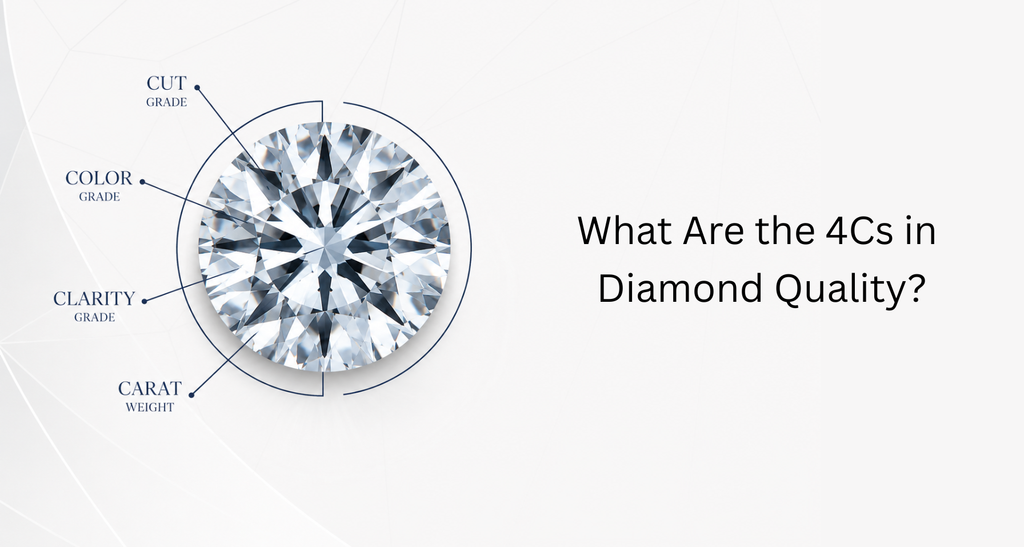
What Are the 4Cs in Diamond Quality?
If you’ve ever searched for a diamond, chances are you’ve come across the term “4Cs” (Cut, Colour, Clarity, and Carat ) are the main standards used to evaluate a diamond’s quality. Each factor is graded separately using its own scale to measure a specific characteristic of the diamond.
At first, it can sound overly technical, almost like something only jewellers understand. But once you break it down, the 4Cs are actually quite simple. They help explain why one diamond sparkles more than another, why some appear brighter, and why prices can vary so much even between stones that look similar at first glance.
But here’s something many people don’t realise when buying jewellery for the first time: the best diamond is not always the biggest or the most expensive one. What really matters is how these four elements come together. Let’s understand each one properly.
Cut
Out of all the 4Cs, cut is often considered the most important because it directly affects how much a diamond sparkles.
A lot of people confuse cut with shape, but they are not the same thing. Shape refers to whether the diamond is round, oval, pear, emerald, or princess. Cut refers to how well the diamond has been crafted and faceted.
When a diamond is cut properly, light enters the stone, reflects beautifully inside it, and returns through the top. This creates the brilliance and fire that people instantly notice in a diamond..
If the cut is too deep or too shallow, light escapes from the sides or bottom instead of reflecting back properly. As a result, the diamond can appear dull, even if it has good color or clarity.
This is why a smaller diamond with an excellent cut can sometimes look more beautiful than a larger diamond with a poor cut.
What Makes a Diamond Sparkle?
Think about the moment someone notices a diamond for the first time. They usually don’t ask about its clarity or carat weight immediately. What catches attention first is the sparkle.
That sparkle comes from the cut.
A well-cut diamond looks lively and bright in different lighting conditions, whether you’re standing in sunlight, sitting at dinner, or attending an evening event.
Common Diamond Cut Grades

- Ideal Cut
- Excellent
- Very Good
- Good
- Fair
- Poor
For engagement rings and fine jewellery, most people prefer Excellent or Very Good cuts because they give the diamond stronger brilliance and fire.
Color
Diamond color measures how white or colorless a diamond appears.
Most diamonds naturally contain slight traces of yellow or warm tones. The less color a diamond has, the rarer and more valuable it usually becomes.
Diamond color is graded from D to Z.
- D represents a completely colorless diamond
- Z represents diamonds with visible yellow or brown tones
However, many people are surprised to learn that you do not always need the highest color grade for a diamond to look beautiful.
Understanding Diamond Color Better

Diamonds graded between D and F are considered colourless diamonds . These diamonds appear extremely bright and icy white.
Diamonds between G and J are called near-colourless diamonds. They still appear white to the naked eye, especially once set into jewellery. This range is popular because it offers a beautiful balance between appearance and value.
Lower diamond colour grades begin to show warmer tones more clearly, though some people actually prefer that softer appearance, especially in yellow or rose gold settings.
The Setting Also Changes Appearance
The metal you choose can affect how the diamond color looks.
- White gold and platinum make color more noticeable
- Yellow gold and rose gold can make slightly warmer diamonds appear softer and richer
That’s why choosing a diamond is never just about numbers on a certificate. It’s also about how the stone looks when worn.
Clarity
Clarity refers to the tiny marks found inside or on the surface of a diamond.
The internal marks are called inclusions, while surface marks are called blemishes. These form naturally during the diamond’s creation process.
Most diamonds have some level of inclusions, but many are so small that they cannot be seen without magnification.
What Most Buyers Should Know About Clarity

A flawless diamond is extremely rare and expensive, but that does not mean you need one for your jewellery to look stunning.
In reality, many diamonds with slight inclusions still appear perfectly clean to the naked eye.
This is why experienced buyers often focus on diamonds that are “eye-clean” rather than flawless under a microscope.
Diamond Clarity Grades
- FL – Flawless
- IF – Internally Flawless
- VVS1/VVS2 – Very Very Slightly Included
- VS1/VS2 – Very Slightly Included
- SI1/SI2 – Slightly Included
For everyday jewellery and engagement rings, At Lukson, we often recommend VS and VVS diamonds because they offer a clean and beautiful appearance without significantly increasing the cost.
Placement Matters Too
Not all inclusions affect a diamond the same way.
A tiny inclusion hidden near the edge may not impact the appearance at all once the diamond is set. But a darker inclusion near the center may be more noticeable.
This is why clarity should always be evaluated along with the overall look of the stone.
Carat
Carat is the unit used to measure a diamond’s weight, not its visible size. This is one of the most common misunderstandings people have while buying diamonds.
One carat equals 200 milligrams, which may sound small, but even slight differences in carat weight can affect a diamond’s pricing and overall presence.
At Lukson, our collection includes diamonds ranging from 0.25ct to 1ct, 2ct, 3ct, 4ct, and even higher carat diamonds designed for special occasions.
As the carat weight increases, diamonds become more rare in nature, which is why higher carat diamonds are usually more valuable. However, a bigger diamond does not always mean a more beautiful diamond.
Two diamonds with the same carat weight can look very different depending on how they are cut and shaped.
Why Cut Still Matters
A diamond with an excellent cut reflects light more efficiently, creating better sparkle and brightness. Because of this, a smaller well-cut diamond can sometimes look more attractive than a larger diamond with poor proportions.
This is why carat should always be considered together with cut quality instead of separately.
Diamond Shape Also Changes Appearance
Certain diamond shapes naturally create a larger visual appearance even when the carat weight remains the same.
- Oval diamonds often appear larger than round diamonds
- Pear shapes create more surface coverage on the finger
- Emerald cuts can look bigger because of their elongated structure
This is why the overall appearance of a diamond depends on more than just carat weight alone.
Why the 4Cs Work Together
The 4Cs should never be viewed separately. They work together to create the overall appearance of a diamond.
For example:
- A slightly warmer diamond can still look stunning if the cut is excellent
- A VS clarity diamond may appear identical to a flawless diamond without magnification
- A smaller carat weight with strong brilliance can feel more impressive than a heavier dull stone
The goal is not to chase the highest grade in every category. The goal is to find the right balance.
How We Look at the 4Cs at Lukson
At Lukson, we believe diamond shopping should feel exciting, not overwhelming.
The 4Cs are important because they help customers understand quality, but choosing a diamond is also about emotion and personal style. Some people love bright sparkle, while others prefer softer brilliance or cleaner minimal designs.
That’s why we focus on how a diamond actually looks and feels in real life, not just how it appears on paper.
Every diamond in our collection is carefully selected to create balance between brilliance, craftsmanship, and wearability, so you can choose something that feels personal and lasting.
Final Thoughts
Understanding the 4Cs makes diamond shopping much easier because you begin to notice what actually matters.
You stop focusing only on size and start paying attention to sparkle, balance, and overall beauty.
A beautiful diamond is not simply the one with the highest grading. It is the one that catches light beautifully, suits your style, and feels right the moment you wear it.
-
Posted in
4Cs in Diamond, Diamond cut, diamond grading, diamond quality, lab diamond


