




 All Earrings
 Stud Earrings
 Drop Earrings
 Solitaire
 Hoop Earrings
 Halo Earrings
 Vermeil Earrings
 Round
Round
 Oval
Oval
 Emerald
 Pear
Pear
 Princess
 Heart
Heart
 Marquise
 All Rings
 Solitaire Rings
 Band Rings
 Halo Rings
 Cocktail Rings
 Eternity Rings
 Fashion Ring
 Stack Rings
 Men's Rings
 Vermeil Rings
 All Necklaces
 Necklet
 Mangalsutra
 Solitaire
 Tennis Necklace
 Statement Necklace
 Vermeil Necklace
 Alphabets
 Solitaire Pendant
 Halo Pendant
 Vermeil Pendants
 All Bracelets
 Solitaire Bracelet
 Tennis Bracelet
 Fashion Bracelet
 Mangalsutra
 Vermeil Bracelets
 All Vermeil
 Vermeil Earring
 Vermeil Pendant
 Vermeil Ring
 Vermeil Necklace
 Vermeil Mangalsutra
 Vermeil Bracelets
 Vermeil Bangles
 Vermeil Men’s
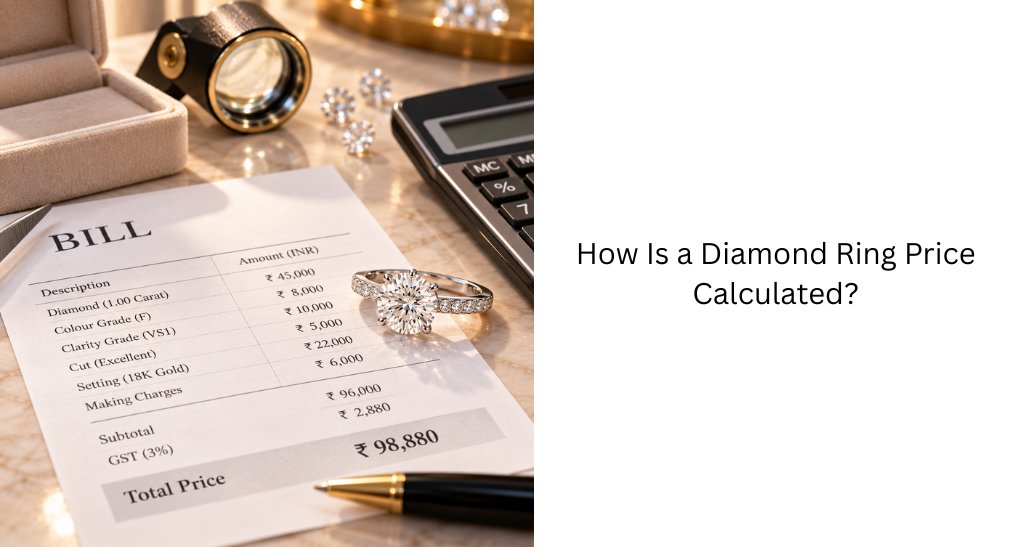
How Is a Diamond Ring Price Calculated? Diamond, Gold, Making Charges and GST
Buying a diamond ring is not only about the price of the diamond. The final amount you pay usually includes several parts, such as the diamond, gold, making charges and GST.
This is why two rings that look similar can have very different prices.
If you understand how each part of the price is calculated, it becomes much easier to compare rings and know what you are actually paying for.
What Makes Up the Price of a Diamond Ring?
The final price of a diamond ring usually includes:
-
Diamond cost
-
Gold cost
-
Making charges
-
GST
-
Sometimes additional charges for customisation or special design work
The exact calculation can vary from jeweller to jeweller, but understanding these basic components gives you a clear idea of where the money is going.
1. Diamond Cost
The diamond is usually one of the biggest parts of a ring's price.
Diamond pricing depends on several factors, commonly known as the 4Cs:
-
Carat
-
Cut
-
Colour
-
Clarity
Carat
Carat refers to the weight of the diamond, not its size.
For example, a 1 carat diamond weighs more than a 0.50 carat diamond. However, two diamonds with the same carat weight can still have different prices because their cut, colour and clarity may differ.
Cut
Cut affects how well a diamond reflects light. A well-cut diamond can look brighter and more lively.
Cut is different from the shape of a diamond. Round, oval, pear and marquise are shapes, while cut refers to how the diamond has been proportioned and finished.
Colour
For white diamonds, colour refers to how much colour the diamond shows. A diamond with less visible colour generally falls higher on the traditional colour grading scale.
Clarity
Clarity refers to internal and external characteristics in a diamond. Diamonds with fewer visible inclusions generally cost more.
Natural vs Lab Grown Diamonds
The type of diamond also affects the price.
Natural diamonds are formed naturally over a very long period of time, while lab grown diamonds are created using advanced technology in a controlled environment.
Both can have the same basic chemical composition and can be graded using the same 4Cs. However, their pricing can be very different.
This is one reason why the diamond type should always be checked before comparing two rings.
2. Gold Cost
The second major part of a diamond ring price is the gold used to make the ring.
Gold jewellery is commonly available in different purities, such as 9KT, 14KT and 18KT.
The karat tells you how much pure gold is present in the metal.
For example:
-
9KT gold contains 37.5% pure gold
-
14KT gold contains 58.5% pure gold
-
18KT gold contains 75% pure gold
The remaining portion consists of other metals that are added to create the required strength, colour and properties.
How Is the Gold Price Calculated?
A simple way to understand the calculation is:
Gold value = Gold weight × applicable gold rate × purity factor
For example, if a ring contains 4 grams of 18KT gold, its gold value is not calculated as 4 grams of 24KT pure gold. The 18KT purity has to be considered.
The actual jewellery bill may also use the jeweller's applicable rate and calculation method, so it is worth checking the detailed price breakup.
3. Making Charges
Making charges are the cost of turning the raw metal into a finished piece of jewellery.
They can cover things such as:
-
Designing the ring
-
Goldsmith or manufacturing work
-
Setting the diamonds
-
Polishing
-
Finishing
-
Other production processes
Making charges can vary depending on the design.
A simple ring may require less work than a detailed ring with multiple stones, intricate settings or unusual shapes.
Some jewellers calculate making charges based on the weight of the gold, while others may use a fixed amount or another pricing method.
That is why it is useful to ask how the making charge has been calculated rather than looking only at the final amount.
4. Diamond Setting and Other Charges
Certain rings may involve additional work because of their design.
For example, a ring with several small diamonds can require more setting work than a simple solitaire ring.
Custom designs may also have additional charges depending on the amount of work involved.
If you are buying a customised ring, ask the jeweller whether the quoted price includes design, production and setting charges.
5. GST on Diamond Jewellery
GST is also added to the jewellery bill.
In India, GST treatment for jewellery can depend on the type of transaction and how the charges are structured. For a typical retail jewellery purchase, the applicable GST should be clearly shown on the invoice.
Instead of trying to estimate GST separately, check the final invoice and look at the tax amount mentioned there.
A proper jewellery invoice should provide a clear breakup so that you can understand what you are being charged for.
A Simple Example of Diamond Ring Price Calculation
Suppose you are buying a ring with:
Diamond cost: ₹40,000
Gold value: ₹25,000
Making charges: ₹8,000
The price before applicable GST would be:
₹40,000 + ₹25,000 + ₹8,000 = ₹73,000
GST would then be calculated according to the applicable tax treatment, bringing the final payable amount higher than ₹73,000.
The numbers above are only an example. Actual prices will depend on the diamond, gold rate, ring weight, design and jeweller.
Why Do Similar Diamond Rings Have Different Prices?
Two rings may look almost identical but have different prices for several reasons.
The diamond in one ring may have a different carat weight, cut, colour or clarity. One ring may use 18KT gold while another uses 14KT gold.
Making charges can also be different. For example, a simple solitaire ring and a detailed halo ring may use a similar amount of gold but require different levels of manufacturing and diamond-setting work.
So, comparing only the appearance of two rings is not enough. Compare the specifications and price breakup as well.
Does a Bigger Diamond Always Mean a More Expensive Ring?
Not necessarily. Carat weight is important, but it is only one part of diamond pricing.
A smaller diamond with a higher colour and clarity grade can cost more than a larger diamond with lower grades.
For example, D, E and F colour diamonds are generally higher on the colour grading scale and can be priced higher than diamonds in lower colour ranges such as G, H or F to H, depending on the diamond and its other specifications.
Clarity also affects the price. For example, a VS1 or VS2 diamond generally has fewer visible inclusions than a diamond with a lower clarity grade, which can affect its price.
This means a 0.90 carat diamond with a higher colour and clarity grade may cost more than a 1 carat diamond with lower colour and clarity grades.
The diamond's cut and shape can also affect its price. So, when comparing two diamonds, do not look at carat weight alone. Check the carat, colour, clarity, cut and shape together to understand why one diamond is priced higher than another.
How to Compare Diamond Ring Prices
When comparing two rings, check these details:
Diamond details
-
Natural or lab grown
-
Total carat weight
-
Number of diamonds
-
Cut
-
Colour
-
Clarity
-
Certification, where applicable
Gold details
-
Gold purity
-
Gold weight
-
Gold rate used for calculation
Additional charges
-
Making charges
-
Diamond-setting charges, if separately listed
-
Customisation charges, if any
-
GST
This gives you a much clearer picture of why one ring costs more than another.
What Should You Check on the Jewellery Invoice?
Before making the payment, look at the invoice carefully.
It should give you enough information to understand what you are buying and how the final amount was calculated.
Depending on the jeweller and product, you may see details such as:
-
Gold purity
-
Gold weight
-
Diamond weight
-
Diamond specifications
-
Diamond certification details
-
Making charges
-
Taxes
-
Final amount
If something is unclear, ask the jeweller before completing the purchase.
Does Certification Affect the Price of a Diamond Ring?
Yes, certification can play an important role when buying a diamond, but a certificate itself does not automatically make a diamond more expensive.
A diamond grading report provides information about the diamond's key characteristics, such as carat weight, colour, clarity, cut and measurements. It helps buyers understand exactly what they are purchasing and makes it easier to compare one diamond with another.
In India, you may come across diamond reports from laboratories such as IGI (International Gemological Institute), GIA (Gemological Institute of America) and SGL (Solitaire Gemological Laboratories).
What Does an IGI or GIA Certificate Tell You?
An IGI or GIA diamond grading report records important details about a diamond. Depending on the report, these can include:
- Diamond shape and cutting style
- Carat weight
- Colour grade
- Clarity grade
- Cut grade, where applicable
- Polish and symmetry
- Measurements
- Fluorescence
- Identification or report number
This information helps you compare diamonds based on their actual specifications instead of relying only on how they look.
What About SGL Certification?
SGL is another gemological laboratory that provides diamond grading reports. An SGL report can include important details about the diamond's characteristics, allowing buyers to check specifications such as carat weight, colour and clarity.
If a jeweller is offering a certified diamond, check the certificate number and grading details and make sure they match the diamond being sold.
Does a Certificate Increase the Diamond's Price?
Not by itself. The price is mainly influenced by the diamond's characteristics, including its carat, colour, clarity, cut and shape. The grading report gives you a documented assessment of these characteristics.
For example, two 1 carat diamonds may have different prices if one has a higher colour and clarity grade than the other, even if both come with grading reports.
This is why you should compare the actual diamond specifications and grading report, rather than choosing a diamond simply because it has a certificate from a particular laboratory.
Before buying, you can also ask the jeweller for the grading report and verify that the report details match the diamond mentioned on your invoice.
How Can You Avoid Paying More Than Expected?
You do not need to be a diamond expert to understand a jewellery bill.
Start by asking for a clear price breakup.
Check:
Diamond + Gold + Making Charges + Applicable Taxes = Final Price
Then compare the specifications of the diamond and gold with another ring you are considering.
Also check whether the price includes services such as resizing, customisation, exchange or buyback, as these terms can vary between jewellers.
Final Thoughts
The price of a diamond ring is based on much more than the diamond itself. The diamond's specifications, gold purity and weight, making charges, design and applicable GST all contribute to the final amount.
Once you understand these components, comparing diamond rings becomes much easier.
Instead of asking only, "How much does this ring cost?", look at the complete price breakup and the specifications behind it. That will help you understand what you are paying for and make a more informed jewellery purchase.


