










 All Earrings
 Stud Earrings
 Drop Earrings
 Solitaire
 Hoop Earrings
 Halo Earrings
 Vermeil Earrings
 Round
Round
 Oval
Oval
 Emerald
 Pear
Pear
 Princess
 Heart
Heart
 Marquise
 All Rings
 Solitaire Rings
 Band Rings
 Halo Rings
 Cocktail Rings
 Eternity Rings
 Fashion Ring
 Stack Rings
 Men's Rings
 Vermeil Rings
 All Necklaces
 Necklet
 Mangalsutra
 Solitaire
 Tennis Necklace
 Statement Necklace
 Vermeil Necklace
 Alphabets
 Solitaire Pendant
 Halo Pendant
 Vermeil Pendants
 All Bracelets
 Solitaire Bracelet
 Tennis Bracelet
 Fashion Bracelet
 Mangalsutra
 Vermeil Bracelets
 All Vermeil
 Vermeil Earring
 Vermeil Pendant
 Vermeil Ring
 Vermeil Necklace
 Vermeil Mangalsutra
 Vermeil Bracelets
 Vermeil Bangles
 Vermeil Men’s
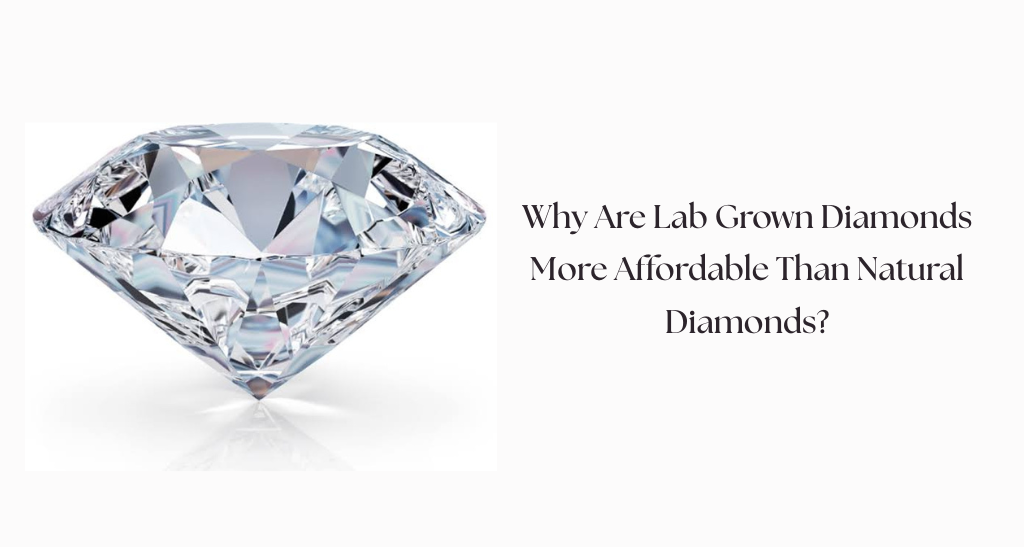
Why Are Lab Grown Diamonds More Affordable Than Natural Diamonds?
If you have ever compared a lab grown diamond with a natural diamond of similar carat, colour and clarity, you may have noticed a significant difference in price.
That naturally raises a question: Why are lab grown diamonds so much cheaper than natural diamonds if both are diamonds?
The answer comes down to more than just where the diamond comes from. The price difference is shaped by scarcity, mining, production methods, technology, supply and market economics.
A lab grown diamond is created in a controlled environment using CVD or HPHT technology, while a natural diamond forms deep inside the Earth through geological processes. These different routes to the finished stone create very different cost structures.
Let's look at what actually makes lab grown diamonds more affordable.
First, What Is a Lab Grown Diamond?
A lab grown diamond is a diamond created in a controlled laboratory environment rather than extracted through traditional mining.
There are two primary methods used to grow lab grown diamonds:
-
CVD, or Chemical Vapor Deposition
-
HPHT, or High Pressure High Temperature
In the CVD process, carbon-containing gases are introduced into a controlled chamber, where carbon atoms gradually deposit onto a diamond seed and form a diamond crystal.
HPHT uses high pressure and high temperature to create conditions suitable for diamond growth.
Both methods are used to produce gem-quality diamonds. Lab grown diamonds should not be confused with diamond simulants such as cubic zirconia or moissanite.
The Biggest Reason: Natural Diamonds Are Naturally Scarce
One of the biggest factors behind the price difference is supply.
Natural diamonds are limited by geology. They form under specific conditions deep within the Earth and are found only in certain deposits. Increasing natural diamond supply requires exploration and the discovery and development of viable deposits.
Lab grown diamonds work differently.
Manufacturers can grow diamonds in controlled facilities using specialised equipment. Production can be increased as manufacturing capacity and technology develop.
This creates a fundamental difference in the way the two markets respond to demand.
- A natural diamond is a scarce geological resource.
- A lab grown diamond is produced through a scalable manufacturing process.
That difference has a direct effect on pricing.
Mining Adds Significant Costs to Natural Diamonds
Before a natural diamond reaches a jewellery store, it has already gone through a long process.
Mining companies need to explore potential deposits, develop mining infrastructure and extract diamond-bearing material. The process can involve heavy machinery, energy, labour, transportation and extensive processing.
Once the rough diamonds are recovered, they still need to be sorted, cut, polished, graded and distributed.
Each stage adds to the overall cost.
Lab grown diamonds do not require traditional diamond mining. They are grown directly in specialised facilities before going through cutting, polishing, grading and jewellery production.
The manufacturing process still requires sophisticated equipment, electricity, skilled workers, raw materials and quality control. However, the cost structure is different because there is no traditional extraction stage.
Lab Grown Diamond Production Can Respond Faster to Demand
Natural diamond supply cannot be increased quickly.
If demand for a particular size or quality of natural diamond increases, the industry cannot simply create more natural diamonds. New mining projects can take years of exploration, development and investment.
Lab grown diamond production operates differently.
Manufacturers can adjust production according to market conditions and available capacity. As technology improves and production facilities become more efficient, the industry can respond to changing demand much faster.
This ability to scale production is an important part of why lab grown diamonds can be offered at lower prices.
Technology Has Changed the Cost of Production
Technology is another major factor behind the changing economics of lab grown diamonds.
As CVD and HPHT technology has developed, manufacturers have improved growth processes, equipment, quality control and production efficiency.
Like other manufactured products, greater efficiency and scale can reduce the cost of production over time.
This is why it is too simplistic to say that lab grown diamonds are cheaper just because they are "made in a lab."
The bigger factor is that manufacturing can be improved, repeated and scaled.
GIA has documented significant advances in both CVD and HPHT production, including improvements in the size and quality of gem-quality laboratory-grown diamonds.
A Different Supply Chain Can Mean Lower Costs
A natural diamond travels through a supply chain that begins with exploration and mining.
After extraction, the rough material needs to be recovered, sorted, processed and eventually cut and polished before reaching the jewellery market.
Lab grown diamonds start at a different point.
Instead of extracting diamond-bearing rock, manufacturers grow diamond material in a controlled facility. The resulting rough diamond is then cut, polished, graded and supplied to the jewellery industry.
There are still costs at every stage, but removing traditional mining and extraction changes the overall economics of the supply chain.
Then Why Are Natural Diamonds More Expensive?
Natural diamonds have a characteristic that lab grown diamonds cannot reproduce: natural geological origin combined with limited supply.
Their formation is part of a geological process that takes place over extremely long periods of time. Natural deposits are finite, and finding and extracting them requires significant investment.
That scarcity has commercial value.
People also place value on the idea that a natural diamond is a rare geological product formed by nature. For some buyers, that origin is an important part of the purchase.
So the higher price of a natural diamond is not simply a reflection of how much it costs to physically cut and polish the stone. It also reflects the economics and perceived value of a naturally scarce resource.
Does a Lower Price Mean a Lab Grown Diamond Is Lower Quality?
Not necessarily.
Price and quality are two different things.
A lab grown diamond can be produced with the same fundamental diamond material and can be graded according to characteristics such as carat weight, colour, clarity and cut.
The quality of an individual diamond still depends on those characteristics.
For example, a well-cut lab grown diamond can have excellent light performance, while a poorly cut diamond may appear less bright regardless of whether it was grown in a laboratory or formed naturally.
So when comparing diamonds, the price alone does not tell you the complete quality story.
What About the 4Cs?
The traditional 4Cs - cut, colour, clarity and carat weight - remain important when evaluating a lab grown diamond.
Cut affects how effectively the diamond reflects and returns light.
Colour describes the degree of colour visible in the stone.
Clarity refers to internal and external characteristics.
Carat refers to the diamond's weight, not simply its visible size.
Two diamonds with the same carat weight can have very different prices because their cut, colour, clarity, shape and certification may differ.
The same principle applies when comparing natural diamonds.
Why Can You Get a Bigger Diamond for the Same Budget?
This is one of the biggest practical advantages for jewellery buyers.
When a significant part of a jewellery budget goes towards the diamond, a lower diamond price can give you more flexibility.
For example, instead of spending the same amount on a smaller natural diamond, you may be able to consider a larger lab grown diamond or choose a higher colour or clarity grade.
You can also allocate more of your budget towards the jewellery itself, such as the gold, setting or overall design.
This is particularly relevant for engagement rings, where the centre diamond often represents a large part of the total cost.
Are Lab Grown Diamonds the Same as Diamond Simulants?
No. A diamond simulant is a different material that is designed to look like a diamond. Cubic zirconia and moissanite are common examples.
A lab grown diamond is diamond material produced through a controlled growth process.
The key difference is not "real versus fake." It is the type of material and, in the case of lab grown diamonds, the way the diamond was formed.
Can You Tell a Lab Grown Diamond From a Natural Diamond?
Not reliably just by looking at it.
Lab grown diamonds can have the visual characteristics associated with diamonds, but specialised gemological equipment can identify features related to their growth.
This is why proper grading and disclosure are important when buying a diamond.
What Are You Actually Paying For When You Buy a Diamond?
A diamond's price is not simply the cost of producing the stone.
When you purchase a finished piece of diamond jewellery, your price can include:
-
The diamond
-
Cutting and polishing
-
Grading and certification
-
Gold or other precious metal
-
Jewellery manufacturing
-
Design
-
Skilled labour
-
Packaging
-
Logistics
-
Retail and operating costs
-
Brand positioning
-
Customer service
This is an important point when comparing jewellery prices.
Two rings may have diamonds with similar specifications but different final prices because their gold weight, craftsmanship, design, certification, business costs and retail positioning are different.
Looking only at the carat weight or the diamond itself does not always tell you what you are actually paying for.
Lab Grown vs Natural Diamonds: What's the Difference?
| Feature | Lab Grown Diamond | Natural Diamond |
|---|---|---|
| Origin | Created in a controlled laboratory environment | Formed naturally inside the Earth |
| Growth Method | CVD or HPHT | Natural geological process |
| Mining Required | No traditional diamond mining | Requires diamond mining |
| Supply | Can be produced through manufacturing | Limited by natural deposits |
| Production Time | Grown over a much shorter production cycle | Formed over geological timescales |
| Chemical Composition | Diamond | Diamond |
| Physical Properties | Comparable to natural diamond | Naturally occurring diamond |
| Optical Properties | Can exhibit the same diamond optical characteristics | Naturally occurring diamond |
| Price | Generally lower | Generally higher |
| Rarity | Not naturally scarce in the same way | Naturally scarce |
| Resale Considerations | Market dynamics differ and should be considered before purchase | Market dynamics differ and depend on quality and market conditions |
The most important difference is origin and the economics surrounding that origin.
Are Lab Grown Diamonds Worth Buying?
For many jewellery buyers, they can be.
A lab grown diamond can give you more flexibility within a fixed budget. You may be able to choose a larger centre stone, a higher grade or put more of your budget towards the jewellery design.
But the right choice depends on what you value.
If natural origin, geological rarity and the traditional natural diamond market are important to you, a natural diamond may be the better fit.
If your priority is getting a genuine diamond while making your jewellery budget go further, a lab grown diamond can be a practical option.
The important thing is to understand the difference before you buy.
Frequently Asked Questions
1. Why are lab grown diamonds so much cheaper than natural diamonds?
Lab grown diamonds are generally less expensive because they are produced through a controlled manufacturing process rather than extracted from limited natural deposits. Their supply can also be scaled more easily as production technology and capacity develop.
2. Are lab grown diamonds real diamonds?
Yes. Lab grown diamonds are genuine diamonds. They are created using CVD or HPHT technology and have the fundamental characteristics associated with diamond material.
3. Why are natural diamonds more expensive?
Natural diamonds are limited by geological supply and require exploration, mining and extraction. Their natural origin and scarcity also contribute to their market value.
4. lab grown diamonds have resale value?
Lab grown diamonds can have resale or exchange value, but buyers should not assume that they will retain their original retail price. The market has changed as production has scaled, so resale terms and current market conditions should be considered before purchasing.
The Bottom Line
Lab grown diamonds are more affordable because they are produced in controlled environments without traditional diamond mining, and their supply can scale with advances in technology and production.
Natural diamonds, meanwhile, are limited by geological supply, and their rarity and natural origin contribute to their higher market value.
For buyers, the lower price of a lab grown diamond can mean more flexibility with carat size, quality or jewellery design.
The real difference is not whether the diamond is real. It is where it comes from and how the market values that origin.


