






 All Earrings
 Stud Earrings
 Drop Earrings
 Solitaire
 Hoop Earrings
 Halo Earrings
 Vermeil Earrings
 Round
Round
 Oval
Oval
 Emerald
 Pear
Pear
 Princess
 Heart
Heart
 Marquise
 All Rings
 Solitaire Rings
 Band Rings
 Halo Rings
 Cocktail Rings
 Eternity Rings
 Fashion Ring
 Stack Rings
 Men's Rings
 Vermeil Rings
 All Necklaces
 Necklet
 Mangalsutra
 Solitaire
 Tennis Necklace
 Statement Necklace
 Vermeil Necklace
 Alphabets
 Solitaire Pendant
 Halo Pendant
 Vermeil Pendants
 All Bracelets
 Solitaire Bracelet
 Tennis Bracelet
 Fashion Bracelet
 Mangalsutra
 Vermeil Bracelets
 All Vermeil
 Vermeil Earring
 Vermeil Pendant
 Vermeil Ring
 Vermeil Necklace
 Vermeil Mangalsutra
 Vermeil Bracelets
 Vermeil Bangles
 Vermeil Men’s
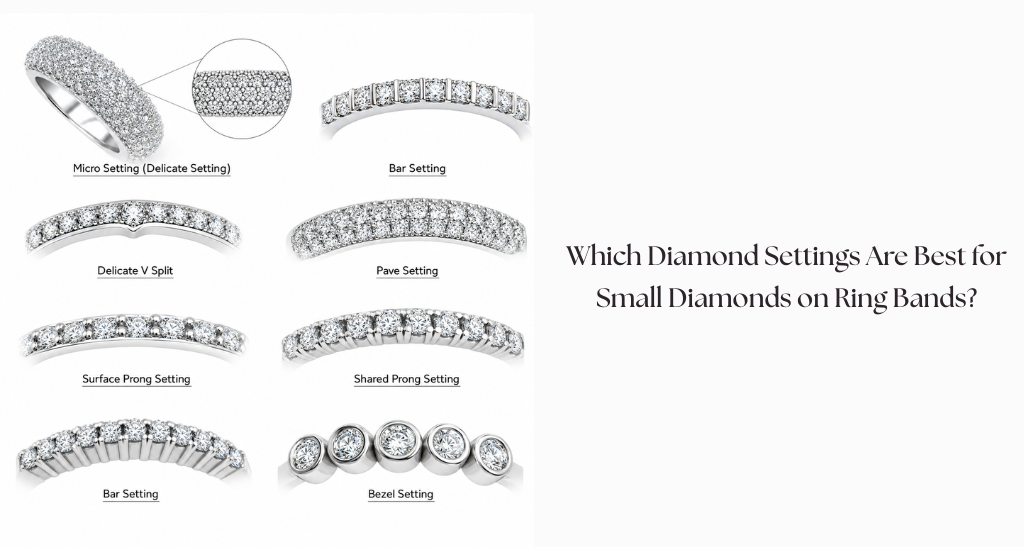
Which Diamond Settings Are Best for Small Diamonds on Ring Bands?
Small diamonds can completely change the look of a ring band. A row of tiny diamonds can add shine to a plain band, highlight the shape of a larger centre stone, or create a continuous sparkle across the finger.
But with small diamonds, the setting matters just as much as the stones themselves. Since these diamonds are smaller, the way they are held in the band affects how much light they receive, how secure they are and how the ring looks from a distance.
If you are choosing a diamond band, here are some of the best settings for small diamonds and what makes each one different.
1. Pavé Setting
A pavé setting is one of the most popular choices for small diamonds on ring bands.
The word pavé means "paved," which describes the appearance of the diamonds. Small stones are placed closely together across the surface of the band, with tiny metal beads or prongs holding them in place.
Because there is very little visible metal between the diamonds, the band can look almost completely covered in diamonds.
Why choose pavé?
-
Creates a continuous sparkle
-
Works well with very small diamonds
-
Gives the band a bright, diamond-covered appearance
-
Pairs well with solitaire and engagement rings
-
Can make a simple band look more detailed
Pavé is especially good if your goal is to make a ring band look full of diamonds without using large stones.
The trade-off is that the tiny beads and prongs need to be checked from time to time. If you wear the ring every day, regular professional inspection is a good idea.
2. Micro-Pavé Setting
Micro-pavé takes the same idea as pavé but uses even smaller diamonds and very fine metalwork.
The diamonds are placed extremely close together, creating a smooth line of sparkle across the band. Because the stones are small, the setting can look very refined without making the ring appear bulky.
Why choose micro-pavé?
Micro-pavé is a good option when you want:
-
Maximum sparkle from small stones
-
A fine, detailed appearance
-
A narrow diamond band
-
A ring that pairs easily with a solitaire
-
Less visible metal between stones
This setting is often used in engagement rings and wedding bands where the small diamonds are meant to complement a centre stone rather than compete with it.
3. Channel Setting
A channel setting places small diamonds between two parallel walls of metal. The diamonds sit inside the channel rather than being held individually by visible prongs.
This creates a clean, smooth appearance across the ring.
Why choose channel setting?
-
Provides good protection around the diamonds
-
Creates a neat and continuous row
-
Has fewer exposed prongs
-
Works well for everyday rings
-
Gives the band a clean, modern appearance
Channel settings are particularly practical for people who use their hands frequently because there are fewer raised parts that can catch on clothing.
One thing to consider is that repairs can be more complicated if a stone becomes loose because the diamonds share the same metal structure.
4. Bezel Setting
In a bezel setting, a thin rim of metal surrounds each diamond or group of diamonds.
It is one of the more protective ways to set a diamond because the metal surrounds the edges of the stone.
For small diamonds on a ring band, a bezel setting can create a clean and slightly more modern appearance.
Why choose bezel?
-
Offers strong protection for the stone
-
Smooth surface
-
Less likely to catch on clothes
-
Good for everyday wear
-
Works well with modern ring designs
The downside is that a bezel covers more of the diamond than an open setting. This can slightly reduce the amount of visible sparkle compared with some prong-based settings.
5. Flush Setting
A flush setting places the small diamond directly into the metal so that it sits level with or very close to the surface of the ring.
There are no large prongs extending above the stone, which gives the band a smooth appearance.
This is a popular option for men's bands, wedding rings and everyday jewellery.
Why choose flush setting?
-
Very low profile
-
Comfortable for everyday use
-
Minimal chance of catching on clothing
-
Protects the diamond well
-
Works especially well with simple bands
If you want a small diamond detail rather than a full row of sparkle, a few flush-set diamonds can be a great choice.
6. Shared Prong Setting
In a shared prong setting, two neighbouring diamonds share the same prongs.
This reduces the amount of metal between the stones, allowing more of each diamond to remain visible.
It is often used for diamond eternity bands and rings with a continuous row of stones.
Why choose shared prongs?
-
Shows more of each diamond
-
Creates a brighter, more open appearance
-
Uses less visible metal
-
Works well for rows of diamonds
-
Can make small diamonds appear more prominent
However, the prongs need to be maintained properly. If a shared prong becomes damaged, more than one diamond can potentially be affected.
7. Bar Setting
A bar setting uses small metal bars between the diamonds to hold them securely in place.
Instead of tiny individual prongs, you see slim metal sections separating each stone or group of stones.
This gives a ring band a more structured and geometric appearance.
Why choose a bar setting?
-
Clean and modern look
-
Good for geometric designs
-
Protects the sides of the diamonds
-
Creates clear separation between stones
-
Works well with contemporary ring bands
Bar settings are particularly attractive when you want the diamonds to be part of the overall design rather than simply creating a continuous line of sparkle.
8. Shared Prong Setting
In a shared prong setting, two neighbouring diamonds share the same prongs.
This reduces the amount of metal between the stones, allowing more of each diamond to remain visible.
It is often used for diamond eternity bands and rings with a continuous row of stones.
Why choose shared prongs?
- Shows more of each diamond
- Creates a brighter, more open appearance
- Uses less visible metal
- Works well for rows of diamonds
- Can make small diamonds appear more prominent
However, the prongs need to be maintained properly. If a shared prong becomes damaged, more than one diamond can potentially be affected.
Micro Setting (Delicate Setting)
A micro setting, also known as a delicate setting, is designed for very small diamonds. It uses fine metalwork and tiny prongs or beads to hold each stone securely while keeping the visible metal to a minimum.
Because the diamonds are set very close together, the ring band gets a fine line of sparkle without looking heavy or bulky. This makes micro setting a good choice for thin diamond bands, wedding rings and engagement ring bands where you want the smaller diamonds to complement the centre stone.
Why choose a micro setting?
- Works well with very small diamonds
- Gives the ring a fine, delicate appearance
- Creates closely spaced sparkle
- Keeps a thin band looking light and neat
- Works well around a larger centre diamond
- Can add detail without making the ring look heavy
One thing to keep in mind is that the setting uses very fine metalwork. The small prongs or beads can be more vulnerable to everyday wear, so regular checking and proper care are important, especially if you wear the ring every day.
Pavé vs Channel vs Flush: Which Is Better?
There is no single "best" setting for every ring. The right choice depends on the look and how you plan to wear the ring.
| Setting | Best For | Appearance | Protection |
|---|---|---|---|
| Pavé | Maximum sparkle | Diamond-covered | Moderate |
| Micro-pavé | Very small diamonds | Fine and detailed | Moderate |
| Channel | Everyday wear | Smooth row | Good |
| Bezel | Protection | Clean and modern | Very good |
| Flush | Minimal designs | Low-profile | Very good |
| Shared prong | Maximum diamond visibility | Bright and open | Moderate |
| Bar | Modern designs | Structured | Good |
Which Setting Makes Small Diamonds Look Bigger?
If your main goal is to make small diamonds appear more noticeable, pavé, micro-pavé and shared prong settings are worth considering.
These settings reduce the amount of visible metal around the stones, so the diamonds appear closer together and create more continuous sparkle.
The diamond's cut and quality still matter, though. A well-cut small diamond can look brighter than a larger diamond with poor proportions.
Which Setting Is Best for Everyday Wear?
For a ring you plan to wear every day, channel, bezel and flush settings are generally practical choices.
The stones sit more securely within the metal and there are fewer exposed prongs or raised areas.
That does not mean a pavé or shared-prong ring cannot be worn daily. It simply means these settings may need more regular inspection because the small prongs are more exposed to everyday wear.
What About Diamond Bands for Engagement Rings?
Small diamonds are often used on engagement ring bands to add extra sparkle around a centre stone.
For example, a solitaire ring with a plain band can look completely different when small pavé diamonds are added along the shoulders.
If you want the centre diamond to remain the main focus, micro-pavé is a good option because the smaller stones add sparkle without overwhelming the centre stone.
If you prefer a cleaner look, a channel-set band can provide a neat row of diamonds without making the ring feel overly detailed.
Lab Grown Diamonds for Ring Bands
If you want several small diamonds across a ring band, lab grown diamonds can be another option to consider.
Lab grown diamonds have essentially the same chemical composition and crystal structure as natural diamonds. Since they are generally more affordable, you can choose multiple diamonds for a band while keeping the overall jewellery budget more manageable.
This can be useful for designs such as eternity bands, pavé rings and diamond wedding bands where the total number of stones can quickly increase the cost.
You can also combine a lab-grown diamond centre stone with smaller lab-grown diamonds on the band for a consistent look.
How to Choose the Right Setting
Before choosing a setting, think about three things: how you want the ring to look, how often you will wear it and how much maintenance you are comfortable with.
- If sparkle is your priority, pavé or micro-pavé can be a strong choice.
- If you want a smooth and practical band, channel or flush setting may suit you better.
- If protection is your main concern, a bezel setting is worth considering.
And if you want small diamonds to remain as visible as possible, shared prongs can give the stones a more open appearance.
Final Thoughts
Small diamonds do not need to be large to make a ring stand out. The right setting can bring them together and create a band that looks bright, balanced and well-designed.
Pavé and micro-pavé are great when you want continuous sparkle, while channel and flush settings work well for a cleaner, everyday look. Bezel settings offer more protection, and shared prongs allow more of the diamonds to remain visible.
When choosing your ring, do not look at the diamonds alone. Pay attention to the setting too. It can make a big difference in how your ring looks, feels and performs over time.


