







 All Earrings
 Stud Earrings
 Drop Earrings
 Solitaire
 Hoop Earrings
 Halo Earrings
 Vermeil Earrings
 Round
Round
 Oval
Oval
 Emerald
 Pear
Pear
 Princess
 Heart
Heart
 Marquise
 All Rings
 Solitaire Rings
 Band Rings
 Halo Rings
 Cocktail Rings
 Eternity Rings
 Fashion Ring
 Stack Rings
 Men's Rings
 Vermeil Rings
 All Necklaces
 Necklet
 Mangalsutra
 Solitaire
 Tennis Necklace
 Statement Necklace
 Vermeil Necklace
 Alphabets
 Solitaire Pendant
 Halo Pendant
 Vermeil Pendants
 All Bracelets
 Solitaire Bracelet
 Tennis Bracelet
 Fashion Bracelet
 Mangalsutra
 Vermeil Bracelets
 All Vermeil
 Vermeil Earring
 Vermeil Pendant
 Vermeil Ring
 Vermeil Necklace
 Vermeil Mangalsutra
 Vermeil Bracelets
 Vermeil Bangles
 Vermeil Men’s
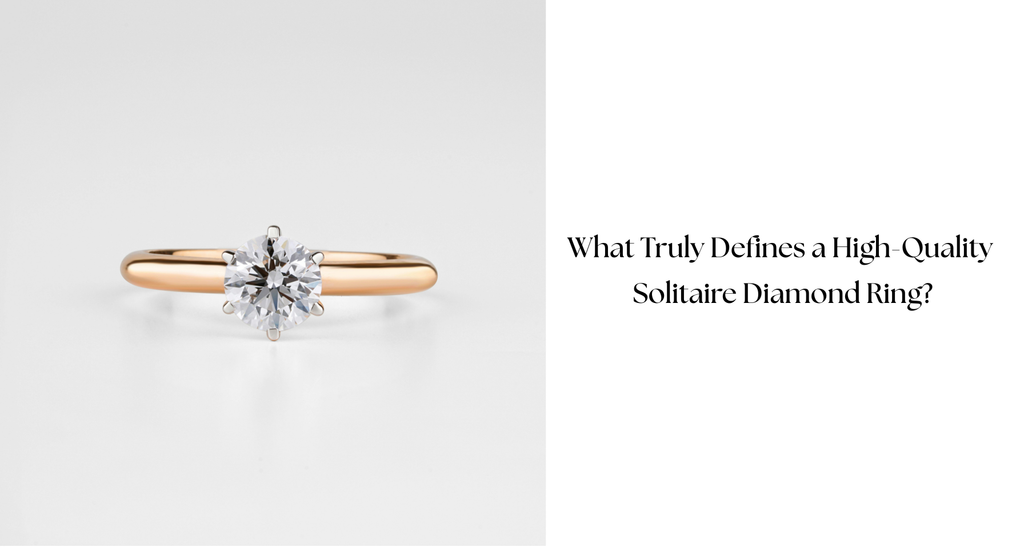
What Truly Defines a High-Quality Solitaire Diamond Ring?
A solitaire diamond ring may look simple because the design usually centres on one diamond. However, that simplicity leaves very little room to hide poor diamond quality, weak proportions or average craftsmanship. With no halo or cluster of smaller stones competing for attention, the centre diamond, setting and band must work well together.
A high-quality solitaire ring is not automatically the one with the largest diamond or the highest price. It is a ring with a well-cut centre stone, suitable colour and clarity, a secure setting, properly finished gold and proportions that look balanced on the hand.
Here is what you should check before choosing a solitaire diamond ring.
The Centre Diamond Should Be the Main Focus
A solitaire ring is designed around one centre diamond. The band and setting should support the stone without making the design look heavy or distracting.
The diamond should appear properly aligned in the centre of the ring. It should not tilt towards one side, sit unevenly between the prongs or look too small for the setting holding it.
The setting should also match the diamond’s shape. A round diamond requires a different prong arrangement from a pear, marquise or princess-cut diamond. Pointed shapes need protection around their tips, while diamonds with corners require a setting that holds each vulnerable edge securely.
The single centre diamond is also what gives this design its symbolic value. Learn more about what a solitaire ring really represents and why it remains a popular choice for engagements.
A well-made solitaire allows the diamond to remain prominent while keeping it stable enough for regular wear.
Cut Quality Matters More Than Most Buyers Realise
Many buyers first compare solitaire rings by carat weight. However, a large diamond will not necessarily look impressive if it has been cut poorly.
The cut determines how effectively light enters the diamond, reflects between its facets and returns to the viewer. A well-cut diamond generally appears brighter and more lively. A poorly proportioned diamond may look dark, flat or dull, even when it has a high colour and clarity grade.
For round brilliant diamonds, the grading certificate may include a formal cut grade. For other diamond shapes, you should pay close attention to the stone’s proportions, symmetry and visible appearance rather than relying on carat weight alone.
When viewing a solitaire diamond, check whether:
- Light appears evenly distributed across the stone
- The centre does not look noticeably dark
- The diamond does not appear dull under normal lighting
- The outline looks even and properly shaped
- The facets appear balanced rather than irregular
A diamond should be viewed in different lighting conditions. Bright showroom lighting can make almost any stone appear highly reflective. Natural daylight and ordinary indoor light usually provide a more realistic understanding of its appearance.
Carat Weight Does Not Tell You the Complete Size
Carat measures the weight of a diamond, not exactly how large it appears from the top.
Two diamonds with the same carat weight can have different visible sizes. One may carry more weight in its depth, while another may spread more across the finger.
This is why the diamond’s length, width and depth measurements are important.
For example, two one-carat oval diamonds may not look identical. One may be longer and narrower, while another may be shorter and broader. Similarly, a deep round diamond may look smaller from the top than another diamond with the same carat weight but more balanced proportions.
A high-quality solitaire diamond should not be selected only because it reaches a particular carat number. It should also have:
- Suitable face-up dimensions
- Balanced proportions
- A pleasing length-to-width ratio
- No unnecessary depth that hides weight below the setting
The visible size should also suit the wearer’s finger. A diamond that looks balanced on one hand may appear understated or oversized on another.
Colour Should Be Judged in the Selected Metal
Diamond colour grades indicate how much visible colour is present in a white diamond. However, the highest colour grade is not necessary for every solitaire ring.
The colour should be evaluated along with the ring’s metal.
White gold and platinum can make warmth in a diamond more noticeable because the metal provides a colourless background. Yellow and rose gold may make slightly warmer diamond grades appear more neutral, particularly when only the prongs or basket are visible around the stone.
Diamond shape can also affect how colour appears. Round brilliant diamonds often hide colour better than some elongated or step-cut shapes. Emerald and asscher-cut diamonds may show colour more easily because of their broad, open facets.
A high-quality ring does not always need a colourless diamond. The better choice is a diamond that appears white enough to your eye in the selected setting.
Paying significantly more for a colour difference that is not visible once the ring is worn may not improve the actual appearance.
Clarity Should Be Clean to the Eye
Clarity describes the internal and surface characteristics found in a diamond. Internal features are known as inclusions, while external features are called blemishes.
A higher clarity grade usually increases the diamond’s price, but not every inclusion can be seen without magnification.
For a solitaire ring, the practical goal is usually to choose a diamond that looks clean when viewed normally. This is often called an eye-clean diamond.
An eye-clean diamond does not need to be internally flawless. It simply means that inclusions are not easily visible without magnification from a normal viewing distance.
The location of an inclusion can be as important as its size. An inclusion near the outer edge may be hidden by a prong, while one positioned directly under the centre table may be easier to notice.
Before choosing the diamond, ask:
- Can any inclusion be seen without magnification?
- Is there a dark inclusion near the centre?
- Is any inclusion close to a vulnerable corner or edge?
- Does the clarity feature affect transparency or brightness?
- Can the setting safely cover a minor edge inclusion?
A high clarity grade does not compensate for weak cut quality. A visually clean diamond with better cut can often look more attractive than a higher-clarity stone with average proportions.
The Diamond Shape Should Be Even and Well Proportioned
Diamond shape is not only a matter of personal preference. The quality of the outline also affects how refined the solitaire looks.
A round diamond should appear properly circular. An oval should not look uneven or excessively narrow unless that proportion is deliberately chosen. A pear-shaped diamond should have balanced shoulders and a centred point. A cushion should not appear unintentionally crooked or lopsided.
Elongated shapes should also be checked for the bow-tie effect. This is a darker area that may appear across the centre of oval, pear, marquise and some radiant-cut diamonds.
A slight bow tie is common in many elongated diamonds. However, a very dark or wide bow tie can distract from the diamond’s overall appearance.
Since fancy-shaped diamonds do not always have a simple overall cut grade, videos and hand-view images are particularly useful. The certificate provides measurements, but the actual appearance should also be evaluated.
Certification Confirms What You Are Buying
A high-quality solitaire diamond should come with a grading report from a recognised gemological laboratory.
The report provides an independent assessment of the diamond and may include:
- Whether the diamond is natural or lab grown
- Diamond shape and cutting style
- Carat weight
- Colour grade
- Clarity grade
- Measurements
- Polish
- Symmetry
- Fluorescence
- Proportions
- Report number
For a lab grown solitaire diamond, the report should clearly identify the stone as laboratory grown. The diamond may also carry a report number or lab-grown identification on its girdle through a laser inscription.
The report number should be verified through the grading laboratory’s official system. The details on the report should match the diamond and the information provided on the invoice.
Certification does not automatically mean that the diamond will look beautiful. It confirms the specifications, while the visible quality still depends heavily on the stone’s cut, proportions and appearance.
The Setting Should Hold the Diamond Securely
The centre diamond may be the most valuable part of a solitaire ring, so the setting should be examined carefully.
The prongs should be evenly spaced and should hold the diamond firmly. One prong should not look noticeably thicker, shorter or more open than the others. There should be no visible gap between the diamond and the prong holding it.
Common solitaire settings include four-prong, six-prong and bezel settings.
A four-prong setting leaves more of the diamond visible and can create a more open appearance. A six-prong setting provides additional points of support and is commonly used for round diamonds. A bezel setting surrounds the diamond with a border of metal and can provide greater edge protection.
The best setting depends on the diamond’s shape, size and how regularly the ring will be worn.
The diamond should not move or produce a clicking sound when the ring is handled gently. Any movement may indicate that the prongs need adjustment.
Setting Height Affects Both Appearance and Comfort
A high-set solitaire raises the diamond above the band. This can make the centre stone appear more prominent and may allow a straight wedding band to sit closely beside the engagement ring.
However, a high setting may catch on clothes, hair, gloves or bags. It can also feel inconvenient for someone who works frequently with their hands.
A low-profile setting keeps the diamond closer to the finger. It may feel more practical for daily wear, although some low settings may not sit flush with a standard wedding band.
A high-quality solitaire ring should not only look attractive in a product image. Its height should suit the wearer’s routine.
Before purchasing, check the ring from the side. This view shows:
- How high the diamond sits
- Whether the basket looks balanced
- How much of the diamond is exposed
- Whether another band can sit beside it
- Whether the setting is likely to catch during daily use
Gold Purity and Band Strength Both Matter
The quality of a solitaire ring is not decided by the diamond alone. The metal band supports the setting and affects the ring’s long-term durability.
Gold solitaire rings are commonly available in different purities, including 9K, 14K and 18K gold.
Higher-karat gold contains a greater percentage of pure gold, while lower-karat options contain a higher proportion of alloy metals. The alloy affects the metal’s strength, colour and price.
The band should have enough metal to support the centre setting. An extremely thin band may make the diamond appear larger, but it can also be more likely to bend or lose shape over time.
The ideal width depends on the design, diamond size and wearer’s preference. The lower part of the band should not be made unnecessarily thin simply to reduce gold weight.
The ring should also carry the applicable hallmark and purity identification. For gold jewellery in India, buyers should check the BIS hallmark and HUID details.
Craftsmanship Can Be Seen in the Small Details
A solitaire ring has fewer decorative elements, so workmanship is easier to notice.
Look closely at the following areas:
Prong Finish
Prongs should be smooth and should not catch on fabric. Their tips should appear evenly shaped.
Diamond Alignment
The centre diamond should sit straight when viewed from the front, side and top.
Band Symmetry
Both sides of the band should meet the setting at the same height and angle.
Surface Finish
The gold should appear smooth and evenly polished without rough areas, dents or visible tool marks.
Inner Band
The inside of the ring should feel smooth against the finger. Hallmarks and engravings should be clear without creating sharp edges.
Setting Connection
The basket or head holding the diamond should connect firmly with the band. It should not look weak or disproportionately narrow below a large centre stone.
Good craftsmanship may not always be noticeable in a product photograph. A close video and side-view images can help buyers examine these details before ordering.
The Band and Diamond Should Look Proportionate
The diamond, setting and band should look like parts of the same design.
A very large centre diamond on an extremely thin band may look top-heavy and rotate on the finger. A thick band with a small centre stone may make the diamond appear less prominent than intended.
The taper of the band can also affect the appearance. A band that becomes narrower near the diamond directs attention towards the centre. A consistent-width band creates a more structured look.
The ring should be evaluated as a complete piece rather than judging the centre diamond separately.
The proportions should feel balanced from:
- The top view
- The side view
- The hand view
- The base of the band
- The point where the setting meets the band
The Ring Should Fit Correctly
A high-quality ring will still feel uncomfortable if the size is wrong.
The solitaire should slide over the knuckle with slight resistance and sit securely at the base of the finger. It should not press deeply into the skin or feel so loose that the centre diamond rotates constantly.
Some rotation can happen when the knuckle is wider than the base of the finger. A top-heavy setting can make this more noticeable.
In such cases, the jeweller may recommend:
- A slightly wider lower band
- Sizing beads
- An internal sizing bar
- A lower centre setting
- A more balanced ring structure
The possibility of resizing should be confirmed before purchase. While many plain solitaire bands can be adjusted, the amount of alteration possible depends on the design and metal.
Price Transparency Is Part of Quality
A high-quality ring should be sold with a clear price breakup.
The buyer should understand what they are paying for, including:
- Centre diamond value
- Gold weight and purity
- Gold rate
- Making charges
- Additional charges, if any
- Discount
- Applicable taxes
- Final amount
For a lab grown diamond solitaire ring, the invoice should clearly mention that the centre diamond is lab grown. It should also show the carat weight and certificate details where applicable.
A high price does not automatically prove high quality. Similarly, an unusually low price should be checked carefully to understand whether the difference comes from diamond quality, gold weight, certification, setting construction or after-sales terms.
After-Sales Support Should Be Checked Before Buying
Solitaire rings may require professional inspection over time, especially when worn daily.
Ask the jeweller whether they provide:
- Prong inspection
- Professional cleaning
- Polishing or refinishing
- Ring resizing
- Repair support
- Certificate and invoice assistance
- Exchange or buyback options
- Replacement support if the centre stone becomes loose
Buyback and exchange policies should be read carefully. The value offered later may depend on the gold rate, diamond type, deductions and the brand’s written terms.
After-sales support does not change the original diamond quality, but it can make the ring easier to maintain throughout regular wear.
A Practical Checklist for Choosing a Solitaire Ring
Before making the final decision, check:
- Does the diamond appear bright in normal lighting?
- Is the shape even and properly proportioned?
- Does its visible size match its measurements?
- Is the diamond clean to the eye?
- Does the colour look suitable in the chosen metal?
- Is there a recognised grading report?
- Does the report clearly state whether the diamond is natural or lab grown?
- Does the laser inscription match the certificate?
- Are all prongs even and secure?
- Is the diamond properly aligned?
- Is the setting height practical for the wearer?
- Does the band have enough strength to support the diamond?
- Is the gold properly hallmarked?
- Does the ring fit comfortably?
- Is the price breakup clearly explained?
- Are return, resizing, exchange and repair terms provided in writing?
Final Thoughts
A high-quality solitaire diamond ring is defined by more than carat weight or price. The centre diamond should have good cut quality, balanced proportions, suitable colour and clarity, and reliable certification. The setting should hold it securely, while the gold band should be strong, properly finished and comfortable to wear.
The most expensive diamond is not automatically the best choice. A slightly smaller, well-cut diamond can look more attractive than a larger stone with poor proportions. Similarly, paying for extremely high colour or clarity grades may not improve the visible appearance if the difference cannot be seen once the ring is worn.
Look at the complete ring rather than only the certificate or centre diamond. When the stone, setting, band and craftsmanship work together, even a simple solitaire design can feel carefully made and remain suitable for years of regular wear.


