




 All Earrings
 Stud Earrings
 Drop Earrings
 Solitaire
 Hoop Earrings
 Halo Earrings
 Vermeil Earrings
 Round
Round
 Oval
Oval
 Emerald
 Pear
Pear
 Princess
 Heart
Heart
 Marquise
 All Rings
 Solitaire Rings
 Band Rings
 Halo Rings
 Cocktail Rings
 Eternity Rings
 Fashion Ring
 Stack Rings
 Men's Rings
 Vermeil Rings
 All Necklaces
 Necklet
 Mangalsutra
 Solitaire
 Tennis Necklace
 Statement Necklace
 Vermeil Necklace
 Alphabets
 Solitaire Pendant
 Halo Pendant
 Vermeil Pendants
 All Bracelets
 Solitaire Bracelet
 Tennis Bracelet
 Fashion Bracelet
 Mangalsutra
 Vermeil Bracelets
 All Vermeil
 Vermeil Earring
 Vermeil Pendant
 Vermeil Ring
 Vermeil Necklace
 Vermeil Mangalsutra
 Vermeil Bracelets
 Vermeil Bangles
 Vermeil Men’s
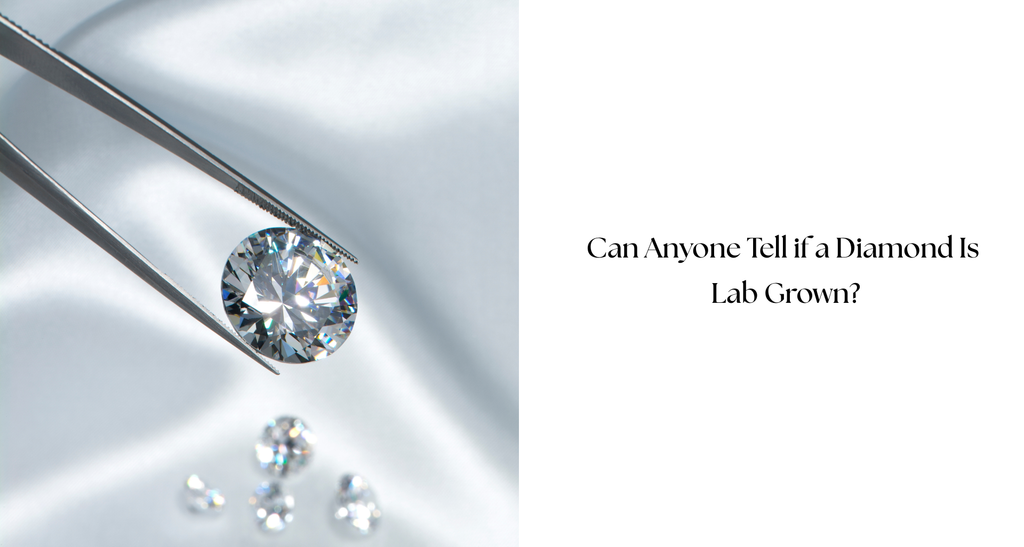
Can Anyone Tell if a Diamond Is Lab Grown? Here’s What You Need to Know
- kajal seo
Lab grown diamonds are now commonly chosen for engagement rings, earrings, pendants and other fine jewellery. They look like diamonds, sparkle like diamonds and are also graded on characteristics such as cut, colour, clarity and carat.
Still, many buyers have one concern before purchasing: Will people be able to tell that my diamond is lab grown?
Usually, the answer is no. A person cannot look at a diamond and confidently identify whether it was formed naturally beneath the earth or created in a laboratory. Even an experienced jeweller may need proper documents or specialised testing equipment to confirm its origin.
Here is how lab grown diamonds are identified and what you should check before buying one.
Can You Identify a Lab Grown Diamond Just by Looking at It?
A lab grown diamond cannot usually be identified with the naked eye.
When it is set in a ring or another piece of jewellery, it can have the same brilliance, transparency and overall appearance as a natural diamond. Its laboratory origin does not create a visible mark, unusual colour or different type of sparkle.
Friends, relatives or other people looking at your jewellery are likely to notice the diamond’s size, shape and design. They will not be able to determine its origin simply by looking at it.
Claims such as “lab grown diamonds look too perfect” or “they sparkle differently” are not reliable. Both natural and lab grown diamonds are available in different cut, colour and clarity grades. A poorly cut diamond may appear dull, while a well-cut diamond can look bright regardless of where it was formed.
Why Do Lab Grown and Natural Diamonds Look Alike?
Lab grown diamonds are not artificial stones made to resemble diamonds. They are diamonds created in a controlled environment.
Natural diamonds develop beneath the earth through natural heat and pressure. Lab grown diamonds are produced using technology that recreates the conditions required for diamond crystal growth.
The two commonly used methods are:
- CVD, or Chemical Vapour Deposition
- HPHT, or High Pressure High Temperature
The formation process and origin are different, but both types have the basic physical and optical properties of diamond. This is why they can look alike after cutting and polishing.
The difference is not something that can normally be seen while wearing the jewellery.
Are Lab Grown Diamonds Fake Diamonds?
No, lab grown diamonds are not fake diamonds.
They should not be confused with cubic zirconia, American diamonds or moissanite. These stones may be used as diamond alternatives, but they are made from different materials.
A lab grown diamond has the crystal structure and hardness associated with diamond. It can also be graded for carat weight, colour, clarity and other quality factors.
The word “lab grown” explains where the diamond was created. It does not mean that the stone is plastic, glass or an imitation diamond.
Clear disclosure is still important. A seller should always tell the buyer whether the diamond is natural or laboratory grown before completing the purchase.
Can a Jeweller Tell That a Diamond Is Lab Grown?
A jeweller may be able to identify it by checking the diamond certificate and laser inscription. However, looking at the diamond through a regular magnifying lens may not always be enough.
A jeweller will usually check:
- Whether the diamond has a laser inscription
- Whether the inscription number matches the certificate
- Whether the certificate clearly identifies the diamond as lab grown
- Whether the report details match the actual stone
Some jewellery stores also have diamond-screening machines. These can help separate natural diamonds from stones that may require additional testing.
The availability and quality of testing equipment can differ between stores. When there is still doubt about the diamond’s origin, it can be sent to a recognised gemological laboratory for examination.
Can a Regular Diamond Tester Identify a Lab Grown Diamond?
A normal handheld diamond tester may confirm that the stone behaves like a diamond, but it generally cannot tell whether it is natural or lab grown.
Many common testers work by measuring how the stone conducts heat. Since both natural and lab grown diamonds have diamond-like thermal properties, both may pass the same basic test.
This means a tester showing “diamond” does not automatically mean “natural diamond.”
Basic testers are more useful for separating diamonds from certain imitation stones. More advanced instruments are required to identify the diamond’s origin.
Therefore, do not accept a basic tester result as complete proof that a diamond is natural or laboratory grown.
How Do Laboratories Identify Lab Grown Diamonds?
Gemological laboratories use specialised equipment to examine features that cannot normally be seen by a buyer.
Natural and lab grown diamonds may show different:
- Crystal growth patterns
- Trace elements
- Fluorescence behaviour
- Phosphorescence behaviour
- Internal structures
- Atomic-level characteristics
These features are related to how and where the diamond formed.
Laboratories do not usually depend on one simple sign. They examine multiple characteristics before stating whether a diamond is natural or laboratory grown.
This is why proper laboratory testing is more dependable than judging a stone through its sparkle, inclusions or surface appearance.
What Is a Laser Inscription on a Diamond?
A laser inscription is a very small number or message placed on the girdle of a diamond.
The girdle is the narrow outer edge running around the stone. The inscription is generally too small to see without magnification and does not affect the diamond’s normal appearance.
It may include:
- The diamond report number
- A reference showing that the diamond is lab grown
- The grading laboratory’s initials
- A brand name or identifying code
The inscription helps connect the physical diamond with its grading report.
A jeweller can locate it under magnification and check whether the number matches the certificate provided with the jewellery.
Does Every Lab Grown Diamond Have a Laser Inscription?
Not every lab grown diamond will necessarily have an easily visible inscription.
Centre diamonds sold with individual grading reports are more likely to have report numbers inscribed on their girdles. Smaller diamonds used around a centre stone may not be individually certified or inscribed.
The inscription can also become difficult to locate after the diamond is set. A prong or part of the metal setting may cover the section where the number is placed.
Therefore, not seeing an inscription immediately does not prove that the diamond is natural. The jeweller may need to rotate the jewellery or examine it from different angles.
When the diamond does not have an inscription, its origin may need to be confirmed through documentation or laboratory testing.
Is a Laser Inscription Enough to Verify the Diamond?
A laser inscription is useful, but it should not be checked alone.
The inscription number should match:
- The grading report
- The online report-verification record
- The diamond’s shape and carat weight
- The measurements mentioned in the report
- The information given on the invoice
You should enter the report number on the grading laboratory’s official verification portal. This helps confirm that the report exists and shows the details issued by the laboratory.
A report number by itself does not tell the complete story if the diamond’s measurements and specifications do not match.
The safest process is to compare the inscription, grading report, online verification and purchase invoice together.
What Should the Diamond Certificate Mention?
The report should clearly state that the diamond is laboratory grown.
Depending on the diamond and the type of report, it may include:
- Diamond shape
- Carat weight
- Measurements
- Colour grade
- Clarity grade
- Cut grade, where applicable
- Polish and symmetry
- Growth method
- Any detected post-growth treatment
- Report number
- Laser inscription details
The report should not use unclear wording that leaves the diamond’s origin open to interpretation.
Before buying, check the report number online and confirm that the details match the diamond being offered to you.
Can People Tell When You Are Wearing a Lab Grown Diamond?
No one can normally tell during a casual conversation or by seeing the jewellery on your hand.
A lab grown diamond does not carry a visible “lab grown” appearance. Someone looking at your ring may assume it is a diamond, but they cannot reliably decide its origin from the sparkle or size.
People may only know that it is lab grown when:
- You tell them
- They see the certificate or invoice
- They check the laser inscription
- The diamond is tested with suitable equipment
Choosing a lab grown diamond may allow a buyer to select a larger centre stone or better specifications within the same budget. However, its larger appearance still does not prove that it is lab grown.
Diamond prices vary for many reasons, so even the jewellery’s price cannot be used to identify its origin.
Do Lab Grown Diamonds Sparkle Differently?
Lab grown diamonds do not have a separate type of sparkle.
A diamond’s visible brilliance depends mainly on how it has been cut. Its proportions, polish and facet arrangement affect the way light travels through and reflects from the stone.
Other factors that affect sparkle include:
- Cut quality
- Symmetry
- Polish
- Diamond shape
- Lighting conditions
- Cleanliness of the stone
Soap, oil, moisturiser, dust and everyday residue can collect around a diamond and make it look less bright. This can happen with both natural and lab grown diamonds.
A clean, properly cut lab grown diamond can show strong brilliance. A badly cut or dirty diamond may appear dull, regardless of its origin.
Can You Test a Lab Grown Diamond at Home?
There is no simple home test that can reliably confirm whether a diamond is natural or lab grown.
Online suggestions such as breathing on the stone, scratching glass or checking whether text is visible through it are not suitable for identifying diamond origin.
These methods may give incorrect results because they do not examine how the diamond was formed.
You should also avoid tests that may scratch the stone, loosen the setting or damage the jewellery.
A buyer can perform these safer checks instead:
- Review the diamond certificate
- Verify the report number online
- Ask the jeweller to show the laser inscription
- Match the diamond details with the report
- Check that the invoice mentions the diamond’s origin
- Seek independent laboratory verification when required
These steps provide more useful information than informal home experiments.
Can a Lab Grown Diamond Be Sold as a Natural Diamond?
A responsible jeweller should never sell a lab grown diamond as a natural diamond.
The diamond’s origin should be clearly mentioned during the sale, on the grading report and preferably on the invoice. Buyers should not have to guess whether they are purchasing a natural or lab grown stone.
Before paying, ask the seller to confirm in writing:
- Whether the diamond is lab grown or natural
- Which laboratory issued the grading report
- Whether the centre diamond has an inscription
- Whether the report can be verified online
- Whether the invoice mentions the diamond details
Clear documentation protects the buyer and reduces confusion later.
Purchasing from a jeweller who provides transparent product details is more important than depending only on verbal claims.
What Should You Ask Before Buying a Lab Grown Diamond?
Before finalising your jewellery, ask the following questions:
Is the Centre Diamond Certified?
Larger centre diamonds should ideally come with a recognised grading report. Smaller diamonds used in the band may be covered through the jewellery invoice rather than separate certificates.
Which Laboratory Issued the Report?
Ask for the laboratory name and verify the report through its official system.
Does the Report Clearly Mention Lab Grown?
The origin should be stated clearly. It should not be hidden in unclear or technical wording.
Is the Report Number Inscribed on the Diamond?
Ask the jeweller whether the centre diamond has a laser inscription and whether you can view it under magnification.
Does the Invoice Mention the Same Details?
The invoice should mention important information such as lab grown origin, carat weight, gold purity and certificate number where applicable.
Is the Carat Weight for the Centre Diamond or the Entire Ring?
Some rings show total diamond weight, which includes the centre and all smaller diamonds. Confirm both figures separately.
What Return, Exchange and Buyback Policies Apply?
Check the policy specifically for lab grown diamond jewellery. Do not assume that the same terms apply to every product or diamond type.
Can a Lab Grown Diamond Be Replaced With a Natural Diamond in the Same Ring?
In many designs, the centre diamond can technically be replaced, but this depends on the size, shape and setting.
A replacement diamond must fit the existing setting correctly. Even two diamonds with the same carat weight may have different measurements.
The jeweller may need to:
- Adjust or remake the prongs
- Change the centre setting
- Modify the ring design
- Create a new setting for the replacement stone
Replacing the diamond may also affect the strength and finish of the ring. It should only be done by an experienced jeweller after examining the design.
Should You Be Concerned That Others Will Know?
The decision should depend on what you want from the jewellery, not on whether someone else can identify the diamond’s origin.
A lab grown diamond may be suitable for buyers who want:
- A certified diamond
- A larger appearance within a set budget
- Better colour or clarity specifications
- More flexibility in choosing a ring design
- Clear information about the diamond’s laboratory origin
People cannot normally tell the difference by sight. What matters is that you know what you are buying and receive accurate documentation.
Final Thoughts
A lab grown diamond cannot generally be identified by simply looking at it. It can have the same visible brilliance and overall appearance that buyers expect from a diamond.
Friends, family members and even jewellers may not be able to confirm its origin without checking the report, laser inscription or using appropriate testing equipment.
The best way to verify a lab grown diamond is to check its grading report, confirm that the report clearly mentions its origin, match the certificate number with the laser inscription and verify the details online.
Rather than worrying about whether someone can tell, focus on the diamond’s cut, certification, setting and the transparency provided by the jeweller. A clearly documented purchase gives you confidence that the diamond you received matches what was promised.


