











 All Earrings
 Stud Earrings
 Drop Earrings
 Solitaire
 Hoop Earrings
 Halo Earrings
 Vermeil Earrings
 Round
Round
 Oval
Oval
 Emerald
 Pear
Pear
 Princess
 Heart
Heart
 Marquise
 All Rings
 Solitaire Rings
 Band Rings
 Halo Rings
 Cocktail Rings
 Eternity Rings
 Fashion Ring
 Stack Rings
 Men's Rings
 Vermeil Rings
 All Necklaces
 Necklet
 Mangalsutra
 Solitaire
 Tennis Necklace
 Statement Necklace
 Vermeil Necklace
 Alphabets
 Solitaire Pendant
 Halo Pendant
 Vermeil Pendants
 All Bracelets
 Solitaire Bracelet
 Tennis Bracelet
 Fashion Bracelet
 Mangalsutra
 Vermeil Bracelets
 All Vermeil
 Vermeil Earring
 Vermeil Pendant
 Vermeil Ring
 Vermeil Necklace
 Vermeil Mangalsutra
 Vermeil Bracelets
 Vermeil Bangles
 Vermeil Men’s
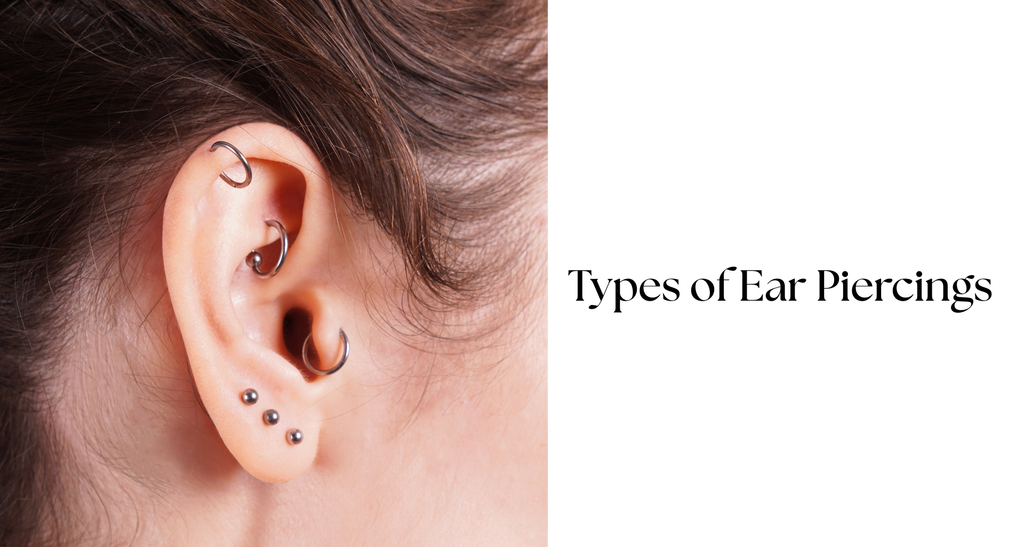
Types of Ear Piercings and Their Exact Placement
Ear piercings can be placed on different parts of the ear, from the soft lower lobe to the firmer cartilage around the outer and inner sections. The name of each piercing usually comes from the part of the ear where it is positioned.
Some placements sit close to each other and can easily be confused. For example, a helix piercing is placed on the outer rim, while a flat piercing sits on the broad cartilage area just inside that rim. Similarly, an inner conch and outer conch are both placed in the middle section of the ear but at different points.
Understanding the exact placement can help you identify each piercing correctly before choosing one.
1. Standard Lobe Piercing
A standard lobe piercing is placed on the soft, fleshy part at the bottom of the ear.
It usually sits near the centre of the earlobe, with enough space around it for the earring to rest comfortably. This is generally the first ear piercing most people get.
After it has fully healed, a standard lobe piercing can be worn with different lab grown diamond earrings, including studs, hoops and drop designs.
The placement may be adjusted slightly depending on the size and shape of the earlobe. On a small lobe, it may sit closer to the centre, while on a larger lobe, the piercer may leave more space around the edges.
Since the lobe does not contain hard cartilage, it feels softer than the upper sections of the ear.
2. Upper Lobe Piercing
An upper lobe piercing is placed above the standard lobe piercing but still within the soft part of the ear.
It is usually positioned between the first lobe piercing and the point where the cartilage begins. Depending on the available space, a person may have a second, third or even fourth lobe piercing.
The exact position is decided by maintaining enough distance between each hole. If the piercings are too close, the earrings may overlap. If they are too far apart, the arrangement may look uneven.
An upper lobe piercing should not be confused with a low helix piercing. The upper lobe remains in the soft tissue, while the low helix passes through cartilage.
3. High Lobe Piercing
A high lobe piercing is positioned near the upper edge of the earlobe, just below the beginning of the cartilage.
It sits higher than a regular second or third lobe piercing. On some ears, this area may contain a combination of soft tissue and thin cartilage.
The exact placement depends on where the person’s lobe ends and the outer cartilage begins. This can vary significantly from one ear to another.
A high lobe piercing creates a transition between lower-lobe piercings and cartilage piercings placed further up the ear.
4. Transverse Lobe Piercing
A transverse lobe piercing passes horizontally through the earlobe rather than from the front to the back.
The entry and exit points are placed along the side or lower edge of the lobe. This means both ends of the jewellery may be visible across the width of the earlobe.
The piercing follows a sideways path through the soft tissue. Its position depends on the thickness and width of the lobe.
People with very small or attached earlobes may not have enough tissue for this placement. It should not be confused with two separate lobe piercings because a transverse lobe uses one continuous channel through the ear.
5. Helix Piercing
A helix piercing is placed on the curved outer cartilage rim of the upper ear.
This rim begins above the lobe and continues around the top edge of the ear. A standard helix piercing is usually positioned on the upper outer section, although it can be placed at different points along the rim.
The piercing passes through the thin cartilage forming the outer border. It does not sit on the broad inner surface of the upper ear.
A person may have one helix piercing or multiple piercings placed vertically along the rim. Two placements are commonly called a double helix, while three may be called a triple helix.
6. Mid-Helix Piercing
A mid-helix piercing is placed on the middle section of the ear’s outer cartilage rim.
It sits lower than a standard upper helix but higher than the lobe. This area is sometimes also called the auricle.
The exact placement is usually around the centre of the outer curve, roughly level with the central bowl of the ear.
A mid-helix should not be confused with an outer-conch piercing. Both may appear near the middle of the ear, but the mid-helix goes through the rim, while the outer conch sits on the flatter cartilage just inside it.
7. Low Helix Piercing
A low helix piercing is placed on the lower part of the outer cartilage rim, close to where the lobe meets the cartilage.
It sits above a high-lobe piercing but below the mid-helix.
The key difference is the type of tissue. A high-lobe piercing is mainly placed through soft tissue, while a low helix goes through the firmer outer cartilage.
Because the boundary between the lobe and cartilage differs between individuals, the exact position may appear slightly different on each ear.
8. Forward Helix Piercing
A forward helix piercing is placed on the front section of the upper cartilage, close to where the ear joins the side of the head.
It sits opposite the regular helix piercing. While the standard helix follows the outer rear edge, the forward helix is positioned on the small cartilage fold at the front of the ear.
This area may have enough space for one, two or three piercings placed in a short vertical row.
The available space is limited, so the placements are generally close together. Not every ear has enough cartilage for multiple forward-helix piercings.
9. Hidden Helix Piercing
A hidden helix piercing is positioned underneath the curved upper fold of the ear.
Instead of being placed directly on the visible outer rim, the piercing sits slightly inside or below the top cartilage fold. The entry point may remain partly concealed when the ear is viewed from the front.
Its exact position depends on whether the upper ear has a defined fold with enough space beneath it. Some ears have a prominent upper rim, while others have a flatter structure.
A hidden helix differs from a standard helix because the piercing is placed beneath the fold rather than directly through the exposed outer edge.
10. Flat Piercing
A flat piercing is placed on the broad, flat area of cartilage in the upper ear.
This area lies inside the outer helix rim and above the central folds of the ear. It is sometimes referred to as the scapha.
The piercing does not pass through the outer edge. Instead, it goes directly through the flatter cartilage surface between the helix and the inner ear ridges.
The exact location can be moved slightly higher, lower or towards the centre depending on the available space. Multiple flat piercings may also be placed across this area.
11. Inner Conch Piercing
An inner conch piercing is placed in the deep, bowl-shaped cartilage area near the centre of the ear.
This central section surrounds the opening of the ear canal. The inner conch sits closer to the canal and further inside the ear than the outer conch.
The piercing passes through the thicker central cartilage. From the front, it usually appears within the hollow part of the ear.
It is positioned below the flat piercing and behind the tragus. Because the conch area differs in size and depth, the exact location is selected according to the individual ear.
12. Outer Conch Piercing
An outer conch piercing is placed on the flatter middle cartilage between the inner conch and the outer helix rim.
It sits further away from the ear canal than an inner-conch piercing. From the front, it appears closer to the outer edge of the ear.
This area may also be referred to as the contraconch, although piercing terminology can vary between professionals.
The outer conch should not be confused with a mid-helix. The mid-helix passes through the raised outer rim, while the outer conch is placed slightly inside that rim on the broader cartilage surface.
13. Daith Piercing
A daith piercing is placed through the small inner fold of cartilage directly above the opening of the ear canal.
This fold is located deep inside the ear, below the rook area and behind the forward helix.
The piercing passes through the curved cartilage ridge rather than the central bowl of the conch. From the front, it appears tucked into the inner part of the ear.
The exact placement depends on the size and definition of the fold. Some people may not have a sufficiently prominent cartilage fold for this piercing.
14. Tragus Piercing
A tragus piercing is placed through the small flap of cartilage immediately in front of the ear canal.
The tragus partially covers the entrance of the canal and can be felt as the small raised section closest to the face.
The piercing generally passes from the outer surface of the tragus towards the inner side.
The size and thickness of the tragus vary between individuals. A very small or thin tragus may offer limited space for the placement.
It should not be confused with a forward helix, which is positioned higher up where the ear connects to the head.
15. Anti-Tragus Piercing
An anti-tragus piercing is positioned on the small cartilage ridge directly opposite the tragus.
It sits above the earlobe and below the inner conch. When viewed from the front, the tragus and anti-tragus face each other across the lower opening of the ear.
The anti-tragus is usually smaller and less defined than the tragus. For this reason, the placement may not be suitable for every ear.
It is different from an upper-lobe piercing because the anti-tragus passes through a raised cartilage section rather than soft lobe tissue.
16. Rook Piercing
A rook piercing is placed through the raised inner cartilage ridge in the upper-middle part of the ear.
It sits above the daith and below the flat area. The piercing passes through the fold that separates the upper flat cartilage from the deeper inner ear.
Unlike a flat piercing, which goes through a broad surface, the rook passes through a distinct curved ridge.
The cartilage fold must be prominent enough to support the placement. On ears with a shallow or less defined ridge, a rook piercing may not be possible.
17. Snug Piercing
A snug piercing is placed through the inner cartilage ridge running along the middle section of the ear.
It usually sits between the anti-tragus and the outer helix, following the raised ridge above the conch.
The piercing travels horizontally through this cartilage fold. Both ends of the jewellery generally remain visible on the front side of the ear.
A snug is sometimes confused with a conch piercing. However, a conch goes through the central bowl or flatter cartilage, while a snug passes through the raised inner ridge.
18. Industrial Piercing
An industrial piercing consists of two separate cartilage piercings connected by one straight piece of jewellery.
The most common placement connects the forward section of the upper ear to the outer helix rim. One hole is positioned near the front of the upper cartilage, while the other is placed further back on the outer rim.
Both holes must align correctly so that the jewellery can pass through them in a straight line.
The exact position depends heavily on ear anatomy. The flat area of the ear must not press against the connecting jewellery.
Difference Between Commonly Confused Ear Piercings
Several piercing types are located close together, but their exact positions are different.
- A lobe piercing passes through soft tissue, while a helix piercing passes through the outer cartilage.
- A helix piercing sits on the raised outer rim, while a flat piercing is placed on the broad cartilage surface inside the rim.
- An inner conch piercing is located closer to the ear canal, while an outer conch piercing sits further towards the outer edge.
- A tragus piercing is placed on the cartilage flap in front of the ear canal, while an anti-tragus piercing sits on the opposite ridge above the lobe.
- A daith piercing passes through the inner fold just above the ear canal, while a rook piercing sits higher on the inner cartilage ridge.
- A high-lobe piercing remains mainly within soft tissue, while a low helix piercing is positioned slightly higher through cartilage.
Final Thoughts
Each ear piercing gets its name from the exact part of the ear where it is placed. Lobe piercings sit in the soft lower section, helix piercings follow the outer rim, while flat, conch, tragus and daith piercings are positioned across different cartilage areas.
Since every ear has a slightly different structure, the final placement may vary from person to person. Understanding these locations makes it easier to identify each piercing correctly and discuss the preferred placement with a professional piercer.
-
Posted in
Ear peircing, lab grown diamond earrings


