





 All Earrings
 Stud Earrings
 Drop Earrings
 Solitaire
 Hoop Earrings
 Halo Earrings
 Vermeil Earrings
 Round
 Oval
 Emerald
 Pear
 Princess
 Heart
 Marquise
 All Rings
 Solitaire Rings
 Band Rings
 Halo Rings
 Cocktail Rings
 Eternity Rings
 Fashion Ring
 Stack Rings
 Men's Rings
 Vermeil Rings
 All Necklaces
 Necklet
 Mangalsutra
 Solitaire
 Tennis Necklace
 Statement Necklace
 Vermeil Necklace
 Alphabets
 Solitaire Pendant
 Halo Pendant
 Vermeil Pendants
 All Bracelets
 Solitaire Bracelet
 Tennis Bracelet
 Fashion Bracelet
 Mangalsutra
 Vermeil Bracelets
 All Vermeil
 Vermeil Earring
 Vermeil Pendant
 Vermeil Ring
 Vermeil Necklace
 Vermeil Mangalsutra
 Vermeil Bracelets
 Vermeil Bangles
 Vermeil Men’s
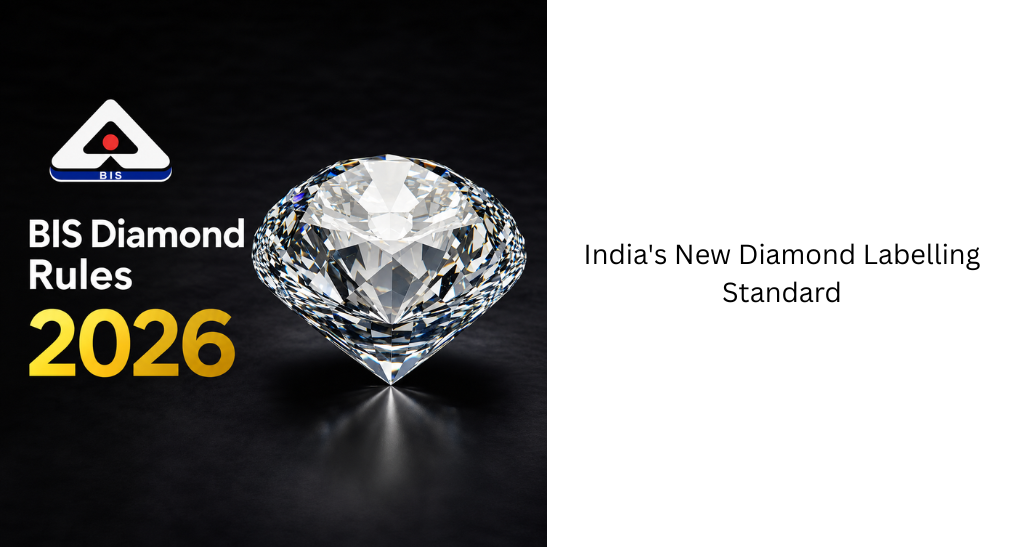
India's New Diamond Labelling Standards: What Lab Grown Diamond Ring Buyers Should Know
Buying a lab grown diamond ring involves more than choosing its design or carat weight. You should also know exactly what type of diamond you are purchasing. To make this clearer, the Bureau of Indian Standards (BIS) introduced IS 19469:2025, a standard that sets guidelines for how natural, laboratory-grown and treated diamonds should be described and advertised in India.
The standard addresses a common problem in the jewellery market: confusing product descriptions that make it difficult for buyers to distinguish between different types of diamonds.
Here's what the new standard means if you are planning to buy a lab grown diamond ring.
What Is BIS Standard IS 19469:2025?
IS 19469:2025 is based on the international standard ISO 18323:2015. It establishes clear terminology for describing diamonds and diamond-like products.
Under this standard, the word "diamond" without any additional description refers to a natural diamond. Laboratory-grown stones must be identified using the terms "laboratory-grown diamond" or "laboratory-created diamond".
The aim is to help customers understand what they are buying without relying on assumptions or unclear marketing language.
3 Important Changes Buyers Should Know
1. Clear Identification of Laboratory-Grown Diamonds
Sellers must clearly distinguish laboratory-grown diamonds from natural diamonds. The standard recognises the terms "laboratory-grown diamond" and "laboratory-created diamond" for these stones.
It also restricts shortened descriptions and abbreviations such as "lab diamond" and "LGD" in commercial descriptions.
2. Misleading Product Descriptions Are Restricted
Terms such as "fake diamond" and "artificial diamond" are not appropriate descriptions for laboratory-grown diamonds. Similarly, sellers should not use language that creates confusion about a stone's origin.
This helps buyers understand the difference between a laboratory-grown diamond and an imitation stone such as cubic zirconia.
3. Diamond Treatments Must Be Disclosed
If a diamond has undergone treatments to change its colour or clarity, this information should be clearly disclosed.
This matters because two diamonds may look similar but have different treatment histories. Knowing these details helps buyers make a better comparison.
What Should You Check Before Buying a Lab Grown Diamond Ring?
Apart from understanding the new labelling standard, check these details before placing an order:
-
Diamond origin: Confirm that the product description clearly identifies the stone as laboratory-grown.
-
Grading report: Ask for the available diamond grading report and check its details.
-
4Cs: Compare cut, colour, clarity and carat weight rather than choosing a ring based on carat alone.
-
Gold purity: Check whether the ring is made in 14KT or 18KT gold and look for applicable BIS hallmark details.
-
Invoice: Make sure the invoice clearly mentions the jewellery and diamond specifications.
These checks are particularly useful when purchasing a ring online, where you cannot examine the diamond in person before ordering.
Does IS 19469:2025 Mean Every Lab Grown Diamond Ring Comes with a Certificate?
No. This is an important difference.
IS 19469:2025 deals with diamond terminology and disclosure. It does not automatically certify every laboratory-grown diamond or replace an individual grading report.
A grading report provides information about a particular stone, while the BIS standard explains how different types of diamonds should be described.
Always check what documentation the jewellery brand provides before making a purchase.
Final Thoughts
India's new diamond labelling standard gives buyers clearer information when comparing natural and laboratory-grown diamonds. It also makes product descriptions more important, particularly when shopping online.
Before choosing a lab grown diamond ring, check its origin, grading details, gold purity and invoice specifications. Understanding these details can help you select a ring that matches your expectations and budget.
FAQs
1. What is BIS IS 19469:2025?
It is an Indian standard that sets guidelines for describing natural diamonds, laboratory-grown diamonds, treated diamonds and imitation stones.
2. Are laboratory-grown diamonds real diamonds?
Yes. They have the same basic chemical composition and crystal structure as natural diamonds. The main difference is how and where they are formed.
3. Does a lab grown diamond ring need a BIS certificate?
The standard does not automatically require an individual BIS certificate for every ring. A diamond grading report is separate documentation that buyers can request from the seller.
4. What should I check before buying a lab grown diamond ring?
Check the diamond's origin, grading report, 4Cs, gold purity, invoice and return policy.


