




 All Earrings
 Stud Earrings
 Drop Earrings
 Solitaire
 Hoop Earrings
 Halo Earrings
 Vermeil Earrings
 Round
 Oval
 Emerald
 Pear
 Princess
 Heart
 Marquise
 All Rings
 Solitaire Rings
 Band Rings
 Halo Rings
 Cocktail Rings
 Eternity Rings
 Fashion Ring
 Stack Rings
 Men's Rings
 Vermeil Rings
 All Necklaces
 Necklet
 Mangalsutra
 Solitaire
 Tennis Necklace
 Statement Necklace
 Vermeil Necklace
 Alphabets
 Solitaire Pendant
 Halo Pendant
 Vermeil Pendants
 All Bracelets
 Solitaire Bracelet
 Tennis Bracelet
 Fashion Bracelet
 Mangalsutra
 Vermeil Bracelets
 All Vermeil
 Vermeil Earring
 Vermeil Pendant
 Vermeil Ring
 Vermeil Necklace
 Vermeil Mangalsutra
 Vermeil Bracelets
 Vermeil Bangles
 Vermeil Men’s
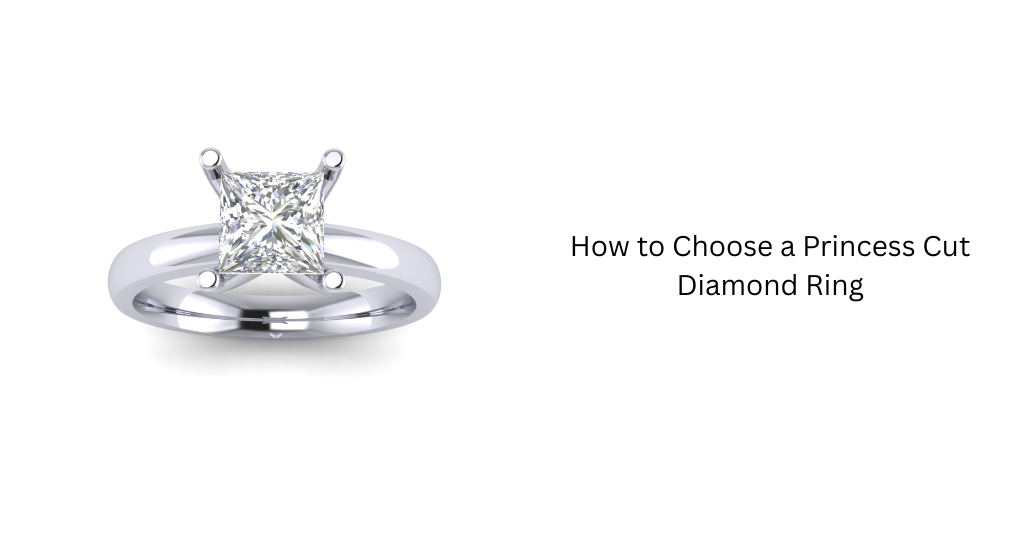
How to Choose a Princess Cut Diamond Ring
A princess cut diamond is recognised by its square shape, pointed corners and brilliant sparkle. Its geometric appearance gives it a modern look, making it a popular choice for engagement rings and everyday diamond jewellery.
However, choosing the right princess cut diamond involves more than selecting its carat weight. Its proportions, colour, clarity and symmetry all influence how it looks. Understanding these details can help you find a diamond that suits your style and budget.
What Is a Princess Cut Diamond?
A princess cut is a square or slightly rectangular diamond with four pointed corners and a brilliant-style faceting pattern. It is also known as a square modified brilliant cut.
Unlike an emerald cut, which has long, step-like facets, a princess cut uses triangular and chevron-shaped facets to create flashes of light and sparkle.
Its square outline makes it a popular alternative to round brilliant diamonds, particularly for buyers who prefer a clean geometric design.
History of the Princess Cut
The princess cut developed from earlier square diamond cuts, including the French cut. Diamond cutters gradually introduced new faceting arrangements to improve light reflection while retaining more of the original rough diamond.
In 1961, Arpad Nagy developed the Profile Cut, followed by Basil Watermeyer's Barion cut in 1971. These designs contributed to the development of modern square brilliant cuts.
The modern princess cut emerged around 1979-1980 through the work of diamond cutters Israel Itzkowitz, Betzalel Ambar and Ygal Perlman. Its combination of a square shape and brilliant-style facets made it a popular alternative to traditional round diamonds.
Understanding the Anatomy of a Princess Cut Diamond
A diamond's structure influences how it reflects light and appears when viewed from different angles. The main parts of a princess cut diamond include:
-
Table: The flat surface at the top that allows light to enter the diamond.
-
Crown: The upper section between the table and girdle, contributing to brightness and fire.
-
Girdle: The narrow edge separating the crown and pavilion.
-
Pavilion: The lower section that influences how light travels through the diamond.
-
Culet: The bottom point of the diamond.
-
Facets: The polished surfaces responsible for reflecting light and creating sparkle.
Understanding these parts helps when comparing diamond specifications in a grading report.
Important Diamond Specifications to Check
Before purchasing a lab grown diamond princess cut diamond ring, pay attention to these characteristics.
1. Carat Weight
Carat measures a diamond's weight, not its physical size. One carat equals 200 milligrams.
Two princess cut diamonds with the same carat weight may have different visible sizes because of variations in their proportions and depth. Always compare their measurements in millimetres.
2. Colour Grade
Diamond colour is graded from D to Z, with D representing colourless diamonds.
For a bright appearance, many buyers consider diamonds in the D to H range. The choice also depends on the ring's metal colour and personal preference.
3. Clarity Grade
Clarity refers to internal inclusions and external blemishes in a diamond. The grading scale ranges from Flawless (FL) to Included (I1, I2 and I3).
VS1 and VS2 diamonds are popular choices, while an eye-clean SI1 may also offer good value. For princess cuts, pay particular attention to inclusions near the pointed corners.
4. Table and Depth
Table percentage measures the width of the top surface in relation to the diamond's overall width. Depth percentage measures its total height against its average width.
These proportions influence light performance and how large the diamond appears from above. Rather than relying on a single ideal number, compare the overall appearance of the stone.
5. Polish and Symmetry
Polish describes the smoothness of the diamond's surface, while symmetry refers to how evenly its facets are arranged.
Good polish and symmetry contribute to a balanced appearance. Check that the four corners and square outline look even.
6. Length-to-Width Ratio
This ratio determines whether a princess cut diamond looks square or rectangular.
A ratio close to 1.00 creates a classic square appearance, while a slightly higher ratio gives the stone a more elongated shape. A ratio around 1.00 to 1.05 is a useful starting point for buyers who prefer a square design.
How to Choose the Right Princess Cut Diamond
Start with your budget and preferred carat weight, then compare colour and clarity grades to find a combination that suits your expectations.
Look at the actual diamond under different lighting conditions. Check for dark areas, uneven sparkle and visible inclusions. If you are purchasing online, ask for clear videos and the grading report of the exact stone.
One important point is that GIA does not assign an overall cut grade to princess cut diamonds in the same way it does for round brilliant diamonds. Therefore, visual inspection and proportion checks are particularly useful.
For laboratory-grown diamonds, also check whether the stone was produced using CVD or HPHT and make sure its grading report clearly identifies it as laboratory-grown.
Popular Settings for Princess Cut Diamond Rings
The pointed corners of a princess cut diamond need proper protection. The right setting can also change the overall appearance of the ring.
-
Solitaire: Keeps attention on the centre diamond. V-shaped prongs can protect its corners.
-
Halo: Surrounds the centre stone with smaller diamonds for additional sparkle.
-
Bezel: Uses a metal rim around the diamond to protect its edges.
-
Three-stone: Places two smaller diamonds on either side of the centre stone for a balanced look.
For everyday wear, prioritise a secure setting that protects all four corners.
Final Thoughts
Choosing a princess cut diamond ring is about balancing appearance, quality and budget. Look beyond carat weight and consider the diamond's proportions, colour, clarity and symmetry before making a decision.
A well-selected princess cut diamond, paired with a setting that protects its corners, can make a beautiful choice for an engagement ring or everyday jewellery.


