







 All Earrings
 Stud Earrings
 Drop Earrings
 Solitaire
 Hoop Earrings
 Halo Earrings
 Vermeil Earrings
 Round
Round
 Oval
Oval
 Emerald
 Pear
Pear
 Princess
 Heart
Heart
 Marquise
 All Rings
 Solitaire Rings
 Band Rings
 Halo Rings
 Cocktail Rings
 Eternity Rings
 Fashion Ring
 Stack Rings
 Men's Rings
 Vermeil Rings
 All Necklaces
 Necklet
 Mangalsutra
 Solitaire
 Tennis Necklace
 Statement Necklace
 Vermeil Necklace
 Alphabets
 Solitaire Pendant
 Halo Pendant
 Vermeil Pendants
 All Bracelets
 Solitaire Bracelet
 Tennis Bracelet
 Fashion Bracelet
 Mangalsutra
 Vermeil Bracelets
 All Vermeil
 Vermeil Earring
 Vermeil Pendant
 Vermeil Ring
 Vermeil Necklace
 Vermeil Mangalsutra
 Vermeil Bracelets
 Vermeil Bangles
 Vermeil Men’s
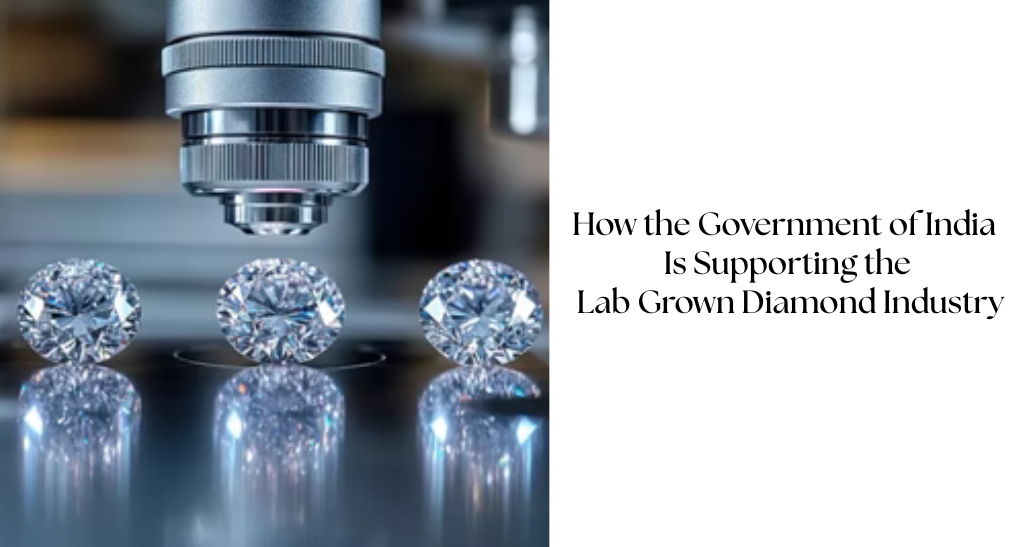
How the Government of India Is Supporting the Lab Grown Diamond Industry
India has long been a major centre for diamond cutting, polishing and jewellery manufacturing. The growth of lab grown diamonds now gives the country an opportunity to build its own diamond growing technology, machinery and research capabilities.
The Government of India has supported this sector through research funding, customs duty relief, separate trade codes and export focused initiatives. These measures aim to strengthen domestic manufacturing and improve India’s position in the global lab grown diamond industry.
Why Is the Government Supporting Lab Grown Diamonds?
India already has a large network of diamond cutters, polishers, exporters and jewellery manufacturers. However, growing diamonds requires specialised reactors, suitable diamond seeds, scientific knowledge and precise production control.
Manufacturers need to manage temperature, pressure, gases, growth speed and crystal quality. Some parts of this ecosystem, including machinery, diamond seeds and technical processes, have traditionally depended on imports.
Government support is focused on helping India develop more of this capability within the country. The larger objective is to reduce import dependence, improve domestic manufacturing and strengthen India’s position in the international lab grown diamond market.
A stronger domestic ecosystem may support researchers, engineers, equipment manufacturers, diamond growers, grading laboratories, jewellery businesses and skilled workers.
₹242 Crore Research Grant for IIT Madras
One of the most important measures was the approval of a research and development grant for IIT Madras.
The Department of Commerce commissioned the InCent Lab Grown Diamond Project at IIT Madras in March 2023 with a grant of approximately ₹242.96 crore. The five year programme focuses on encouraging indigenous production of lab grown diamond seeds and manufacturing machinery.
The work is being carried out through the Indian Centre for Lab Grown Diamonds, also known as InCent LGD.
The programme brings together research knowledge from physics, mechanical engineering, electrical engineering, material science, laser technology and diamond characterisation.
Lab grown diamond production involves more than placing a seed inside a reactor. Researchers must understand the complete growth process, machine design, gas composition, pressure, temperature, crystal formation and any treatment carried out after growth.
The long term purpose of this funding is to create technologies that Indian manufacturers can eventually use commercially.
Developing Diamond Growing Technology in India
Lab grown diamonds are mainly produced through Chemical Vapour Deposition and High Pressure High Temperature processes.
Chemical Vapour Deposition
Chemical Vapour Deposition, commonly known as CVD, grows diamonds inside a controlled chamber.
A thin diamond seed is placed inside the reactor. Carbon rich gases are introduced into the chamber, and carbon atoms gradually form layers of diamond crystal on the seed.
The process requires careful control over temperature, gas composition, pressure and growth speed. Changes in these conditions can affect the structure and final quality of the diamond.
High Pressure High Temperature
High Pressure High Temperature, commonly known as HPHT, recreates the high pressure and temperature conditions required for diamond growth.
HPHT equipment must maintain extreme and consistent conditions throughout the process. The machinery and production knowledge required can be technically complex.
Both methods can produce diamonds for jewellery, industrial equipment and advanced technological applications.
Government supported research can help India develop more of the machinery, knowledge and processes required for both methods.
Why Are Diamond Seeds Important?
A diamond seed is a small piece of diamond that provides the starting surface for growing a larger lab grown diamond.
During the CVD process, carbon atoms settle on the seed and gradually form a larger diamond crystal. The size, structure and consistency of the seed can affect the growth process and the quality of the finished diamond.
Indian growers have often depended on imported seeds. Customs duty on these seeds added another cost to domestic production.
Reducing this cost was therefore identified as one way to support Indian growers while the country works towards developing its own seed technology.
Customs Duty on Diamond Seeds Reduced to Zero
In the Union Budget 2023 to 2024, the Government of India reduced the customs duty on seeds used for manufacturing rough lab grown diamonds from 5 percent to zero.
The government stated that reducing this duty would lower the production cost faced by Indian growers and help make Indian lab grown diamond exports more competitive. The recommendation to create separate HS codes for lab grown diamonds was also accepted at the same time.
Diamond seeds are only one part of the total manufacturing cost. Lab grown diamond production also involves reactor costs, electricity, skilled labour, maintenance, quality control, cutting, polishing, grading, certification and logistics.
The duty reduction does not mean that every finished lab grown diamond becomes cheaper by 5 percent. It removes one input cost from a much larger production process.
Import Conditions Simplified in 2025
The government introduced another change in the Union Budget 2025 to 2026.
The Customs Import of Goods at Concessional Rate condition attached to the duty exemption on diamond seeds was removed. This applied to imported seeds used for manufacturing rough lab grown diamonds.
The customs duty exemption had already brought the applicable duty to zero. Removing the additional condition simplified the procedure through which eligible manufacturers could import and use these seeds.
Government support is not limited to reducing a tax rate. Documentation and compliance requirements can also affect the time and administrative cost involved in manufacturing.
Removing the condition made the exemption simpler for eligible lab grown diamond growers to use.
Government Support Continued in Union Budget 2026 to 2027
The Government of India continued customs support for domestic lab grown diamond manufacturing in the Union Budget 2026 to 2027.
The customs duty exemption available on seeds imported for manufacturing rough lab grown diamonds was extended until 31 March 2028.
This extension allows eligible Indian growers to continue importing diamond seeds without the earlier basic customs duty burden.
The policy developed across three stages. In 2023, the duty was reduced from 5 percent to zero. In 2025, the attached import condition was removed. In 2026, the exemption was extended until 31 March 2028.
The extension gives manufacturers greater certainty when planning seed procurement, production capacity and future investment.
Separate HS Codes for Lab Grown Diamonds
The Government of India also accepted the introduction of separate Harmonised System codes for lab grown diamonds.
HS codes are used by customs and trade authorities to classify products during international import and export.
Separate codes make it easier to track lab grown diamond trade independently from natural diamonds and other synthetic stones.
This can provide clearer information about rough diamond imports, polished diamond exports, international demand, domestic production and changes in trade volumes.
Natural and lab grown diamonds can have similar physical and optical properties, but they have different origins and market pricing. Separate classification helps maintain a clearer distinction within trade records.
NITI Aayog Studied the Growing Lab Grown Diamond Sector
In April 2026, NITI Aayog released the seventh edition of its Trade Watch Quarterly publication.
The thematic section focused on India’s gems and jewellery sector. It examined global demand, India’s export profile, emerging segments such as lab grown diamonds and the country’s position within global value chains.
The report also discussed structural challenges affecting the wider gems and jewellery industry, including reliance on imported inputs, limited access to finance, skill and design gaps, market concentration and the need for greater value addition.
This was not a new financial subsidy for lab grown diamond manufacturers. However, the inclusion of lab grown diamonds in the report shows that the sector is being considered within India’s broader trade and export planning.
NITI Aayog noted the need for investment in technology, skills, raw material access, market diversification and stronger integration into global value chains.
The Role of the Indian Centre for Lab Grown Diamonds
The Indian Centre for Lab Grown Diamonds at IIT Madras is focused on developing indigenous capabilities for diamond growth and related technologies.
Its work may support diamond seed development, CVD reactor technology, HPHT equipment, larger crystal growth, high purity diamonds, manufacturing efficiency and advanced industrial applications.
The centre can help connect academic research with the practical requirements of commercial manufacturers.
Government funded research will create a larger industry impact when the technology moves beyond laboratories and becomes usable for commercial production.
This will require collaboration between researchers, machinery manufacturers, diamond growers, grading laboratories and jewellery businesses.
New Diamond Traceability Technology Developed in 2026
In June 2026, IIT Madras showcased work developed by the Indian Centre for Lab Grown Diamonds involving laser based diamond markings.
Researchers developed technology capable of embedding invisible QR codes, logos and customised markings inside diamond seeds and gems without affecting their clarity or structural integrity.
The technology may help with diamond authentication, protection against counterfeiting and supply chain traceability.
It could also allow a physical diamond to be connected with digital records containing information about its manufacturing, identification or ownership.
This development shows that government backed research is moving beyond diamond growth. It is also examining systems that may help identify and track diamonds throughout the supply chain.
Traceability becomes increasingly important as the industry grows. Buyers, jewellers and laboratories need dependable methods for connecting a diamond with its documented specifications and origin.
Improved Export Access for Lab Grown Diamonds
A Government of India press release published in February 2026 announced improved market access for Indian gems and jewellery exports under the India and United States Bilateral Trade Agreement.
The release stated that zero duty market access had been secured for major categories including diamonds, platinum and coins. It specifically listed lab grown synthetic diamonds among the export categories expected to benefit.
The government stated that the relevant zero duty categories covered a United States market valued at approximately USD 29 billion.
This may improve opportunities for Indian diamond growers, cutters, polishers, exporters and jewellery manufacturers selling in the United States.
Improved market access does not guarantee export growth on its own. Indian businesses will still need to compete on quality, pricing, certification, delivery timelines and compliance with United States regulations.
Research Beyond Diamond Jewellery
Government supported research is not limited to diamonds used in rings, earrings, pendants and bracelets.
Diamond has physical properties that can make it useful in scientific and industrial applications. It is extremely hard, can manage heat effectively and can be engineered for specialised electronic uses.
IIT Madras has referred to work involving diamond based semiconductor technologies, radiation detectors and quantum technology applications.
This is one reason why government investment in lab grown diamond research goes beyond the jewellery market.
Technology developed through the programme may eventually support semiconductors, electronics, sensors, thermal management, medical equipment, industrial tools and other advanced sectors.
Supporting Domestic Manufacturing
India is already recognised globally for diamond cutting and polishing. Developing local diamond growing technology can help the country participate in more stages of the supply chain.
A stronger domestic ecosystem may support diamond growing facilities, seed production, reactor manufacturing, equipment servicing, cutting and polishing units, grading laboratories, jewellery manufacturing and export businesses.
These developments are also shaping the future of lab grown diamonds in India, as the country builds stronger research, manufacturing and export capabilities.
Domestic technology may give Indian manufacturers greater control over equipment, maintenance and production processes. Instead of depending completely on imported systems, Indian companies may eventually be able to develop, modify and service machinery according to domestic production requirements.
Supporting Indian Lab Grown Diamond Exports
Each government measure supports a different part of the lab grown diamond industry.
The IIT Madras grant addresses the long term need for indigenous technology. The customs duty exemption lowers one direct production input. The removal of the import condition simplifies compliance. The extension until 2028 gives manufacturers greater policy certainty.
Separate HS codes improve trade tracking. NITI Aayog’s review places lab grown diamonds within wider trade planning. The IIT Madras traceability technology may support authentication, while the announced United States market access may improve export opportunities.
However, government support alone cannot guarantee commercial success.
International competitiveness will still depend on consistent diamond quality, energy costs, manufacturing efficiency, certification, pricing, international demand and reliable delivery.
What Does This Mean for Jewellery Brands?
A stronger domestic lab grown diamond sector may provide jewellery brands with access to more manufacturing partners and a wider supply of loose diamonds within India.
This may help brands offer more options in diamond shapes, carat weights, colour grades, clarity grades, engagement rings, solitaire jewellery, daily wear designs and customised products.
Domestic manufacturing may also improve coordination between diamond growers, jewellery manufacturers and retailers.
However, jewellery brands should not claim that every diamond has been grown in India unless they can verify its exact origin.
A piece of jewellery may be designed and manufactured in India while the diamond seed, rough diamond or equipment used during production came from another country. Product claims should be based on clear supply chain information.
What Does This Mean for Jewellery Buyers?
Government support does not act as a quality certificate for every lab grown diamond sold in India.
The policies strengthen the industry behind the product. Buyers must still evaluate the individual diamond and jewellery piece before purchasing.
Customers should check whether the centre diamond is certified, which laboratory issued the report and whether the report clearly states that the diamond is lab grown.
They should also check the centre diamond carat weight, total carat weight, colour, clarity, measurements and laser inscription details.
For the jewellery itself, buyers should check the gold purity, BIS hallmark, HUID and the brand’s return, exchange and buyback policies.
Government funded research does not replace diamond certification, gold hallmarking or clear product information from the jewellery brand.
Does Government Support Make Every Lab Grown Diamond Sustainable?
No. Government funding for research or domestic manufacturing does not automatically make every lab grown diamond sustainable.
Growing diamonds requires energy. The environmental impact can differ according to the electricity source, growth method, reactor efficiency, production time and energy management practices.
A diamond grown using renewable electricity may have a different environmental impact from one produced using electricity generated mainly from fossil fuels.
Customers should be careful with broad claims such as completely green or completely eco friendly unless a brand provides evidence about its production process and energy sources.
The government measures discussed here are mainly focused on research, domestic manufacturing, import reduction, trade facilitation and export competitiveness.
Why Clear Disclosure Still Matters
As the lab grown diamond industry expands, correct identification will remain important.
The diamond’s origin should be accurately mentioned in grading reports, certificates, invoices, product descriptions, online listings and retail communication.
Customers should not have to guess whether they are purchasing a natural or lab grown diamond.
Separate HS codes improve identification at the trade level. Certification, invoices and transparent product information are required at the customer level.
Both are important for building confidence in the industry.
Government Support for Lab Grown Diamonds by Year
2023
The Government of India approved a ₹242 crore research grant for IIT Madras, reduced customs duty on lab grown diamond seeds from 5% to zero and accepted the creation of separate HS codes for lab grown diamonds.
2025
The import condition attached to the customs duty exemption on seeds used for manufacturing rough lab grown diamonds was removed.
2026
The seed customs duty exemption was extended until 31 March 2028. NITI Aayog examined lab grown diamonds as an emerging segment within the gems and jewellery sector. IIT Madras showcased invisible diamond marking technology, and improved United States market access was announced for lab grown synthetic diamonds.
What Still Needs to Happen?
Government support creates a foundation, but further work is required to build a more independent lab grown diamond manufacturing ecosystem in India.
Research must be converted into machinery and production systems that commercial manufacturers can use consistently.
The industry will also need more professionals trained in reactor operation, diamond growth, material science, equipment manufacturing, quality control and advanced diamond applications.
Manufacturers must control production costs while maintaining quality. Jewellery brands must communicate clearly about certification, origin, pricing and after sales policies.
These factors will determine how effectively government research and policy support translate into long term commercial growth.
Final Thoughts
The Government of India is supporting the lab grown diamond industry through research funding, customs duty relief, simpler import procedures and clearer trade classification.
The ₹242.96 crore IIT Madras project, the zero customs duty on eligible diamond seeds and the extension of this exemption until 31 March 2028 can help strengthen domestic technology and manufacturing. Separate HS codes, trade research and new traceability systems may also support transparency and export growth.
At Lukson, we see these developments as important steps towards making certified lab grown diamond jewellery more accessible to buyers in India. Customers should still check the diamond certificate, gold hallmark, product specifications and Lukson’s return, exchange and buyback policies before making a purchase.


