




 All Earrings
 Stud Earrings
 Drop Earrings
 Solitaire
 Hoop Earrings
 Halo Earrings
 Vermeil Earrings
 Round
Round
 Oval
Oval
 Emerald
 Pear
Pear
 Princess
 Heart
Heart
 Marquise
 All Rings
 Solitaire Rings
 Band Rings
 Halo Rings
 Cocktail Rings
 Eternity Rings
 Fashion Ring
 Stack Rings
 Men's Rings
 Vermeil Rings
 All Necklaces
 Necklet
 Mangalsutra
 Solitaire
 Tennis Necklace
 Statement Necklace
 Vermeil Necklace
 Alphabets
 Solitaire Pendant
 Halo Pendant
 Vermeil Pendants
 All Bracelets
 Solitaire Bracelet
 Tennis Bracelet
 Fashion Bracelet
 Mangalsutra
 Vermeil Bracelets
 All Vermeil
 Vermeil Earring
 Vermeil Pendant
 Vermeil Ring
 Vermeil Necklace
 Vermeil Mangalsutra
 Vermeil Bracelets
 Vermeil Bangles
 Vermeil Men’s
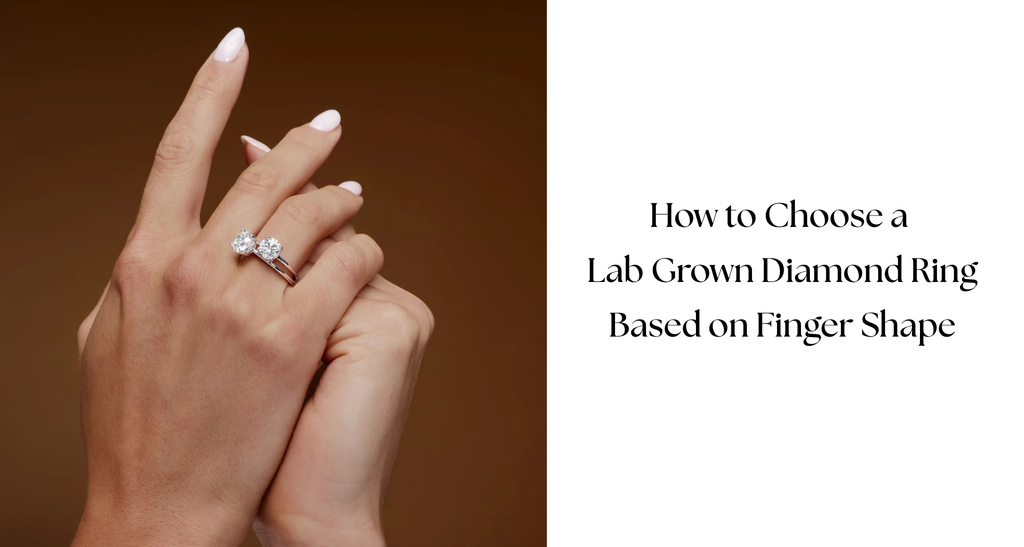
How to Choose a Lab Grown Diamond Ring Based on Finger Shape
A ring may look perfect in a close-up image but appear quite different when worn. The diamond size, cut, band width and setting all affect how the ring looks on your hand. This is why it helps to consider your finger type and size before choosing a lab grown diamond ring.
Finger type usually refers to the length and width of your fingers. Some people have short and slim fingers, while others may have long, broad or wider-knuckle fingers. There is no fixed rule saying that a certain finger type can wear only one kind of ring. However, choosing the right proportions can make the ring look more balanced and feel more comfortable.
This guide will help you understand which diamond shapes, bands and settings may suit different finger types.
First, Understand Your Finger Type
Before looking at ring designs, observe your fingers in a relaxed position.
Consider the following:
- Are your fingers short, medium or long?
- Are they slim or broad?
- Are your knuckles wider than the base of your fingers?
- Is your palm small, medium or broad?
You do not need exact measurements at this stage. These basic details are enough to understand which ring proportions may suit your hand.
For example, someone with short and broad fingers may prefer a ring that creates a longer visual line. Someone with long and slim fingers may prefer a wider setting that gives the ring more presence.
Your ring size is also important. Two people may have fingers of a similar length but different ring sizes. The same diamond may therefore look larger on one hand and smaller on the other.
Best Lab Grown Diamond Rings for Short Fingers
For shorter fingers, rings that create a vertical line usually look balanced. The aim is not to hide the finger type but to avoid a design that covers too much of the available space.
Choose Elongated Diamond Cuts
Oval, pear, marquise, emerald and elongated radiant-cut diamonds can make the finger appear longer.
An oval diamond is a practical choice because it has a stretched outline without sharp corners. It gives good finger coverage and works well in solitaire, halo and three-stone settings.
A pear-shaped diamond also creates length, especially when the pointed end faces towards the fingertip. The rounded base keeps the design soft, while the pointed top draws the eye upwards.
Marquise diamonds have pointed ends and a narrow centre. Their long shape can create a noticeable lengthening effect, even at a moderate carat weight.
Emerald and elongated radiant-cut diamonds have rectangular outlines. They suit buyers who prefer straight lines over rounded diamond shapes.
Consider a Slim or Tapered Band
A slim band leaves more visible space around the ring and can prevent the finger from looking crowded.
A tapered band is another suitable option. It becomes narrower near the centre diamond, which draws attention to the stone and creates a clean visual line.
Very broad bands may cover a large part of a short finger. However, a wider band can still work if the design has open spaces, a split shank or a low-profile centre setting.
Choose a Vertical Setting
For elongated diamonds, a north-south setting is generally suitable for short fingers. This means the diamond is placed vertically along the finger.
An east-west setting places the diamond horizontally. It gives the ring more width but may make the finger appear shorter.
Best Rings for Long Fingers
Long fingers can carry many different ring designs. Wider bands, larger settings and detailed arrangements often look well proportioned on this finger type.
Round, Cushion and Princess-Cut Diamonds
Round diamonds offer a balanced contrast to long fingers. Their even outline adds width without making the finger appear longer.
Cushion-cut diamonds also work well. Their fuller shape and rounded corners give the centre of the finger more presence.
Princess-cut diamonds have a square outline with sharp corners. They suit buyers who prefer a structured design and can look particularly balanced on long fingers.
Wider Bands Can Work Well
A very slim band may look understated on long fingers. A medium or wide band can make the ring feel more noticeable.
Long fingers can usually carry:
- Split-shank bands
- Double bands
- Multi-row diamond bands
- Twisted bands
- Wide solitaire bands
- Three-stone settings
A ring with side diamonds can also provide better coverage across the finger.
Try an East-West Setting
Long fingers are well suited to east-west settings. Oval, emerald, marquise and pear-shaped diamonds can be placed horizontally to add width.
This orientation changes the appearance of a familiar diamond cut and may suit buyers who want something different from a traditional vertical setting.
Best Rings for Slim Fingers
On slim fingers, the centre diamond may appear larger than expected because there is less width around it. This means you may not need a very high carat weight to create a noticeable look.
Choose a Balanced Diamond Size
Small and medium-sized centre diamonds often look proportionate on slim fingers.
Round, oval, pear and princess-cut diamonds are all suitable. An oval or pear shape can maintain the finger’s long appearance, while a round or square diamond can add some width.
An oversized diamond is still an option, but the ring should have a stable band and setting to prevent it from moving from side to side.
Use a Halo for More Coverage
A halo setting surrounds the centre diamond with smaller diamonds. It increases the overall visible size of the ring without requiring a much larger centre stone.
Round and cushion halos can add width to slim fingers. A double halo creates an even fuller appearance, although it may feel too large for buyers who prefer a lighter design.
Check Whether the Ring Rotates
Rings can rotate easily on slim fingers, especially when the centre setting is heavy.
A secure ring size, balanced setting and slightly wider lower band can reduce movement. A low-profile setting may also feel more comfortable than a tall, top-heavy ring.
Best Rings for Broad or Wide Fingers
Broad fingers often suit rings with good finger coverage. A very small solitaire on an extremely thin band may appear less prominent, even if the diamond itself is attractive.
This does not mean you must choose a very large diamond. The total width of the setting, halo and band also matters.
Choose Designs with Wider Coverage
Oval, cushion, emerald and radiant-cut diamonds can provide good coverage.
Three-stone rings are also suitable because the side diamonds spread the design across the finger. Halo, cluster and floral settings can create a similar effect.
A split-shank band adds width near the centre diamond while leaving some visible skin between the two sections. This can make the ring look substantial without appearing like one solid broad band.
Consider Medium-Width Bands
A medium-width band usually looks proportionate on broad fingers. An extremely thin band may make the finger appear wider by contrast.
Diamond bands, multi-row bands and slightly wider plain gold bands can also work well.
Comfort should still be considered. A very wide band may feel tight when you close your fingers, especially in warm weather when fingers can swell slightly.
Check Diamond Measurements, Not Only Carat Weight
Carat refers to the weight of the diamond, not its visible size.
Two diamonds with the same carat weight can have different length and width measurements. An oval or marquise diamond may appear larger from the top than a deeper round diamond of the same weight.
When buying a ring, check the millimetre measurements of the diamond along with the carat weight. This gives you a better idea of how much space the stone will cover on your finger.
Rings for Fingers with Wider Knuckles
Some people have knuckles that are wider than the base of their fingers. In this case, the ring must be large enough to pass over the knuckle but may feel loose once it reaches the base.
This can cause the ring to rotate, especially if the centre setting is heavy.
Choose a Stable Ring Design
Low-profile settings, medium-width bands and balanced side stones can help the ring stay in position.
A very thin band with a large centre diamond may move more easily. A slightly wider band provides better support.
Comfort-fit bands have rounded inner edges and may pass over the knuckle more easily than flat-edged bands.
Sizing beads or internal sizing bars can also be added in some rings. These help the ring fit more securely at the base without making it difficult to remove.
How Different Diamond Cuts Look on the Finger
The diamond cut can change the overall appearance of the ring and the finger.
Round Cut
Round diamonds have balanced proportions and suit almost every finger type. They can add width to slim or long fingers and remain a dependable choice for everyday rings.
Oval Cut
Oval diamonds offer good surface coverage and can make fingers appear longer. They work well on short, broad and medium-length fingers.
Pear Cut
Pear-shaped diamonds have one rounded end and one pointed end. When worn with the point towards the nail, they create a vertical line along the finger.
Marquise Cut
Marquise diamonds are long and narrow with pointed ends. They can make short fingers appear longer and often look larger than their carat weight suggests.
Emerald Cut
Emerald-cut diamonds have a rectangular outline with step-cut facets. Their long shape can create length, while their straight edges give the ring a clean appearance.
Cushion Cut
Cushion diamonds have a square or rectangular outline with rounded corners. Their fuller shape suits long, slim and medium-width fingers.
Princess Cut
Princess-cut diamonds have a square outline and sharp corners. They add width and structure, making them suitable for long and slim fingers.
Radiant Cut
Radiant-cut diamonds are available in square and elongated forms. A square radiant cut adds width, while an elongated radiant cut can make the finger appear longer.
Choose the Right Band Width
The band plays an important role in how the ring looks on the hand.
A slim band can make the centre diamond appear larger and may suit short or petite fingers. A medium-width band gives a balanced appearance and works well for regular wear.
A broad band provides more coverage and may suit long or wide fingers. However, the width should not make the ring uncomfortable.
Tapered bands become narrower near the diamond and draw attention towards the centre. Split-shank bands add width while keeping the design open. Twisted bands create movement but may look busy when paired with a highly detailed centre setting.
Consider the Height of the Setting
A high setting raises the diamond above the band and makes it more visible. It can also allow a wedding band to sit closely beside the ring.
However, high settings may catch on clothes, hair and bags. They may not be practical for people who regularly work with their hands.
A low-profile setting keeps the diamond closer to the finger. It may feel more secure and comfortable for daily wear.
Bezel and semi-bezel settings hold the diamond with a metal border and provide extra protection around the edges. These settings can be suitable for active routines.
Ring Size Affects the Final Look
A diamond does not look the same on every ring size.
For example, a one-carat oval diamond may cover a significant portion of a slim finger but appear more understated on a broad finger.
This is why hand images, videos and exact measurements are useful when shopping online. A close-up photograph may make the diamond appear larger than it will look in real life.
Check the following before buying:
- Diamond length and width
- Band width
- Setting height
- Total width of the halo or side stones
- Ring size shown in the model image
A video of the ring being worn can provide a more realistic idea of its proportions.
Think About Your Daily Routine
A ring should suit your hand as well as your lifestyle.
A high-set solitaire may look striking but may not be practical if you frequently use gloves, handle fabrics or work with your hands.
A low setting, bezel setting or smooth band may be easier to wear every day.
Also consider whether you plan to wear the ring alone or pair it with a wedding band. Some settings leave enough space for another band, while others create a visible gap.
Personal Preference Still Comes First
Finger type can help narrow down your options, but it should not become a strict rule.
You may have short fingers and still prefer a broad cocktail ring. You may have long fingers and feel most comfortable wearing a small solitaire. Both choices are valid.
The ring should match your personal taste, daily routine and comfort. Finger type is simply one factor that can help you understand how different designs may look on your hand.
Final Checklist Before Buying
Before choosing your lab grown diamond ring, check:
- Does the diamond cut suit the look you want?
- Is the ring proportionate to your finger length and width?
- Does the band feel too thin or too broad?
- Does the setting provide enough coverage?
- Is the diamond likely to sit securely?
- Will the ring rotate on your finger?
- Is the setting comfortable for daily wear?
- Have you checked the diamond measurements?
- Have you viewed the ring on a hand?
- Will it pair comfortably with another band?
Final Thoughts
Choosing a lab grown diamond ring based on your finger type and size is mainly about proportion and comfort.
Elongated diamonds can make short fingers appear longer. Round and square diamonds can add width to slim or long fingers. Wider settings and medium-width bands can provide better coverage on broad fingers.
The carat weight alone does not decide how the ring will look. Diamond measurements, band width, setting height and overall design are equally important.
Use these suggestions as a practical guide, but choose the ring that feels right when worn. A well-fitted ring that suits your style and routine will always feel more natural than one selected only by following a fixed rule.
-
Posted in
Lab grown diamond ring


