










 All Earrings
 Stud Earrings
 Drop Earrings
 Solitaire
 Hoop Earrings
 Halo Earrings
 Vermeil Earrings
 Round
Round
 Oval
Oval
 Emerald
 Pear
Pear
 Princess
 Heart
Heart
 Marquise
 All Rings
 Solitaire Rings
 Band Rings
 Halo Rings
 Cocktail Rings
 Eternity Rings
 Fashion Ring
 Stack Rings
 Men's Rings
 Vermeil Rings
 All Necklaces
 Necklet
 Mangalsutra
 Solitaire
 Tennis Necklace
 Statement Necklace
 Vermeil Necklace
 Alphabets
 Solitaire Pendant
 Halo Pendant
 Vermeil Pendants
 All Bracelets
 Solitaire Bracelet
 Tennis Bracelet
 Fashion Bracelet
 Mangalsutra
 Vermeil Bracelets
 All Vermeil
 Vermeil Earring
 Vermeil Pendant
 Vermeil Ring
 Vermeil Necklace
 Vermeil Mangalsutra
 Vermeil Bracelets
 Vermeil Bangles
 Vermeil Men’s
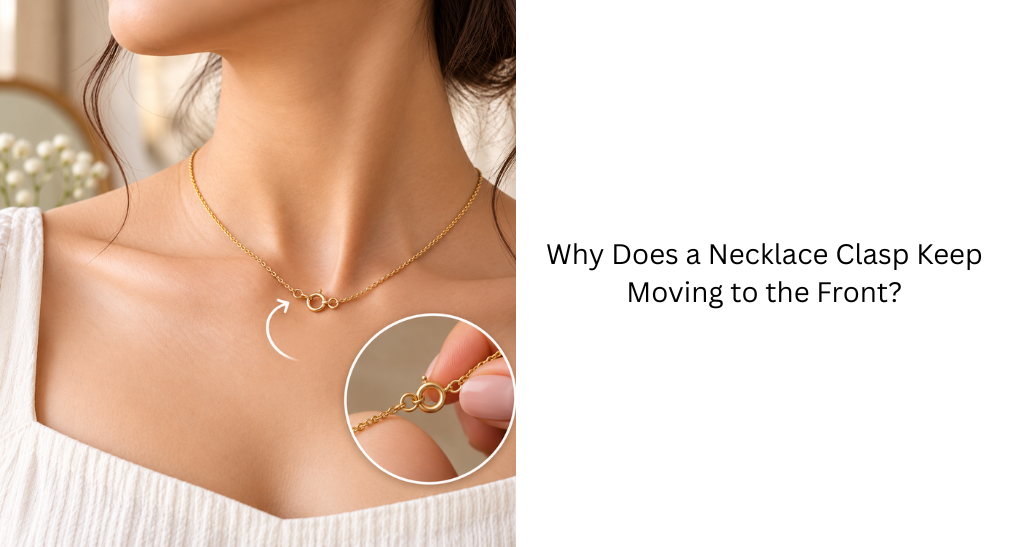
Why Does a Necklace Clasp Keep Moving to the Front? Causes and Solutions
You put on your necklace, fasten the clasp at the back of your neck, and get on with your day. A few hours later, the clasp is sitting near your collarbone. You move it back, but it keeps returning to the same position.
This can happen with delicate gold chains, diamond pendants and even necklaces that fit well. The frustrating part is that the clasp may not be faulty at all. In many cases, the necklace is simply moving as you wear it, and the way its different components interact determines where the clasp eventually settles.
To understand why this happens, it helps to look at the necklace as a complete piece rather than blaming the clasp alone.
What Actually Makes a Necklace Clasp Move Forward?

A necklace does not remain perfectly still around the neck. It shifts slightly when you walk, turn your head, move your shoulders or change clothes. These small movements can gradually rotate the chain.
The clasp moves with the chain because it is attached to one end. Whether it stays at the back or travels towards the front depends on several factors, including the necklace's weight distribution, flexibility, fit and contact with clothing.
Here are the main reasons to investigate.
1. Your Pendant Is Pulling the Chain Downward

A pendant adds extra weight to the front of a necklace, pulling the chain down towards the chest. If the pendant is heavy and the chain is very fine, the weight difference may make the necklace more likely to shift as you move.
However, the pendant's weight is not the only factor. The chain's flexibility, the weight of the clasp and friction from your skin or clothing can also affect how the necklace sits.
For example, a fine chain paired with a large diamond pendant may shift more easily than a necklace where the chain and pendant are better suited to each other. As the chain moves around your neck, the clasp can gradually shift from the back towards the front.
What helps: Check whether the chain is appropriate for the pendant. A jeweller can assess the chain's strength and the overall balance of the necklace. If the pendant is too heavy for the chain, replacing the chain with a suitable design may improve both stability and security.
2. The Clasp Is Too Light for the Necklace's Design
It may seem logical to assume that a heavier clasp will always solve the problem, but that is not necessarily true.

A clasp is one component of the necklace, and its weight is only part of the equation. A very lightweight clasp attached to a flexible chain may move easily, particularly if the necklace has a pendant that pulls the front section downward. On the other hand, a larger clasp may still rotate if the chain moves freely around the neck.
The shape and construction of the clasp matter too. A bulky clasp can feel different against the skin, while a small clasp may be difficult to handle even when it works properly.
What helps: Ask a jeweller whether the clasp is suitable for the chain and pendant. In some cases, a different clasp or a purpose-designed clasp stabiliser may help. Adding weight without assessing the necklace first can create unnecessary strain or affect comfort.
3. The Chain's Construction Allows It to Rotate Easily
Two necklaces of the same length can behave differently because their chains are constructed differently.

A fine cable chain, for example, consists of connected links that move independently. Other chain styles have different link shapes, flexibility and contact points. These differences influence how the chain bends, twists and moves against the neck.
There is no universal rule that one chain style will keep its clasp at the back better than another. The outcome depends on the chain's dimensions, construction, weight and the jewellery attached to it.
A chain that twists easily may also make the clasp appear to move, even when the clasp itself is functioning normally.
What helps: Observe whether the chain is rotating, twisting or simply sliding around your neck. If it repeatedly twists in the same place, have the chain inspected for kinks, damaged links or construction issues. When purchasing a replacement chain, consider its flexibility and compatibility with the pendant rather than choosing by appearance alone.
4. Your Clothes May Be Pulling the Necklace Out of Position
Sometimes the cause has more to do with what you are wearing than with the necklace itself.

A high neckline, a scarf, loose hair or a textured fabric can catch the chain and pull it as you move. Even repeated contact between the necklace and a collar can gradually change its position.
This is particularly relevant if the clasp stays at the back when you wear a low neckline but moves forward when you wear a shirt, sweater or kurta with a higher collar.
What helps: Notice when the movement occurs. If it happens mainly with particular outfits, clothing friction may be the main contributor. Put necklaces on after changing clothes, and take care when pulling garments over your head. Avoid tugging the chain to reposition it, as this can place unnecessary strain on delicate links.
5. The Necklace Length Is Affecting How It Sits
A necklace that sits loosely has more room to move around the neck.

A longer chain may travel more freely, although length alone does not determine whether the clasp will rotate.
A shorter necklace is not automatically more stable either. If it fits too tightly, it may feel uncomfortable and experience additional tension during movement.
The aim is to find a length that works with your neckline, pendant and intended use. If you are choosing a chain for a pendant, the pendant's size and the position at which you want it to sit should also influence your choice.
What helps: If your necklace has an adjustable fastening, try another position and observe whether the movement changes. If the chain is fixed in length, a jeweller can advise whether an alteration is practical. Avoid shortening it solely to stop the clasp from moving without first identifying the cause.
Which Solutions Are Worth Trying?
The most useful solution depends on what is causing the movement.
-
If the pendant is pulling the chain: Check that the chain is strong enough and suitably matched to the pendant.
-
If the clasp seems disproportionately light: Ask a jeweller whether a different clasp or a compatible stabiliser could help.
-
If the chain twists or catches: Check for kinks, damaged links and friction from clothing.
-
If the necklace moves because of its fit: Try an alternative fastening position or seek professional advice about adjusting the length.
-
If the clasp has become loose or damaged: Have it repaired before continuing to wear the necklace.
A necklace clasp stabiliser is not a guaranteed fix. Some designs use additional weight to help keep the clasp near the back, but results vary according to the necklace's construction and fit. Choose an accessory made for your type of chain rather than attaching an improvised weight to a delicate necklace.
When the Clasp Movement Needs Professional Attention
Occasional movement is not necessarily a sign of poor-quality jewellery. However, if the necklace has suddenly started rotating more than it used to, inspect it for changes.
Look for bent connecting rings, loose links, a damaged clasp or areas where the chain no longer bends naturally. These issues can affect how the necklace hangs and may compromise its security.
A jeweller can check whether the problem comes from the clasp, chain construction, pendant weight or overall fit. This is particularly important for fine gold chains and diamond pendants, where an unsuitable adjustment could damage the jewellery.
Avoid adding a heavier clasp, bending connecting rings or modifying the chain yourself. A change that appears small can affect the way delicate components bear weight.
Final Thoughts
When a necklace clasp keeps moving to the front, the clasp itself may not be the problem. The movement can result from the interaction between the pendant, chain, clasp, fit and clothing.
Pay attention to when the clasp shifts and whether the necklace twists, catches on fabric or moves even when you are standing still. These details can help identify the likely cause instead of relying on trial and error.
If the movement continues, have the necklace assessed before making changes. A suitable adjustment should address the reason the chain rotates while preserving the necklace's comfort, appearance and security.


