




 All Earrings
 Stud Earrings
 Drop Earrings
 Solitaire
 Hoop Earrings
 Halo Earrings
 Vermeil Earrings
 Round
Round
 Oval
Oval
 Emerald
 Pear
Pear
 Princess
 Heart
Heart
 Marquise
 All Rings
 Solitaire Rings
 Band Rings
 Halo Rings
 Cocktail Rings
 Eternity Rings
 Fashion Ring
 Stack Rings
 Men's Rings
 Vermeil Rings
 All Necklaces
 Necklet
 Mangalsutra
 Solitaire
 Tennis Necklace
 Statement Necklace
 Vermeil Necklace
 Alphabets
 Solitaire Pendant
 Halo Pendant
 Vermeil Pendants
 All Bracelets
 Solitaire Bracelet
 Tennis Bracelet
 Fashion Bracelet
 Mangalsutra
 Vermeil Bracelets
 All Vermeil
 Vermeil Earring
 Vermeil Pendant
 Vermeil Ring
 Vermeil Necklace
 Vermeil Mangalsutra
 Vermeil Bracelets
 Vermeil Bangles
 Vermeil Men’s
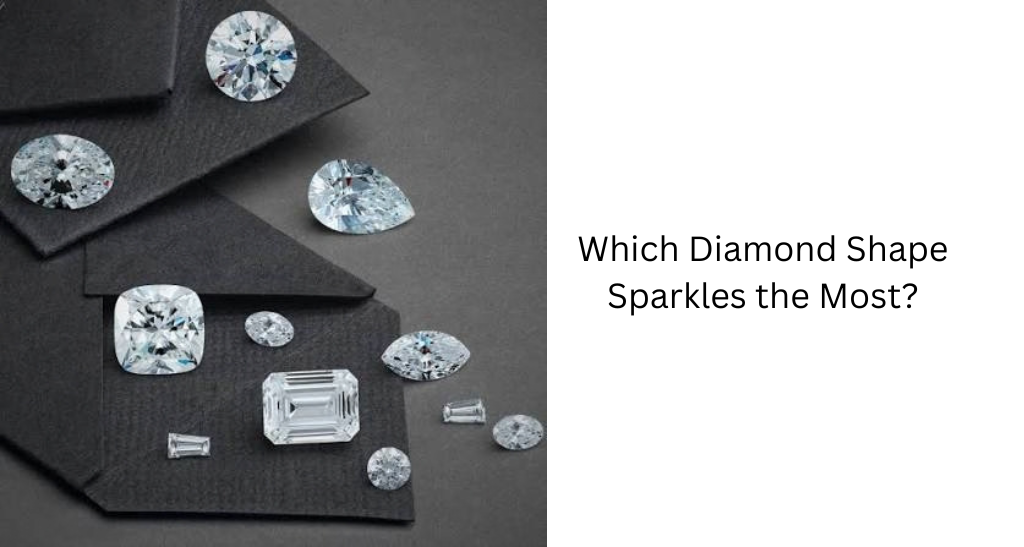
Which Diamond Shape Sparkles the Most?
If sparkle is your priority, the diamond shape matters, but it is not the only thing that determines how bright a diamond looks.
Two diamonds of the same shape and carat weight can have very different levels of sparkle. The reason is that cut quality, proportions, symmetry, polish, and how the diamond interacts with light all affect its appearance. So, which diamond shape sparkles the most?
Round Brilliant Usually Has the Most Sparkle
Among the common diamond shapes, the Round Brilliant is generally known for producing strong brilliance and fire.
It has 58 facets arranged specifically to help reflect light back through the top of the diamond. Its proportions and facet arrangement have also been extensively studied and refined for light performance.
This is why a well-cut round diamond can appear bright and lively across different lighting conditions.
But there is an important point: not every round diamond will sparkle more than every fancy-shaped diamond.
A poorly cut round diamond can look less lively than a well-cut oval, cushion, or other fancy shape.
Why Does a Diamond Sparkle?
Diamond sparkle is not just one thing. It comes from the way light behaves inside the stone.
Brilliance
Brilliance is the amount of white light returned from the diamond. A diamond with strong light return can look bright even when viewed from a distance.
Fire
Fire refers to flashes of colour, such as small red, blue, or yellow flashes, created when white light is dispersed inside the diamond.
Scintillation
Scintillation is the flashes of light you see when either the diamond or the viewer moves.
A diamond that looks constantly bright but does not produce much movement or contrast may appear different from one that gives strong flashes as it moves.
How Different Diamond Shapes Compare
Different shapes interact with light in different ways. Here is what you can generally expect.
| Diamond Shape | Typical Sparkle Character | What Stands Out |
|---|---|---|
| Round Brilliant | Very high brilliance and scintillation | Strong overall sparkle |
| Oval | High brilliance with broad flashes | Larger-looking appearance |
| Pear | Good brilliance with a mix of flashes | Distinctive shape |
| Marquise | Good brilliance with elongated flashes | Long, narrow appearance |
| Cushion | Good brilliance, depending on facet pattern | Softer, broader flashes |
| Radiant | Strong brilliance and lively sparkle | Combination of straight edges and brilliant facets |
| Princess | Good brilliance with sharp flashes | Geometric appearance |
| Emerald | Lower brilliance, stronger broad reflections | Clean, mirror-like flashes |
| Asscher | Lower brilliance with distinct step flashes | Deep, geometric appearance |
These are general characteristics, not a fixed ranking. The actual diamond can look very different depending on its cut and proportions.
Why Emerald Cut Does Not Sparkle Like a Round
The difference becomes especially clear when comparing a Round Brilliant with an Emerald Cut.
Round Brilliant diamonds use many triangular and kite-shaped facets designed to create repeated flashes of light.
Emerald Cut diamonds use step-cut facets. These are larger, elongated facets that create broad flashes rather than lots of small sparkles.
An Emerald Cut can still look bright and beautiful, but its appeal is usually more about clarity, clean reflections, and flashes of light than maximum sparkle.
This is why choosing a diamond based only on the word “sparkle” can be misleading. You also need to consider what kind of light pattern you actually like.
What About Oval, Pear and Marquise Diamonds?
These shapes are known as fancy shapes and can offer plenty of sparkle when they are well cut.
However, they have an additional consideration: light distribution across the stone.
For example, some elongated diamonds can show a darker area through the centre, sometimes called a bow-tie effect. A slight bow-tie can be normal, but a strong one can make the centre of the diamond look noticeably darker.
When buying an oval, pear, or marquise diamond, do not judge it only from a product photograph. Look at the diamond in different lighting and angles if possible.
Cut Quality Can Matter More Than Shape
This is one of the most important things to remember.
Suppose you are comparing:
Diamond A: Round Brilliant with average light performance
Diamond B: Oval with strong light performance
The oval can easily appear brighter or more lively even though round diamonds are generally associated with higher sparkle.
For round diamonds, you can usually find more standardised cut information. Fancy shapes are more complex because there is no single set of proportions that works equally well for every shape.
For this reason, when comparing fancy-shaped diamonds, pay close attention to:
-
Overall proportions
-
Symmetry
-
Polish
-
Facet pattern
-
Light performance
-
Any visible dark areas
-
How the diamond looks when it moves
Does More Facets Mean More Sparkle?
Not necessarily. It is easy to assume that adding more facets automatically creates more sparkle. In reality, facet arrangement and proportions matter just as much.
The facets need to interact with incoming light in a way that produces good brightness and contrast.
A diamond can have many facets and still look dull if its proportions are not working well.
How to Check Sparkle Before Buying
Do not judge a diamond only from a highly edited product photograph.
If you can see the diamond in person, try this:
1. Move the diamond
Tilt it slowly from side to side. Look for flashes that appear and disappear as the diamond moves.
2. View it under different lighting
Check it under bright indoor lighting as well as softer, normal lighting. A diamond that only looks impressive under strong jewellery-store lights deserves a closer look.
3. Look at it from different angles
Do not examine only the face-up view. Check the diamond slightly from the side and at different angles.
4. Look for dark areas
Some contrast is necessary for a diamond to show scintillation. But large areas that remain dark can affect how lively the diamond looks.
5. Compare diamonds of the same shape
This is one of the easiest ways to notice differences in cut quality. If possible, compare two diamonds with similar carat weight, colour, and clarity but different proportions or cut quality.
So, Which Shape Should You Choose?
If your only goal is maximum overall sparkle, a well-cut Round Brilliant is a strong choice.
But if you want sparkle along with a particular look, other shapes may make more sense.
- Choose an Oval if you like an elongated shape with strong brilliance.
- Choose a Radiant if you want a modern shape with plenty of sparkle.
- Choose a Cushion if you prefer softer edges and broader flashes.
- Choose a Emerald Cut if you prefer large, clean reflections over intense sparkle.
- Choose a Pear or Marquise if you want an elongated, distinctive shape with good light return.
The important thing is not to ask only “Which diamond shape sparkles the most?”
A better question is:
“Which diamond gives the type of sparkle I like, while also having good light performance?”
That approach helps you compare diamonds based on what you will actually see, rather than choosing a shape simply because it is known for being sparkly.


