




 All Earrings
 Stud Earrings
 Drop Earrings
 Solitaire
 Hoop Earrings
 Halo Earrings
 Vermeil Earrings
 Round
Round
 Oval
Oval
 Emerald
 Pear
Pear
 Princess
 Heart
Heart
 Marquise
 All Rings
 Solitaire Rings
 Band Rings
 Halo Rings
 Cocktail Rings
 Eternity Rings
 Fashion Ring
 Stack Rings
 Men's Rings
 Vermeil Rings
 All Necklaces
 Necklet
 Mangalsutra
 Solitaire
 Tennis Necklace
 Statement Necklace
 Vermeil Necklace
 Alphabets
 Solitaire Pendant
 Halo Pendant
 Vermeil Pendants
 All Bracelets
 Solitaire Bracelet
 Tennis Bracelet
 Fashion Bracelet
 Mangalsutra
 Vermeil Bracelets
 All Vermeil
 Vermeil Earring
 Vermeil Pendant
 Vermeil Ring
 Vermeil Necklace
 Vermeil Mangalsutra
 Vermeil Bracelets
 Vermeil Bangles
 Vermeil Men’s
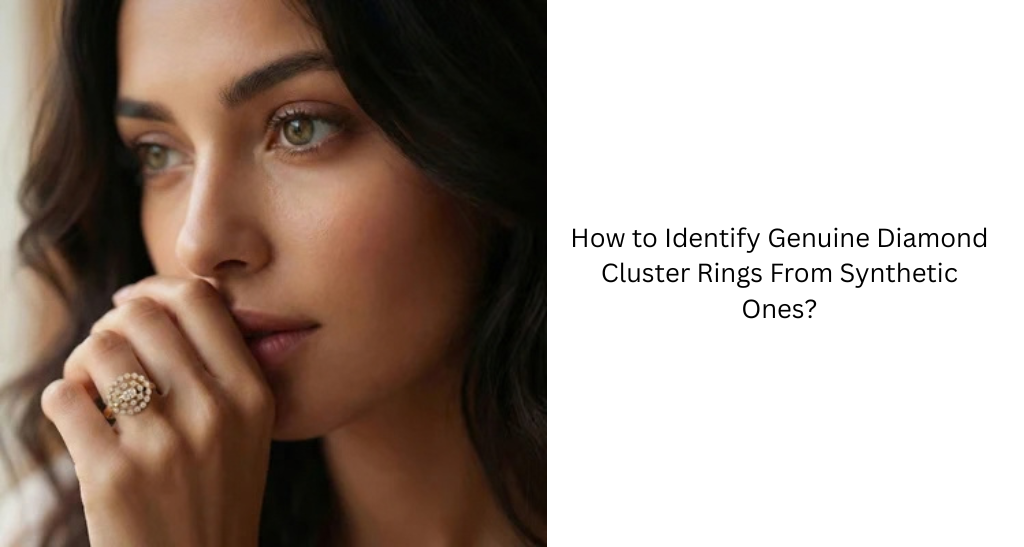
How to Identify Genuine Diamond Cluster Rings From Synthetic Ones?
A diamond cluster ring can contain 10, 20 or even more small stones, arranged closely to create the appearance of a larger centre. Because of this setting, it can be difficult to judge the stones individually.
A cluster ring can also use different types of stones. These may include natural diamonds, lab grown diamonds, cubic zirconia (CZ), moissanite or other diamond simulants.
There is one important distinction to understand first: lab grown diamonds are genuine diamonds. They are different from natural diamonds in origin, but they are not imitation stones. CZ and other simulants, on the other hand, are not diamonds.
So, how do you check what is actually used in a diamond cluster ring?
1. Don't Judge the Ring by Its Sparkle
The first mistake buyers make is judging a diamond by how much it sparkles.
A cluster ring can look very bright simply because multiple stones are positioned close together. The setting can make the entire ring appear larger and more brilliant.
But sparkle does not tell you whether the stones are:
-
Natural diamonds
-
Lab grown diamonds
-
Moissanite
-
Cubic zirconia
-
Another imitation material
Cut quality also affects how much light a stone reflects. A well-cut lab grown diamond can look just as lively as a natural diamond.
So, appearance can tell you how the ring looks, but not what the stones are made of.
2. Check What "Diamond" Means on the Product
Don't stop at a product name such as "diamond cluster ring."
Look at the detailed specifications.
A genuine diamond cluster ring should clearly state whether the diamonds are natural or lab grown. If the product uses another material, it should be identified separately.
For example:
| Description | What it means |
|---|---|
| Natural diamond | Diamond formed naturally in the Earth |
| Lab grown diamond | Real diamond created in a laboratory |
| Moissanite | Diamond simulant, not a diamond |
| Cubic zirconia | Diamond simulant, not a diamond |
| Glass/crystal | Imitation material, not a diamond |
This distinction matters because "lab grown" and "fake" are not the same thing.
3. Check the Carat Weight Carefully
This is one of the most useful checks for a cluster ring.
Suppose you see:
Diamond weight: 1.00 carat
It does not necessarily mean that the ring has one 1-carat centre diamond.
It could be:
-
Centre diamond: 0.30 ct
-
Surrounding diamonds: 0.70 ct
-
Total diamond weight: 1.00 ct
The ring therefore contains 1 carat of diamonds in total, spread across several stones.
This is called total diamond weight (TDW).
Before comparing two cluster rings, check whether the advertised carat weight refers to:
-
The centre stone
-
Total diamond weight
-
Or another measurement
This prevents you from comparing a 1-carat solitaire with a cluster ring containing 1 carat spread across many smaller stones.
4. Look at the Number and Size of the Stones
A cluster ring's appearance depends heavily on the number and size of its diamonds.
For example:
Ring A: 1 × 0.50 ct centre diamond + 10 smaller diamonds
Ring B: 15 smaller diamonds with a combined weight of 0.50 ct
Both may have similar total carat weight, but they will not look the same.
The number of stones also matters because very small diamonds may contribute to the total carat weight without creating the same visual presence as a larger centre stone.
When comparing cluster rings, therefore, look beyond the total carat number.
5. Know the Difference Between a Diamond and a Simulant
This is particularly important when a ring is described as a "diamond look" or "diamond alternative."
- Cubic zirconia (CZ) is not diamond. It is a different material manufactured to resemble diamond.
- Moissanite is also not diamond. It is a separate gemstone with its own optical and physical properties.
- A lab grown diamond, however, is a diamond. It has essentially the same chemical composition and crystal structure as a natural diamond.
So if your requirement is a genuine diamond cluster ring, the relevant question is not simply:
"Is it synthetic?"
Instead ask:
"Are these natural diamonds, lab grown diamonds, or diamond simulants?"
That gives you a much more accurate answer.
6. Check the Grading Report for Certified Diamonds
For a certified diamond, the grading report provides important information about the stone.
Depending on the report, you may find details such as:
-
Diamond origin
-
Carat weight
-
Colour
-
Clarity
-
Cut
-
Measurements
-
Report number
For a cluster ring, however, check which diamond the report belongs to.
If the ring has a certified centre diamond and several small surrounding stones, the report for the centre stone does not automatically mean every surrounding stone has an individual grading report.
This is especially important when the ring's value is based on a large number of smaller diamonds.
7. Check the Laser Inscription Where Applicable
Some certified diamonds have a microscopic laser inscription on the girdle.
The inscription may contain the report number and, depending on the grading laboratory, information identifying the diamond as laboratory grown.
You normally cannot see it with your eyes. A microscope or suitable magnification is required.
If a certified diamond has an inscription, the number can be compared with the grading report.
For a cluster ring, this is most useful when checking a larger certified stone, such as the centre diamond.
8. Don't Rely on DIY Diamond Tests
You may come across tests such as:
-
Fog test
-
Water test
-
Scratch test
-
Newspaper test
-
Checking how quickly the stone reflects light
These are not reliable ways to determine whether a stone is a natural diamond, lab grown diamond or simulant.
A basic diamond tester can also have limitations. Some tests can help identify materials with diamond-like properties, but they do not necessarily establish whether a genuine diamond is natural or laboratory grown.
For an expensive cluster ring, proper documentation and professional gemological testing are more useful than home experiments.
9. Compare the Ring's Details Before You Pay
Before purchasing, look at the product specifications and make sure you understand what each number represents.
For example, don't just note:
1.00 ct diamond cluster ring
Instead, check:
Centre stone: 0.35 ct
Total diamond weight: 1.00 ct
Number of stones: 13
Diamond type: Lab grown
Colour/clarity: As specified
Metal: 18K gold
Now you have a much clearer picture of what you are buying.
The same approach works when comparing two cluster rings. A higher total carat weight does not automatically mean that one ring has a larger centre stone or will look larger.
10. What You Can Actually Check Yourself
You don't need specialised equipment to do the first level of checking.
Before buying, you can verify:
- Product description: Does it clearly state natural or lab grown diamonds?
- Stone type: Are CZ, moissanite or other simulants mentioned?
- Carat weight: Is it centre stone weight or total diamond weight?
- Number of stones: How many diamonds make up the cluster?
- Certificate: Is there a grading report for the relevant certified stone?
- Report details: Do the report number and stone measurements correspond to the diamond?
- Invoice: Does the final bill clearly describe the stones?
If something important is missing, get clarification before making the purchase.
Natural Diamond, Lab Grown Diamond or Simulant?
| Type | Is it a genuine diamond? | How it is formed |
|---|---|---|
| Natural diamond | Yes | Formed naturally in the Earth |
| Lab grown diamond | Yes | Grown in a controlled laboratory environment |
| Moissanite | No | Different gemstone used as a diamond alternative |
| Cubic zirconia | No | Manufactured diamond simulant |
| Glass/crystal | No | Imitation material |
Quick Checklist for Buying a Diamond Cluster Ring
Before buying, check:
☐ Diamond type: Natural or lab grown?
☐ All stones: Are all the stones diamonds?
☐ Simulants: Is any CZ, moissanite or other alternative used?
☐ Centre stone: What is its individual carat weight?
☐ Total diamond weight: What is the combined weight of all diamonds?
☐ Stone count: How many diamonds are used?
☐ Quality: What colour and clarity information is provided?
☐ Certification: Is the relevant diamond certified?
☐ Inscription: If applicable, does the laser inscription match the report?
☐ Invoice: Does it clearly state what stones are included?
Final Takeaway
Identifying a genuine diamond cluster ring is not about finding the ring with the most sparkle. It is about understanding what stones are being used and how their weight and quality are being described.
The most important distinction is simple: natural diamonds and lab grown diamonds are both genuine diamonds, while CZ, glass and other simulants are not.
For a cluster ring, pay particular attention to total diamond weight versus centre stone weight, the number of stones, the type of stones used and the documentation provided for certified diamonds.
That gives you a much clearer idea of what you are actually buying, rather than judging the ring only by how large or sparkly it looks.


