




 All Earrings
 Stud Earrings
 Drop Earrings
 Solitaire
 Hoop Earrings
 Halo Earrings
 Vermeil Earrings
 Round
 Oval
 Emerald
 Pear
 Princess
 Heart
 Marquise
 All Rings
 Solitaire Rings
 Band Rings
 Halo Rings
 Cocktail Rings
 Eternity Rings
 Fashion Ring
 Stack Rings
 Men's Rings
 Vermeil Rings
 All Necklaces
 Necklet
 Mangalsutra
 Solitaire
 Tennis Necklace
 Statement Necklace
 Vermeil Necklace
 Alphabets
 Solitaire Pendant
 Halo Pendant
 Vermeil Pendants
 All Bracelets
 Solitaire Bracelet
 Tennis Bracelet
 Fashion Bracelet
 Mangalsutra
 Vermeil Bracelets
 All Vermeil
 Vermeil Earring
 Vermeil Pendant
 Vermeil Ring
 Vermeil Necklace
 Vermeil Mangalsutra
 Vermeil Bracelets
 Vermeil Bangles
 Vermeil Men’s
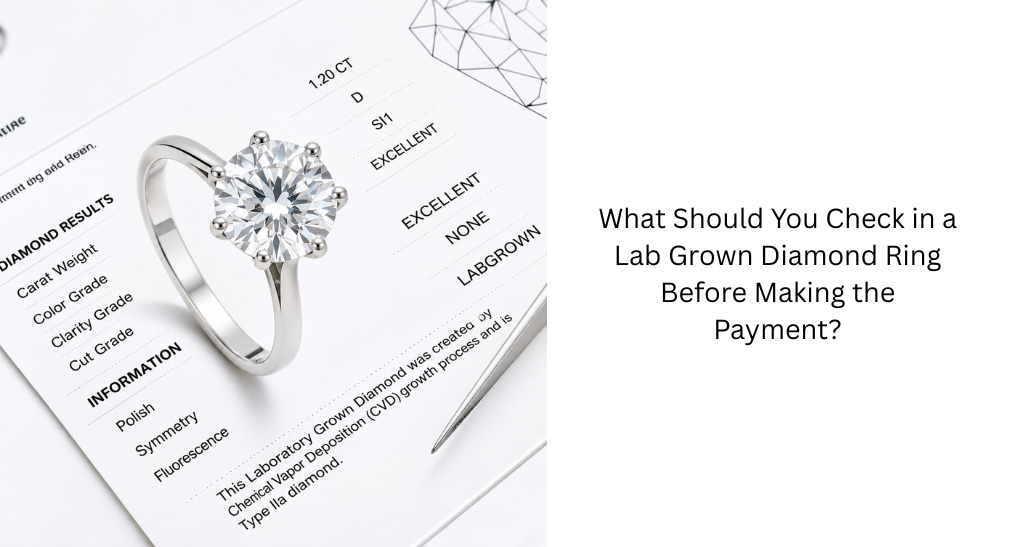
What Should You Check in a Lab Grown Diamond Ring Before Making the Payment?
Buying a lab grown diamond ring is an exciting decision, whether you are choosing it for an engagement, a special occasion or everyday wear. But before making the payment, it is important to understand a few details about the diamond, gold setting and overall quality of the ring.
A diamond may look beautiful in product photographs or under jewellery store lighting, but there are several things you should check before buying it. From diamond certification and the 4Cs to gold purity, ring size and pricing, these details can help you make a better purchase.
If you are planning to buy a lab grown diamond ring, this buying guide covers eight important things to check before completing your order.
1. Check the Diamond Certification
One of the first things to check before buying a lab grown diamond ring is its certification. A grading report provides information about the diamond's quality and characteristics.
Look for a grading report from a recognised gemological laboratory, such as IGI (International Gemological Institute) or SGL (Solitaire Gemmological Laboratories).
The report generally includes:
- Diamond origin: Confirms whether the diamond is laboratory-grown.
- Carat weight: Shows the actual weight of the diamond.
- Colour grade: Indicates how colourless or tinted the diamond appears.
- Clarity grade: Shows the presence of internal inclusions and surface blemishes.
- Cut grade: Provides information about the diamond's cut quality, where applicable.
Do not just check whether the seller provides a certificate. Ask for the report number and verify it through the respective gemological laboratory's report verification facility.
Also, match the details on the report with the actual diamond. If the diamond has a laser inscription, check whether its inscription number matches the report. This is an important step when purchasing an IGI-certified lab grown diamond ring. You can also read our guide to 1 carat lab grown diamond ring prices in India to understand what goes into the final price.
2. Understand the 4Cs of the Diamond
The 4Cs are important when comparing different lab grown diamond rings. They help you understand why diamonds of similar carat weight can have different appearances and prices.
Carat
Carat refers to the weight of a diamond, not its physical size. For example, a 1-carat diamond weighs 0.20 grams.
Before purchasing, check the diamond's carat weight and whether the quoted weight refers to the centre stone or the total diamond weight of the ring.
Cut
Cut affects how well a diamond reflects light. A well-cut diamond can appear brighter because it allows light to enter and reflect through its facets.
Look at the diamond under normal lighting conditions instead of judging it only under bright showroom lights. Also, remember that standard cut grades are not available in the same way for every fancy diamond shape.
Colour
Diamond colour is generally graded from D to Z. D represents colourless diamonds, while lower grades may show increasing yellow or brown tones.
Compare different colour grades to understand which one offers the appearance you prefer.
Clarity
Clarity refers to the internal characteristics and surface blemishes of a diamond.
Grades such as VVS, VS and SI indicate different levels of clarity. A higher clarity grade does not always mean a visibly better-looking diamond. Compare the actual appearance before paying extra for a higher grade.
3. Check Whether the Diamond Is CVD or HPHT
Lab grown diamonds are produced using two main methods: Chemical Vapour Deposition (CVD) and High Pressure High Temperature (HPHT).
Both methods create real diamonds, but the growing conditions are different.
- CVD diamonds: These are grown inside a chamber using carbon-rich gases. Carbon gradually forms diamond layers on a diamond seed.
- HPHT diamonds: These are produced using high pressure and high temperature to recreate conditions similar to those under which natural diamonds form.
As a buyer, you should know which method was used, but do not choose a diamond based on the growing method alone. CVD does not automatically mean lower quality, and HPHT does not automatically mean better quality.
What matters more is the final diamond's cut, colour, clarity, carat weight and overall appearance. Always compare the grading reports and actual diamond quality before making a decision.
4. Verify the Gold Purity and Hallmark
A diamond ring is not just about the centre stone. The gold used in the setting also plays an important role in its quality and durability.
Before making the payment, check the gold purity mentioned in the product details.
Common gold options include:
- 9KT Gold: Contains 37.5% pure gold.
- 14KT Gold: Contains 58.5% pure gold.
- 18KT Gold: Contains 75% pure gold.
In India, look for BIS hallmarking on eligible gold jewellery. Check the BIS mark, purity grade and six-digit HUID number.
You can also verify the HUID using the BIS Care app. Open the app, select the HUID verification option and enter the number stamped on the jewellery. The displayed details should match the gold purity and other relevant hallmark information.
Also, confirm the gold weight separately from the diamond weight. This helps you understand the materials used in your ring and compare prices more accurately, especially when purchasing an 18KT gold lab grown diamond ring.
5. Inspect the Diamond Setting and Ring Finish
The diamond setting determines how securely the stone is held in place. Even a high-quality diamond needs a well-made setting to remain secure during regular use.
Some common settings include:
- Prong setting: Small metal claws hold the diamond in place and allow more light to enter.
- Bezel setting: A metal rim surrounds the diamond, offering additional protection.
- Halo setting: Smaller diamonds surround the centre stone to create a larger-looking design.
- Channel setting: Small diamonds are placed between metal walls, creating a smooth finish.
Check whether the diamond sits properly in the setting. Look for loose stones, uneven prongs, sharp edges or rough finishing.
If you are buying online, ask the brand for close-up product images or a video showing the ring from different angles. You can also check whether the ring has a smooth inner band and comfortable edges.
6. Confirm the Correct Ring Size
Ring size is something buyers often overlook, especially when purchasing online.
A ring that is too tight can feel uncomfortable, while a loose ring may slip off during everyday activities.
Before ordering, measure your finger using a proper ring sizer or get your size checked at a jewellery store.
Also, ask the seller whether resizing is available after purchase. Some designs, especially eternity bands and rings with diamonds set around the entire band, may be difficult to resize.
If the ring is intended as a surprise gift, check whether the brand offers an exchange or resizing option in case the size is incorrect.
7. Understand the Gold Cost and Making Charges
The price of a lab grown diamond ring depends on more than just the diamond. The gold used in the ring and the work involved in creating its design also contribute to the final cost.
Before making the payment, ask the jeweller for a clear price breakdown covering the following:
- Current Gold Rate: Check the gold rate applied on the day of purchase, based on the purity of gold used, such as 9KT, 14KT or 18KT.
- Gold Weight: Confirm the actual gold weight in grams, excluding the diamond weight.
- Diamond Cost: Check the total carat weight and price of the diamond used in the ring.
- Making Charges: Understand the additional cost of crafting the ring. These charges may vary depending on the design, detailing and craftsmanship.
- GST: Confirm the applicable tax and whether it is included in the final quotation.
For example, two rings with similar diamond weights may have different prices because one uses more gold or has a more detailed design.
Always ask for an itemised quotation before completing your purchase. Comparing the gold rate, weight and making charges can help you understand the final lab grown diamond ring price and avoid unexpected costs.
8. Check the Return, Exchange and Warranty Policies
After checking the ring's specifications, do not forget to read the brand's policies.
Before completing your order, understand:
- Whether the brand offers returns or only exchanges.
- How many days you have to request a return.
- Whether customised or made-to-order rings are eligible for returns.
- Whether resizing is available.
- What the warranty covers.
- Whether the brand provides cleaning and maintenance services.
Pay special attention to warranty coverage. For example, some brands may cover manufacturing defects or issues with the setting, while accidental damage, scratches, loss of the diamond or damage caused by improper use may be excluded.
Also, check whether the warranty covers loose stones and whether repairs are free or chargeable. Ask for the warranty terms in writing instead of relying only on verbal assurances.
These details are important because jewellery is a long-term purchase. Having clear policies can make the buying experience easier if you face any issues after delivery.
Final Thoughts
Buying a lab grown diamond ring requires more than choosing a design you like. You should understand the diamond's grading, gold purity, setting quality, ring size and complete pricing before making the payment.
Always ask questions if any product detail is unclear. A reliable jewellery brand should be able to explain the diamond specifications, share certification details and provide transparent pricing.
Taking a little time to check these things before purchasing can help you choose a ring that matches your expectations, budget and everyday needs.


