










 All Earrings
 Stud Earrings
 Drop Earrings
 Solitaire
 Hoop Earrings
 Halo Earrings
 Vermeil Earrings
 Round
 Oval
 Emerald
 Pear
 Princess
 Heart
 Marquise
 All Rings
 Solitaire Rings
 Band Rings
 Halo Rings
 Cocktail Rings
 Eternity Rings
 Fashion Ring
 Stack Rings
 Men's Rings
 Vermeil Rings
 All Necklaces
 Necklet
 Mangalsutra
 Solitaire
 Tennis Necklace
 Statement Necklace
 Vermeil Necklace
 Alphabets
 Solitaire Pendant
 Halo Pendant
 Vermeil Pendants
 All Bracelets
 Solitaire Bracelet
 Tennis Bracelet
 Fashion Bracelet
 Mangalsutra
 Vermeil Bracelets
 All Vermeil
 Vermeil Earring
 Vermeil Pendant
 Vermeil Ring
 Vermeil Necklace
 Vermeil Mangalsutra
 Vermeil Bracelets
 Vermeil Bangles
 Vermeil Men’s
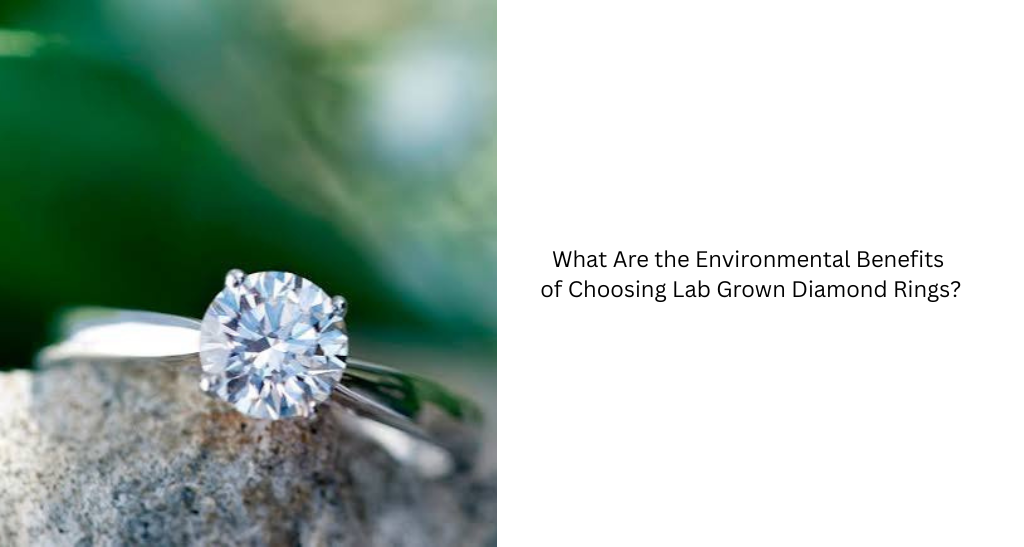
What Are the Environmental Benefits of Choosing Lab Grown Diamond Rings?
Diamonds have always been a popular choice for engagement rings, wedding jewellery and special occasions. However, the way diamonds are made and sourced has become an important part of the buying decision. Today, many buyers are looking beyond the appearance and price of a diamond. They also want to understand its impact on the environment.
This is one reason lab grown diamond rings are gaining attention. They offer the same appearance, chemical composition and physical properties as mined diamonds, but they are created in controlled laboratory conditions instead of being extracted from the earth.
While lab grown diamonds also require energy and resources to produce, they can offer some environmental advantages over traditional diamond mining. Understanding these benefits can help you make a more informed choice when buying a diamond ring.
1. Less Land Damage and Disturbance to Nature
One of the biggest environmental benefits of lab grown diamonds is that they do not require traditional diamond mining.
Mining natural diamonds often involves digging large open pits or creating underground mines. This can disturb large areas of land, remove vegetation and affect the natural habitats of animals and plants. The process can also change the surrounding landscape and damage local ecosystems.
Lab grown diamonds are produced inside specialised machines in factories. They do not require large mining sites or deep excavation to obtain the diamond itself.
This helps reduce land disturbance and avoids many of the environmental problems linked to diamond mining. It is an important advantage, especially in areas where mining can affect forests, wildlife and nearby communities.
2. Reduced Mining Waste
Diamond mining involves extracting large amounts of rock and soil to find small quantities of diamonds. Most of the material removed during this process does not contain usable diamonds and becomes mining waste.
This waste needs to be stored or managed properly. If it is not handled carefully, it can affect nearby land and water sources.
Lab grown diamond production does not involve removing large quantities of rock from the ground. Instead, diamonds are created using carbon-based materials inside controlled chambers.
As a result, the process avoids the large amounts of waste rock and mining leftovers associated with traditional diamond extraction. A 2024 research paper published in Humanities and Social Sciences Communications also discusses how wider use of lab grown diamonds could help reduce mineral waste from the diamond industry.
3. Lower Pressure on Water Resources
Water is an important resource in diamond mining. It is used for washing, separating and processing extracted materials. Large mining operations may also affect nearby water sources through changes in land and waste management.
Lab grown diamonds are made in factories, where water may be used for cooling equipment and other manufacturing activities. Some facilities also use systems that recycle and reuse water.
This can reduce the need for fresh water compared with certain mining operations. However, water consumption is not the same at every production facility. It depends on the machines, cooling systems and manufacturing methods being used.
For buyers who care about responsible resource use, choosing a producer that shares information about its water management practices is a sensible step.
4. Potentially Lower Carbon Emissions
Carbon emissions are another important factor when comparing mined and lab grown diamonds.
Mining requires heavy machinery, transportation, excavation and processing. These activities consume fuel and electricity, which contribute to greenhouse gas emissions.
Lab grown diamonds also need energy, particularly during the growing process. Two common methods are Chemical Vapour Deposition (CVD) and High Pressure High Temperature (HPHT). Both require specialised equipment and controlled conditions to grow diamonds.
The important difference is where the electricity comes from. A laboratory using solar, wind or other renewable energy can produce diamonds with a lower carbon footprint than one relying heavily on coal-based electricity.
This means lab grown diamonds are not automatically carbon-friendly. Their environmental impact depends on the energy source, manufacturing process and efficiency of the facility. The Gemological Institute of America (GIA) has also highlighted that there is no single answer to the environmental impact of lab grown diamond production because energy sources vary.
5. No Need for Traditional Diamond Extraction
Natural diamonds take millions or even billions of years to form deep inside the Earth. They become available for jewellery only after geological processes bring them closer to the surface, where mining can take place.
Lab grown diamonds offer another way to obtain a real diamond without waiting for natural geological formation or extracting it from a mine.
They are created using technology that recreates the conditions needed for diamond growth. The result has essentially the same chemical composition and crystal structure as a mined diamond.
For jewellery buyers, this means they can choose a genuine diamond ring without depending on traditional diamond extraction. It also gives the industry another way to meet demand for diamond jewellery while reducing its reliance on mining.
6. A More Responsible Choice for Modern Jewellery Buyers
Today's jewellery buyers are increasingly interested in knowing how their products are made. They want to understand the materials used, where they come from and how their production affects the environment.
Lab grown diamond rings offer an option for people who want the look and properties of a real diamond while considering the environmental impact of their purchase.
They are also available in different cuts, sizes and designs, including solitaire rings, halo rings, oval rings and everyday diamond bands. Buyers can explore different styles without having to compromise on the appearance of the diamond.
However, it is important to remember that the environmental impact of a finished ring also depends on its gold setting, packaging, transportation and manufacturing. Choosing responsibly sourced or recycled gold can help make the overall purchase more thoughtful.
How to Choose an Environmentally Responsible Lab Grown Diamond Ring
Choosing a lab grown diamond is a good starting point, but buyers should also pay attention to how the diamond and the complete ring are produced.
Here are a few things worth checking before making a purchase:
- Ask about energy sources: Check whether the manufacturer uses renewable energy, such as solar or wind power, during diamond production.
- Check diamond certification: Look for recognised grading reports that provide details about the diamond's quality and origin.
- Look at the gold used: Choose BIS-hallmarked gold and, where possible, ask whether recycled gold is available.
- Understand the manufacturing process: Brands that share clear information about their production practices make it easier for buyers to make informed decisions.
- Avoid unsupported claims: Do not assume every lab grown diamond is completely eco-friendly. Look for actual information about energy use, water consumption and waste management.
Final Thoughts
Lab grown diamond rings offer several environmental advantages, particularly when it comes to reducing land disturbance, mining waste and dependence on traditional diamond extraction. They can also have a lower carbon footprint when produced using renewable energy.
However, no diamond production method is completely free from environmental impact. The electricity used, materials involved and manufacturing practices all matter.
If you are planning to buy a diamond ring, lab grown diamonds are worth considering. They offer the beauty and physical properties of real diamonds while providing an alternative to traditional mining. By choosing a brand that follows responsible manufacturing practices, you can make a more informed jewellery purchase.


