




 All Earrings
 Stud Earrings
 Drop Earrings
 Solitaire
 Hoop Earrings
 Halo Earrings
 Vermeil Earrings
 Round
 Oval
 Emerald
 Pear
 Princess
 Heart
 Marquise
 All Rings
 Solitaire Rings
 Band Rings
 Halo Rings
 Cocktail Rings
 Eternity Rings
 Fashion Ring
 Stack Rings
 Men's Rings
 Vermeil Rings
 All Necklaces
 Necklet
 Mangalsutra
 Solitaire
 Tennis Necklace
 Statement Necklace
 Vermeil Necklace
 Alphabets
 Solitaire Pendant
 Halo Pendant
 Vermeil Pendants
 All Bracelets
 Solitaire Bracelet
 Tennis Bracelet
 Fashion Bracelet
 Mangalsutra
 Vermeil Bracelets
 All Vermeil
 Vermeil Earring
 Vermeil Pendant
 Vermeil Ring
 Vermeil Necklace
 Vermeil Mangalsutra
 Vermeil Bracelets
 Vermeil Bangles
 Vermeil Men’s
What Is the Bow-Tie Effect in Diamonds? Causes & Guide
When choosing a diamond, most buyers focus on its cut, clarity, colour and carat weight. However, there is another visual detail that can significantly influence how a diamond looks: the bow-tie effect.
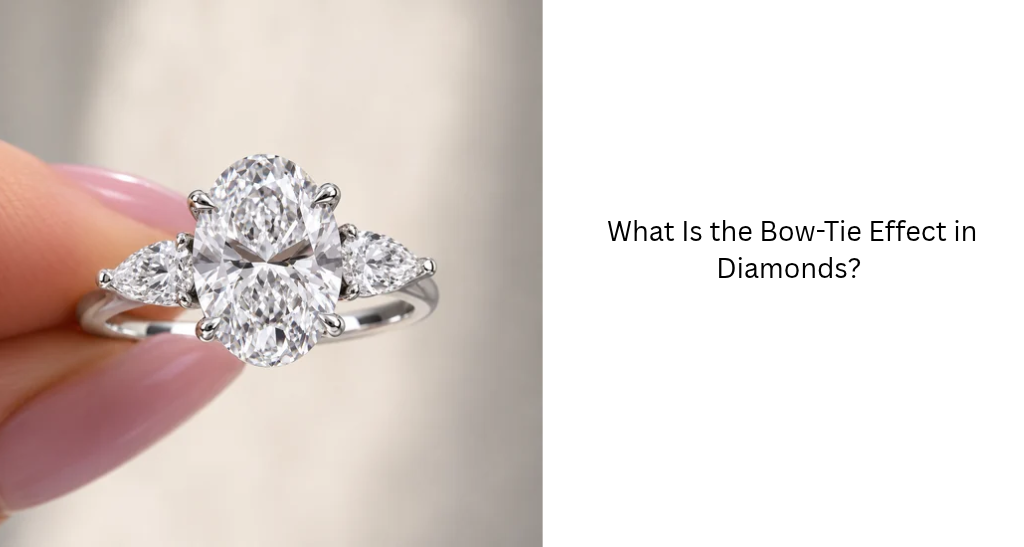
This phenomenon is commonly seen in fancy-shaped diamonds, particularly oval, pear, marquise and heart cuts. It appears as a dark, bow-shaped area across the centre of the diamond, resembling a small bow tie. While some degree of this effect is natural in elongated diamond shapes, its intensity can vary considerably depending on how the diamond is cut.
Understanding the bow-tie effect helps buyers look beyond a diamond's specifications and evaluate how it actually performs in light.
What Is the Bow-Tie Effect in a Diamond?

The bow-tie effect is a dark, symmetrical or sometimes uneven shadow that appears across the centre of certain diamond shapes. It is most noticeable when light enters the diamond and reflects through its facets.
Unlike a physical mark, inclusion or surface defect, the bow-tie effect is related to the diamond's optical performance. It occurs when the internal facets do not reflect light evenly towards the viewer. Instead, certain areas return less light, creating a dark pattern that resembles a bow tie.
The effect is particularly associated with oval, pear and marquise diamonds because of their elongated outlines and facet arrangements.
It is important to understand that a bow tie is not automatically a sign of poor craftsmanship. Almost every elongated fancy-shaped diamond displays some degree of this pattern. The real difference lies in its visibility. A subtle bow tie may add contrast and dimension, whereas a prominent, dark one can make the centre of the diamond appear less lively.
Why Does the Bow-Tie Effect Occur?
The bow-tie effect is primarily caused by the interaction between a diamond's facet arrangement, proportions and the direction of incoming light.
Here are the main factors that influence its appearance:
1. Light Leakage and Uneven Light Return

A diamond's sparkle depends on how effectively its facets reflect and return light to the viewer. When light does not return evenly from the central region, certain areas appear darker.
In elongated shapes, the angle and arrangement of the pavilion facets can create zones where light is reflected away from the viewer rather than towards them. This produces the characteristic dark pattern across the centre.
2. Diamond Proportions

Length-to-width ratio, table size, crown height and pavilion depth all influence how a diamond handles light.
For example, an oval diamond with a very elongated outline may display a more noticeable bow tie if its proportions and facet arrangement are not well balanced.
However, there is no single ideal proportion that guarantees a bow-tie-free diamond. Two diamonds with similar measurements can show noticeably different optical performance.
3. Facet Arrangement and Cutting Precision

The way a diamond is faceted plays an important role in its appearance. Small differences in facet angles, symmetry and pavilion geometry can affect how light travels through the stone.
This is why two oval diamonds of the same carat weight and similar dimensions may look completely different when viewed in natural light.
Which Diamond Shapes Show the Bow-Tie Effect?
Although the effect can occur in several fancy shapes, it is more commonly associated with elongated cuts.

Oval Cut Diamonds
Oval diamonds are among the most familiar examples. A dark bow-shaped pattern can extend across the centre, sometimes becoming particularly noticeable under direct lighting or when the diamond is viewed face-up.
Pear Cut Diamonds
Pear-shaped diamonds combine a rounded end with a pointed tip. Their asymmetrical outline can create an uneven bow-tie pattern, depending on the facet arrangement and cutting quality.
Marquise Cut Diamonds
The elongated structure and pointed ends of marquise diamonds make them particularly susceptible to visible central shadowing. The bow tie may appear wider or more pronounced depending on the stone's proportions.
Heart-Shaped Diamonds
Heart-shaped diamonds can also display a bow-tie pattern across their central region. Its visibility depends on the overall symmetry and how the facets interact with incoming light.
Is the Bow-Tie Effect Bad in a Diamond?
Not necessarily. The presence of a bow tie does not automatically mean that a diamond is poorly cut or unsuitable for purchase.
In fact, some degree of contrast is important for creating visual depth. A diamond that reflects light uniformly without any contrast may appear flat under certain lighting conditions.
The concern arises when the central shadow becomes too dark, broad or persistent. A strong bow tie can reduce the brightness of the diamond's central area and make it appear less brilliant than expected.
The ideal choice is a diamond where the bow-tie pattern is subtle and does not overpower the overall sparkle.
How to Identify the Bow-Tie Effect Before Buying a Diamond
A grading report provides important information about a diamond's characteristics, but it may not fully communicate how noticeable its bow tie is. Buyers should examine the actual stone before making a decision.
Here are a few practical ways to evaluate it:
1. Examine the Diamond Face-Up
Look directly at the diamond from the top. Check whether a dark bow-shaped shadow is visible across the centre. Pay attention to its width, intensity and symmetry.
2. View It Under Different Lighting Conditions
Do not judge a diamond only under bright showroom spotlights. Examine it in diffused daylight, normal indoor lighting and other everyday environments. A prominent bow tie may become more noticeable when lighting conditions change.
3. Observe the Diamond While Moving It
Tilt the diamond slightly from side to side. Watch how the central dark area changes. A well-performing diamond should show lively flashes of light rather than retaining a large, consistently dark patch.
4. Compare Similar Diamonds
If you are choosing between two oval or pear-shaped diamonds, compare them side by side. Even when their carat weights, colours and clarity grades are similar, their light performance may differ significantly.
5. Request a High-Quality Video
Ask the jeweller for a face-up video showing the diamond rotating under neutral lighting. This gives a better understanding of its optical performance than a single product photograph.
Can the Bow-Tie Effect Be Removed?
The bow-tie effect cannot be removed through cleaning, polishing or routine jewellery maintenance because it originates from the diamond's internal facet geometry.
It may be possible to reduce its visibility through recutting, but this involves reshaping the diamond and can result in a loss of carat weight. Recutting is also not guaranteed to eliminate the effect completely.
For this reason, selecting a well-cut diamond from the beginning is generally the better approach.
Final Thoughts
The bow-tie effect is an important visual characteristic to understand when purchasing fancy-shaped diamonds. While it is a natural feature of many oval, pear, marquise and heart cuts, its intensity can make a noticeable difference to the diamond's overall appearance.
Rather than rejecting every diamond that displays a bow tie, focus on its visibility, light return and overall brilliance. A subtle pattern can contribute to the diamond's depth, while an overly dark one may affect its visual appeal.
Ultimately, a diamond should be evaluated not just by its grading report or carat weight, but by how beautifully it reflects light when viewed in person.


