




 All Earrings
 Stud Earrings
 Drop Earrings
 Solitaire
 Hoop Earrings
 Halo Earrings
 Vermeil Earrings
 Round
Round
 Oval
Oval
 Emerald
 Pear
Pear
 Princess
 Heart
Heart
 Marquise
 All Rings
 Solitaire Rings
 Band Rings
 Halo Rings
 Cocktail Rings
 Eternity Rings
 Fashion Ring
 Stack Rings
 Men's Rings
 Vermeil Rings
 All Necklaces
 Necklet
 Mangalsutra
 Solitaire
 Tennis Necklace
 Statement Necklace
 Vermeil Necklace
 Alphabets
 Solitaire Pendant
 Halo Pendant
 Vermeil Pendants
 All Bracelets
 Solitaire Bracelet
 Tennis Bracelet
 Fashion Bracelet
 Mangalsutra
 Vermeil Bracelets
 All Vermeil
 Vermeil Earring
 Vermeil Pendant
 Vermeil Ring
 Vermeil Necklace
 Vermeil Mangalsutra
 Vermeil Bracelets
 Vermeil Bangles
 Vermeil Men’s
Old Mine Cut vs Old European Cut Diamonds: What Is the Difference?
When people start looking at antique diamonds, two names come up again and again: old mine cut and old European cut. Both belong to an older period of diamond cutting, when stones were shaped mostly by hand and cutters worked more with instinct, tools, and the natural form of the rough diamond.
Because of this, these diamonds do not look like today’s modern round brilliant diamonds. Their sparkle is not sharp or machine-perfect. They have broader flashes of light, deeper proportions, visible culets, and small irregularities that give each stone its own character. Still, old mine cut and old European cut diamonds are not the same.
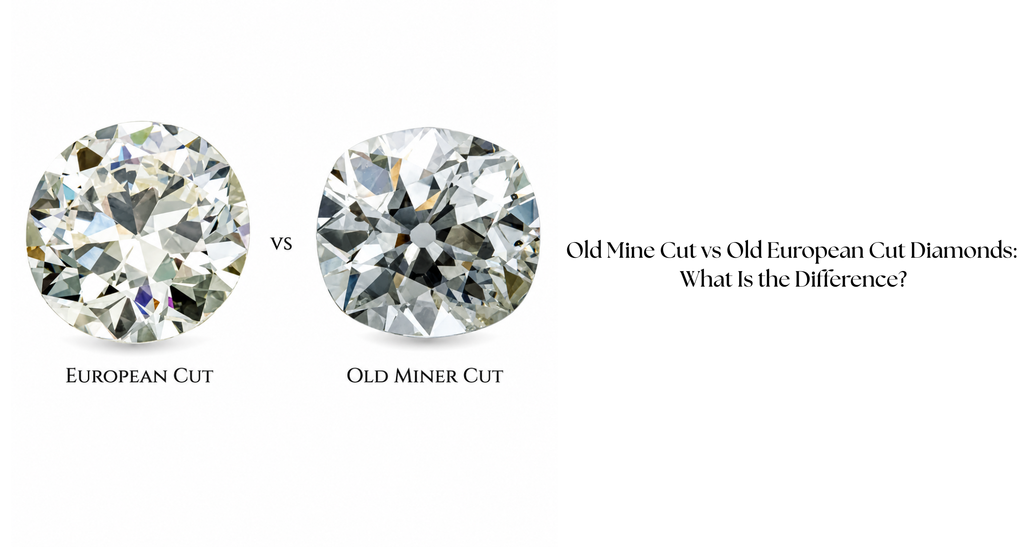
The easiest way to understand the difference is this: an old mine cut diamond usually looks like a rounded square or cushion shape, while an old European cut diamond looks round. Once you notice the outline, the rest of the differences become easier to understand.
What Is an Old Mine Cut Diamond?
An old mine cut diamond is one of the earlier antique diamond cuts. It normally has a cushion-like outline with rounded corners, a high crown, a small table, a deep pavilion, and a large open culet. When you look at the diamond from the top, the culet can often be seen as a small mark or opening near the centre.
These diamonds were common during the 18th and 19th centuries. At that time, diamond cutting was not about creating perfect symmetry. Cutters worked with the natural shape of the rough stone and tried to save as much diamond weight as possible. That is why old mine cuts often look slightly uneven from one side to another.
This unevenness is not always a flaw. In fact, it is one of the reasons people love old mine cut diamonds today. The stone clearly shows that it was shaped by hand. One diamond may have a slightly longer side, another may have uneven corners, and another may have a culet that is not exactly in the centre. These details make the diamond look personal rather than factory-made.
Why Is It Called an Old Mine Cut?
The name “old mine cut” can sound confusing because it does not mean every diamond came from one specific mine. The term became common when newer diamond sources entered the market, especially from Africa. Diamonds from earlier sources, including India and Brazil, were then associated with the older mines.
Over time, the name became attached to the cutting style itself. So today, when someone says old mine cut, they are mainly talking about the shape and structure of the diamond, not the exact place where it was found.
This is important because many people assume the name proves the diamond’s origin. It does not. A diamond can have an old mine cut style without proving that the rough stone came from an old Indian or Brazilian mine.
What Is an Old European Cut Diamond?
An old European cut diamond came after the old mine cut and is much closer to the round diamonds we know today. It still has antique features, such as a high crown, small table, deep pavilion, and visible culet, but the outline is round instead of cushion-shaped.
This cut became common from the late 19th century into the early 20th century. By this time, cutters had better tools and more control over the shape of the diamond. They could create a rounder outline, though the cutting was still not as exact as modern diamond cutting.
Old European cut diamonds are often seen in late Victorian, Edwardian, and early Art Deco jewellery. They have the old-world look of antique diamonds, but with a more organised round shape. This is why they are often seen as the bridge between older hand-cut diamonds and the modern round brilliant.
Which Cut Came First?
The old mine cut came first. It belongs to an earlier stage of diamond cutting, when cutters followed the rough stone more closely. Since the natural rough did not always allow a clean round shape, many old mine diamonds ended up with a cushion-like outline.
The old European cut came later, when cutting tools improved and round outlines became easier to create. This change did not happen suddenly. There were many diamonds made during the transition period that carried features of both cuts.
That is why some antique diamonds are not easy to label at first glance. A stone may look almost round but still have old mine-style proportions, or it may have a cushion outline with a more organised facet pattern. In antique diamonds, names can help, but the actual shape and structure matter more.
The Main Difference Is Shape
Shape is the clearest difference between old mine cut and old European cut diamonds. An old mine cut usually has a rounded square outline. It may look like an early cushion cut, with soft corners and slightly uneven sides.
An old European cut is round. It may not be as perfectly round as a modern brilliant cut, but the circular outline is still clear. When placed side by side, the old European cut will look closer to a traditional round diamond, while the old mine cut will look more cushion-like.
This difference also changes how the stone works in a ring. Old mine cuts often look natural in cushion-shaped settings, antique clusters, bezels, and Victorian-inspired designs. Old European cuts are easier to place in round settings, solitaire rings, halos, and Edwardian or Art Deco-style designs.
The Culet Is Another Big Difference
Both cuts often have a visible culet, but the old mine cut usually has a larger one. In many old mine diamonds, the culet is easy to see from the top. It can look like a small circle or opening in the middle of the stone.
Old European cut diamonds also have open culets, but they are often smaller and more centred. The culet is still part of the diamond’s antique look, but it usually does not dominate the centre as much as it can in an old mine cut.
A visible culet should not be treated like damage. In older cutting styles, it was intentional. The sharp point at the bottom of the diamond was flattened to make the stone less likely to chip. Today, that culet also helps give antique diamonds their recognisable look.
How Their Light Looks Different
Old mine cut diamonds often show large, uneven flashes of light. Because the facets were shaped by hand, the light pattern does not always look perfectly balanced across the stone. Some flashes may appear stronger in one area than another, and the large culet can become part of the visual pattern.
Old European cut diamonds also show broader flashes, but the pattern usually follows the round shape more clearly. The reflections tend to look more organised around the centre because the cut itself is more circular and balanced.
Neither cut looks like a modern round brilliant. Modern diamonds are designed for quicker sparkle and more controlled light return. Old mine and old European cuts show light in a slower way. Their flashes are bigger, but they are not as fast or sharp.
Old Mine Cuts Have More Hand-Cut Character
Old mine cut diamonds usually show more variation because they were shaped around the rough stone. The cutter’s goal was not to make every diamond look identical. The goal was to create a beautiful stone while preserving as much of the original diamond as possible.
This is why an old mine cut may have uneven corners, a slightly off-centre culet, or facets that do not match perfectly. For someone who wants a clean, modern look, these details may seem irregular. But for antique jewellery lovers, this is often the most attractive part.
Old European cuts are also hand-cut, but they usually look more controlled. The round outline gives them a more organised appearance. They still carry antique character, but they are less irregular than most old mine cuts.
Crown, Table, and Depth

Both old mine and old European cuts usually have a high crown and a small table. The crown is the upper part of the diamond, and the table is the flat facet at the top. In antique diamonds, the crown often rises more noticeably than it does in many modern diamonds.
Both cuts also tend to be deep. A lot of the diamond’s weight may sit below the widest part of the stone. Because of this, an antique diamond can sometimes look smaller from the top compared to a modern diamond of the same carat weight.
This does not mean the diamond is less beautiful. It simply means the beauty is distributed differently. Instead of a wide top view and modern sparkle, antique cuts give more depth, stronger side presence, and broader flashes of light.
Do Antique Cuts Look Smaller on the Hand?
Sometimes, yes. Old mine and old European cut diamonds often carry more weight in the lower part of the stone. So, if you compare one with a modern diamond of the same weight, the antique cut may look slightly smaller from above.
This is why measurements matter. Carat weight alone does not tell you how large a diamond will look once it is set in a ring. The face-up size, depth, and setting style all change the final look.
If you are buying an old mine or old European cut diamond, it is better to look at the actual stone instead of judging it only by carat weight. Antique cuts are about appearance, history, and character, not just size.

Old Mine Cut Diamond Rings
Old mine cut diamonds look beautiful in rings that respect their cushion-like shape. They are often seen in Georgian and Victorian-style jewellery, cluster rings, bezel settings, floral designs, and rings with detailed metalwork.
Because the outline is not always even, the setting should be made around the actual stone. A standard cushion setting may not fit properly if the diamond has uneven sides or corners.
The outer edge of an old mine diamond can also be thin in some areas, especially in original antique stones. A good jeweller should check the girdle and protect weak areas with the right setting. A bezel can give more protection, while prongs should be placed carefully around the actual outline of the diamond.
Old European Cut Diamond Rings
Old European cut diamonds work well in round settings. They are often used in solitaire rings, halos, milgrain settings, engraved bands, and Art Deco-inspired designs. Because the outline is round, they are easier to pair with many classic ring styles.
These diamonds often sit a little higher because of their crown and depth. Looking at the ring from the side is important because the side profile tells you how raised the diamond will be on the finger.
Old European cuts are a good choice for someone who wants a round diamond but does not want the sharp look of a modern brilliant cut. They give a more antique appearance while still keeping a familiar round shape.
Antique Diamond or Modern Reproduction?
Not every diamond sold as an old mine style or old European style is a true antique. Cutters today can recreate these styles using modern tools. A new diamond can be cut to look like an old mine cut or old European cut.
A modern reproduction may have a stronger girdle, better symmetry, and a more controlled outline. An original antique diamond will usually show more signs of hand cutting and period craftsmanship.
Both can be good choices. The important thing is honesty. A newly cut antique-style diamond should not be sold as an original antique stone. If age matters to you, ask clearly whether the diamond is genuinely old or newly cut in an old style.
Can a Diamond Be Between Both Cuts?
Yes, and this happens quite often with antique diamonds. Some stones do not fit neatly into one category. A diamond may have a cushion-like outline but a facet style closer to an old European cut. Another may look almost round but still carry the irregular look of an old mine cut.
These diamonds are sometimes called transitional cuts, but different jewellers may describe them differently. This is why it is better to look at the diamond itself instead of relying only on the name.
The outline, culet, crown height, depth, and facet pattern will tell you more than the label. Antique diamonds were not made by strict modern rules, so some overlap is normal.
Old Mine Cut or Old European Cut: Which Is Better?
One is not better than the other. They simply suit different tastes.
Choose an old mine cut if you like a cushion-like outline and want a diamond where the hand-cut character is easy to see. It is a good choice for people who enjoy antique jewellery with visible history.
Choose an old European cut if you want a round diamond with an older cutting style. It gives you a more familiar shape but still keeps the deeper proportions and broader light of antique diamonds.
The setting also matters. If the ring design is cushion-shaped or heavily vintage-inspired, an old mine cut may look more natural. If the design is round, geometric, or Edwardian-inspired, an old European cut may fit better.
Old Mine Cut vs Old European Cut at a Glance
An old mine cut usually has a rounded square outline, a larger culet, and more visible irregularity. It belongs to an earlier period of diamond cutting and is often connected with Georgian and Victorian jewellery.
An old European cut has a round outline, a smaller culet, and a more organised facet pattern. It came later and is often seen in late Victorian, Edwardian, and Art Deco jewellery.
Old mine cuts look closer to early cushion diamonds. Old European cuts look closer to older round diamonds. This is the simplest way to remember the difference.
Final Thoughts
Old mine cut and old European cut diamonds are closely connected, but they are not the same. Both carry the charm of older diamond cutting, but their shape, light pattern, and overall personality are different.
An old mine cut has a rounded square outline and usually shows more hand-cut variation. An old European cut is round and looks more organised, while still keeping the older style of light and depth.
If you want a diamond that feels closer to early antique jewellery, old mine cut is a strong choice. If you want a round antique diamond that sits between old-world cutting and modern round diamonds, old European cut is easier to understand and wear.
The best way to choose is to see both in normal light. Let the shape, culet, and light pattern guide you. Antique diamonds are not about perfect sameness. They are about the details that make each stone different.


