




 All Earrings
 Stud Earrings
 Drop Earrings
 Solitaire
 Hoop Earrings
 Halo Earrings
 Vermeil Earrings
 Round
Round
 Oval
Oval
 Emerald
 Pear
Pear
 Princess
 Heart
Heart
 Marquise
 All Rings
 Solitaire Rings
 Band Rings
 Halo Rings
 Cocktail Rings
 Eternity Rings
 Fashion Ring
 Stack Rings
 Men's Rings
 Vermeil Rings
 All Necklaces
 Necklet
 Mangalsutra
 Solitaire
 Tennis Necklace
 Statement Necklace
 Vermeil Necklace
 Alphabets
 Solitaire Pendant
 Halo Pendant
 Vermeil Pendants
 All Bracelets
 Solitaire Bracelet
 Tennis Bracelet
 Fashion Bracelet
 Mangalsutra
 Vermeil Bracelets
 All Vermeil
 Vermeil Earring
 Vermeil Pendant
 Vermeil Ring
 Vermeil Necklace
 Vermeil Mangalsutra
 Vermeil Bracelets
 Vermeil Bangles
 Vermeil Men’s
Everything You Need to Know About Round Cut Diamond
Round diamond rings have remained popular for generations. The circular shape sits neatly on the hand and works with many ring settings. It appears in engagement rings, anniversary bands, solitaires, and daily wear jewellery.
The round diamond we know today took centuries to develop. Early diamond cutters followed the natural shape of the stone. As tools improved, they began adding facets and changing proportions to control how light moved through the diamond.
This long history gave us several types of round diamonds. Rose cut, round brilliant, Portuguese cut, and old European cut diamonds may share a circular outline, but they do not look alike. Each one handles light in its own way.
What Is a Round Cut Diamond?
A round cut diamond ring has a diamond with a circular outline. However, the word “round” only describes the outside shape. It does not tell us how the surface of the diamond has been faceted.
A rose cut diamond can be round, but its structure is very different from a round brilliant diamond. The same applies to Portuguese and old European cuts. The number of facets, depth, crown height, table size, and bottom of the stone all change its appearance.
This is why two round diamond rings can look completely different, even when the stones have a similar size.
Round Cut and Round Brilliant Are Not Exactly the Same

People often use “round cut” and “round brilliant” as if they mean the same thing. In everyday jewellery conversations, this is common, but technically there is a difference.
Round cut is a broad term for any diamond with a circular outline. Round brilliant refers to a specific facet arrangement created to return a large amount of light through the top of the stone.
Most round diamonds sold in modern jewellery are round brilliants. Rose cut and old European cut diamonds also have round forms, but they belong to earlier cutting traditions.
A Short History of Round Diamonds
Early diamonds were not cut for sparkle in the way modern stones are. Cutting tools were limited, and diamond was valued mainly for its rarity and hardness. Craftsmen often polished the natural crystal instead of changing its form completely.
By the 1400s, simple styles such as the point cut and table cut had appeared. The point cut followed the natural shape of the diamond, while the table cut removed the top point to create a flat surface.
These early experiments showed that polishing and faceting could change the stone’s appearance. Diamond cutting gradually became more than surface finishing.
The rose cut appeared around the 16th century. It had a flat base and a raised top covered with triangular facets. It worked well under candlelight, which was important before electric lighting became common.
During the 17th and 18th centuries, cutters added more facets through styles such as the Mazarin and Peruzzi cuts. These were early steps towards the brilliant cutting style.
The old mine cut followed, usually with a cushion shaped outline and hand cut proportions. By the late 19th century, the old European cut had moved much closer to a true round shape.
A major change came in 1919, when diamond cutter and mathematician Marcel Tolkowsky published Diamond Design . His work studied the angles and proportions that could improve light return in a round diamond. It influenced the development of the modern round brilliant.
Modern technology later allowed cutters to plan, measure, and polish diamonds with greater accuracy. Even so, antique cuts remain popular because their hand cut structure produces a different pattern of light.
Rose Cut Round Diamond

A rose cut diamond has a flat base and a raised top made from triangular facets. It does not have the deep pavilion found under a modern brilliant cut diamond.
Because the bottom is flat, light does not travel through a rose cut in the same way. Instead of sharp flashes, the stone shows a gentle shimmer across its surface. The effect becomes more noticeable as the hand moves.
Rose cuts were widely used when jewellery was viewed under candlelight. Their broad facets responded well to low, warm lighting. This explains why they appear in many surviving pieces from earlier jewellery periods.
A rose cut round diamond also has a lower profile. It sits closer to the finger than many brilliant cut stones, which can make it practical for people who do not want a raised centre setting.
Modern designers often place rose cuts in bezel settings, floral rings, and handcrafted bands. The cut works best when the design allows its flat base and surface facets to remain visible.
The appeal of a rose cut is not based on maximum sparkle. People choose it for the visible facet pattern and its connection with older jewellery making.
Brilliant Cut Round Diamond

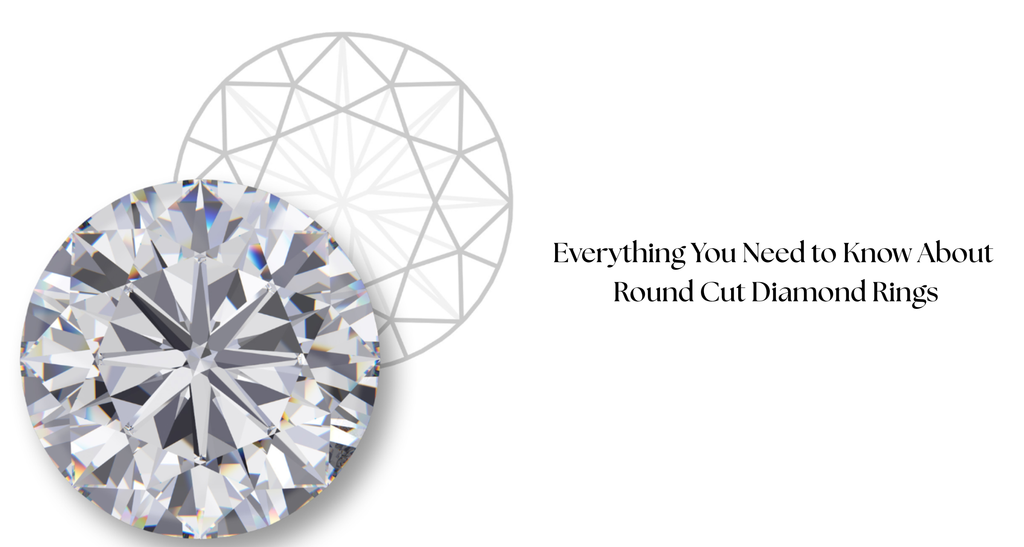
The round brilliant is the most widely recognised round diamond today. It is usually made with 57 or 58 facets, depending on whether the small facet at the bottom, known as the culet, is included in the count.
Its structure includes a table at the top, a crown above the widest part of the diamond, and a pavilion below it. These sections are planned so that light entering the stone can reflect internally and return through the top.
This creates the quick flashes normally associated with modern diamond rings. The stone can show white light, coloured flashes, and changing reflections as it moves.
The development of the modern round brilliant was influenced by better cutting equipment and a deeper understanding of geometry. Tolkowsky’s 1919 study became an important reference, though modern round diamonds are not all cut to one identical formula.
Round brilliant diamonds are commonly used in solitaire, halo, three stone, floral, and pavé rings. They also pair easily with straight wedding bands because their circular outline does not favour one direction.
Someone choosing a round brilliant usually wants the diamond itself to remain the centre of attention. Even a simple setting can work because the facet arrangement already creates movement.
Portuguese Cut Round Diamond

The Portuguese cut is less common in diamond rings. It uses several rows of facets on both the upper and lower parts of the stone, creating a dense pattern when viewed from above.
It has far more facets than a standard round brilliant. Instead of producing a few clear reflections, the surface breaks light into many smaller flashes. This can create an almost patterned appearance inside the stone.
Portuguese cutting is more commonly seen in coloured gemstones because the extra depth can strengthen colour. Diamond versions do exist, but they are harder to find and often need to be specially sourced or cut.
The cut also requires greater depth than many standard round diamonds. For this reason, two stones with the same carat weight may not appear equally wide from the top. A Portuguese cut can carry more of its weight below the setting.
The ring design should leave enough space around the stone for the facet pattern to remain visible. A setting that covers too much of the edge can reduce the main visual feature of the cut.
Portuguese cut round diamond rings suit buyers looking for an uncommon facet pattern rather than a familiar solitaire appearance.
Old European Cut Round Diamond

The old European cut was widely used during the late 19th and early 20th centuries. It came after the old mine cut and before the modern round brilliant.
These diamonds were shaped with the tools available at the time, often by hand. They are generally round, but their outlines may not be mathematically exact.
An old European cut usually has a high crown, small table, deep pavilion, and visible culet. The culet can sometimes be seen through the top as a small open point in the centre.
Its light pattern is different from that of a modern round brilliant. Old European diamonds tend to produce broader flashes instead of many quick reflections. The larger facets create a slower change in light as the ring moves.
Individual stones can vary because cutters worked around the original diamond rather than following one fixed set of measurements. Slight differences in symmetry are therefore part of the cut’s identity.
Old European cut diamonds are often used in antique rings or new designs made to resemble jewellery from an earlier period. They work particularly well with milgrain, engraving, bezel details, and raised gallery settings.
How These Four Round Cuts Differ
A rose cut diamond is shallow and has a flat base. Its light appears mainly across the top surface.
A round brilliant has a deep lower section and a carefully organised facet structure. It is designed to return a large amount of light through the crown.
A Portuguese cut uses many tiers of facets. Its appearance is more complex, and the stone is usually deeper.
An old European cut reflects the methods used before modern precision cutting. It has larger facets, a high crown, and an open culet.
The right choice depends on what someone wants to notice first. Rose cuts show their surface pattern. Round brilliants focus on light return. Portuguese cuts display a dense internal pattern. Old European cuts show the character of hand cutting.
Why Round Diamond Rings Remain Popular
The circular outline works with almost every ring style. It can stand alone in a solitaire or become part of a larger cluster.
Round diamonds are also easy to position. Shapes such as pear, marquise, and oval diamonds have a clear direction, while a round diamond looks the same from every side. This gives the designer more freedom when planning the setting.
Wedding bands can usually sit beside round shape diamond rings without creating an awkward visual gap. The shape also works with curved bands, straight bands, and diamond set bands.
Another reason is familiarity. Many people grow up seeing round diamonds in engagement rings, family jewellery, films, and advertisements. The shape is immediately recognised as a diamond ring.
Its popularity is therefore not based on one passing trend. The design has remained in use while settings, metals, and jewellery preferences have changed around it.
Popular Settings for Round Cut Diamond Rings
A solitaire setting places one round diamond at the centre. The number and position of the prongs can change how much of the diamond remains visible.
A halo setting surrounds the centre stone with smaller diamonds. This adds width to the design and creates a clear border around the round outline.
In a bezel setting, metal circles the edge of the diamond. This protects the stone and gives the ring a lower, smoother profile.
A floral setting uses smaller stones or metal details around the centre diamond to create the form of petals. Round diamonds work naturally in this design because the centre resembles the middle of a flower.
Three stone rings place a main diamond between two side stones. The side stones may also be round, or they may use another shape to create contrast.
The setting should be chosen according to the cut. A rose cut may suit a bezel, while a round brilliant often benefits from a setting that allows more light around the stone.
Round Cut Diamond Rings in Indian Jewellery
Round diamonds are used across modern Indian jewellery. They appear in engagement rings, earrings, pendants, mangalsutra designs, bangles, nose pins, and wedding jewellery.
The shape works with Indian clothing without being limited to it. The same round diamond ring can be worn with a saree, suit, lehenga, or western outfit.
Round brilliants are common in modern engagement rings because buyers are familiar with their light return. Rose cut styles often appear in jewellery influenced by older settings and handcrafted work.
Round diamonds are also useful in cluster jewellery. Artisans can arrange several small round stones into flowers, circles, borders, or geometric patterns without leaving large empty spaces.
For Indian families who want a ring that can be worn beyond one occasion, the round shape is often practical. It can move easily from wedding events to regular use.
The Artisan Skill Behind a Round Diamond Ring
The work begins before the diamond reaches the ring. A diamond cutter studies the rough stone and decides how much material can be removed without losing unnecessary weight.
For a round brilliant, the angles and symmetry must be controlled closely. Small errors can change the way light moves through the stone.
Antique style cuts require a different approach. A rose cut needs even surface facets, while an old European cut must retain the larger facet structure associated with its period.
Once the diamond is ready, the bench jeweller prepares the setting. The seat must match the shape of the stone, and each prong must hold the diamond without covering too much of it.
The jeweller also checks the height of the ring, the thickness of the band, and the space below the diamond. These details decide whether the finished ring sits securely and remains comfortable.
A round diamond may appear simple from above, but that simple outline depends on several stages of skilled work.
Which Round Diamond Ring Should You Choose?
Choose a rose cut round diamond ring when you prefer a low setting and a visible surface pattern. It is also worth considering when standard brilliant sparkle is not your priority.
Choose a round brilliant when you want strong light return and a design that works with most settings. It is the easiest of these cuts to find in different sizes.
Choose a Portuguese cut when you want a diamond with an unusual internal pattern. Keep in mind that availability may be limited, and the stone can be deeper than expected.
Choose an old European cut when the construction of antique jewellery interests you. Each stone may differ slightly because these diamonds were often shaped by hand.
There is no single cut that suits every buyer. The decision should be based on how the diamond looks in real light, how high it sits, and how the ring will be worn.
Final Thoughts
Round cut diamond rings cover more than one cutting style. The same circular outline can hold a rose cut, round brilliant, Portuguese cut, or old European cut diamond.
Rose cuts show a surface shimmer. Round brilliants return strong light. Portuguese cuts create a dense facet pattern. Old European cuts carry the proportions used before modern precision cutting.
Understanding these differences makes it easier to choose a ring for the right reason. Instead of selecting a round diamond only because the shape is familiar, you can choose the cut whose structure and light pattern match what you actually want to wear.


