




 All Earrings
 Stud Earrings
 Drop Earrings
 Solitaire
 Hoop Earrings
 Halo Earrings
 Vermeil Earrings
 Round
Round
 Oval
Oval
 Emerald
 Pear
Pear
 Princess
 Heart
Heart
 Marquise
 All Rings
 Solitaire Rings
 Band Rings
 Halo Rings
 Cocktail Rings
 Eternity Rings
 Fashion Ring
 Stack Rings
 Men's Rings
 Vermeil Rings
 All Necklaces
 Necklet
 Mangalsutra
 Solitaire
 Tennis Necklace
 Statement Necklace
 Vermeil Necklace
 Alphabets
 Solitaire Pendant
 Halo Pendant
 Vermeil Pendants
 All Bracelets
 Solitaire Bracelet
 Tennis Bracelet
 Fashion Bracelet
 Mangalsutra
 Vermeil Bracelets
 All Vermeil
 Vermeil Earring
 Vermeil Pendant
 Vermeil Ring
 Vermeil Necklace
 Vermeil Mangalsutra
 Vermeil Bracelets
 Vermeil Bangles
 Vermeil Men’s
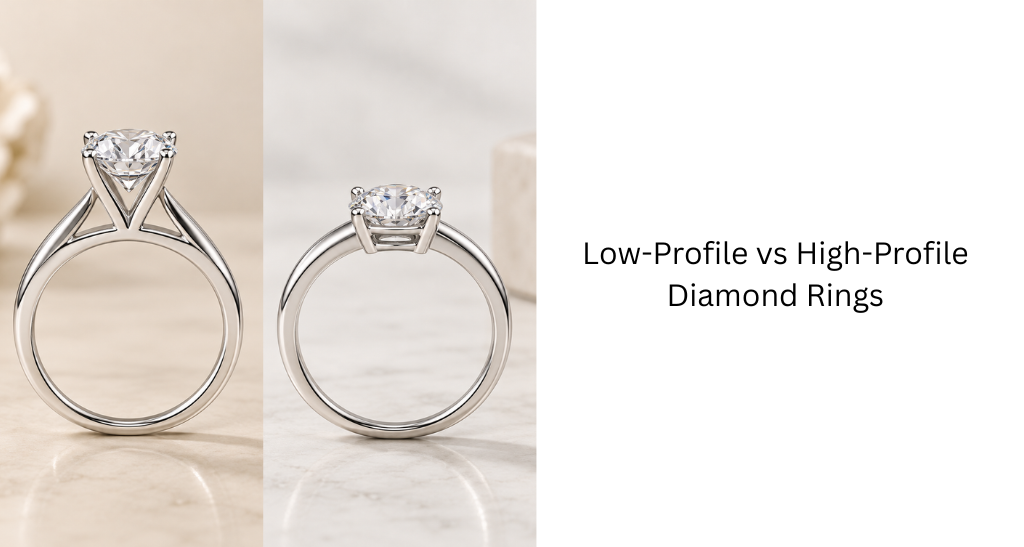
Low-Profile vs High-Profile Diamond Rings: Which Is Better for Daily Wear?
When choosing a diamond ring for everyday use, most buyers focus on the diamond’s shape, carat weight, metal and design. Ring profile is another detail that can make a big difference, especially if you plan to wear the ring every day.
The profile refers to how high the diamond and its setting sit above your finger. A low-profile ring keeps the diamond closer to the finger, while a high-profile ring raises the diamond higher.
Neither profile is automatically better. The right choice depends on your lifestyle, diamond shape, carat size, comfort and whether you want to wear the ring with a wedding band.
What Is a Low-Profile Diamond Ring?
A low-profile diamond ring has a setting that keeps the diamond closer to the finger. The basket, prongs or other parts of the setting are designed to reduce the overall height of the ring.
Because the diamond sits closer to the hand, the ring usually has a more compact feel. This can be useful for people who work with their hands frequently or prefer jewellery that does not feel bulky.
Low-profile designs are commonly seen in everyday rings, simple solitaire styles and some modern engagement rings. The exact height can vary depending on the setting and diamond shape.
What Is a High-Profile Diamond Ring?
A high-profile diamond ring holds the diamond higher above the finger. The setting creates more space underneath or around the centre stone, giving the diamond a more raised appearance.
This style is often used for traditional engagement rings, especially when the centre diamond is large or when the design needs additional height.
The extra height can also make it easier to pair the engagement ring with certain wedding bands. However, a higher setting can also make the ring more exposed to knocks and catching on clothing.
How Is Ring Profile Measured?
Ring profile is generally discussed in terms of how far the setting rises from the finger. There is no single standard height that makes a ring officially low or high profile, because different jewellers and designs use different measurements.
The height depends on several parts of the ring, including the diamond’s depth, the setting style, the basket, the prongs and the thickness of the band.
When buying a ring online, do not judge the profile only from product photographs. Ask for the setting height or a side-view image if this information is not already provided.
Low Profile vs High Profile: Key Differences
The main difference is the position of the diamond in relation to your finger.
| Feature | Low-Profile Ring | High-Profile Ring |
|---|---|---|
| Diamond position | Closer to the finger | Sits higher above the finger |
| Daily comfort | Usually feels more compact | May feel more noticeable |
| Snagging | Generally less likely | More likely depending on design |
| Protection | Diamond is less exposed | Centre stone is more exposed |
| Wedding band fit | May need a curved or fitted band in some designs | Often gives more space for a straight band |
| Large centre stones | Can be difficult with some shapes | Often works well |
| Traditional look | Usually more understated | Often gives a classic raised look |
The actual experience still depends on the individual ring design. A carefully designed high-profile ring can be comfortable, while some low-profile rings can still have edges that catch on clothing.
Which Is More Comfortable for Daily Wear?
For many people, a low-profile ring feels more comfortable because less of the setting rises above the finger. This can be especially helpful if you type frequently, work with your hands or wear gloves during the day.
Comfort also depends on the inside of the band, its width, the ring size and the shape of the setting. A low-profile ring that fits poorly can be less comfortable than a well-fitted high-profile ring.
If you are choosing a ring for everyday wear, pay attention to the complete design rather than looking only at profile height.
Which Is Less Likely to Snag?
Low-profile rings generally have less exposed metal and fewer raised areas, so they are less likely to catch on clothes, hair or other objects.
High-profile rings have more of the setting above the finger. If the prongs or sides of the setting are exposed, they can catch more easily.
This does not mean every high-profile ring will snag. A well-finished setting with properly placed prongs can reduce this problem considerably.
Which Setting Offers Better Diamond Protection?
A lower setting can provide some practical protection because the diamond is positioned closer to the finger. It has less exposure to accidental contact from the side.
However, diamond protection depends more on the setting design than height alone. Prong placement, bezel coverage, the strength of the basket and the condition of the setting all matter.
A bezel setting, for example, surrounds much of the diamond with metal and can offer a different level of protection compared with an exposed prong setting.
If you are choosing a ring for regular wear, check how securely the diamond is held rather than assuming that low profile automatically means better protection.
How Profile Height Affects Wedding Band Fit
Profile height can have a major effect on how an engagement ring sits with a wedding band.
A high-profile engagement ring often leaves enough space beneath the centre diamond for a straight wedding band to sit close to it. This is one reason raised settings are common in traditional engagement rings.
With a low-profile ring, the centre setting may sit closer to the finger and leave less room underneath the diamond. Depending on the design, a straight wedding band may sit against the engagement ring rather than lying flush with it.
This is not necessarily a problem. A curved, contoured or notched wedding band can be designed to fit around a low-profile engagement ring.
If you are planning to wear both rings together, check the band compatibility before buying.
Does Profile Height Affect Diamond Sparkle?
Profile height itself does not determine how much a diamond sparkles.
Diamond sparkle mainly depends on the stone's cut quality, proportions, symmetry, polish and how it interacts with light. The setting also affects how much light can reach the diamond, but simply raising the diamond higher does not automatically make it more brilliant.
For example, a well-cut diamond in a low-profile setting can have excellent sparkle, while a poorly cut diamond in a high-profile setting may not perform as well.
When comparing rings, give more attention to the diamond's cut and proportions than to setting height if sparkle is your priority.
How Diamond Shape Changes the Choice
Diamond shape is important because different shapes have different depths and proportions.
Round diamonds are often easier to accommodate in a wide range of settings. Elongated shapes such as oval, pear, marquise and emerald cuts can require more consideration because their length and depth affect how the setting is built.
A large centre diamond may also need additional support, which can increase the overall height of the ring.
This is why two rings with the same carat weight can have noticeably different profiles. The diamond's dimensions and the setting design both contribute to the final height.
How Carat Size Affects Ring Height
Carat weight does not directly tell you how high a ring will sit.
Two diamonds with the same carat weight can have different measurements depending on their shape and proportions. A deeper diamond may require a taller setting, while a shallower stone may sit closer to the finger.
Larger centre stones can also require stronger baskets or additional support, which may increase the profile.
If you want a larger diamond without a very high setting, ask the jeweller about the diamond's actual dimensions and the setting height rather than relying only on carat weight.
Low-Profile Rings for Active Lifestyles
A low-profile ring can be practical for people who regularly use their hands. The reduced height makes the ring less likely to catch on clothing or objects during everyday activities.
It can also be a practical choice for people who prefer a ring that feels closer to the finger rather than one that stands out from the hand.
However, even a low-profile diamond ring should be removed during activities that can damage jewellery, such as heavy lifting, certain sports, gardening or work involving harsh chemicals.
High-Profile Rings for Traditional Engagement Rings
High-profile settings are often associated with traditional engagement ring designs because they create a more raised centre stone. This can give the diamond greater visual prominence and provide room underneath for certain wedding band styles.
They are particularly useful when the design includes a large centre stone or a setting that needs additional structural support.
The trade-off is that the raised setting is more exposed. If you frequently work with your hands, you may need to take extra care to avoid knocks and snagging.
Cleaning and Maintenance Differences
Both types of rings require regular cleaning and inspection, but the setting design affects how easy the ring is to maintain.
Low-profile rings can have smaller or more enclosed spaces that may collect dirt around the diamond and setting. High-profile rings may provide more visible access around the stone, although raised prongs can also collect dust and require careful cleaning.
Use a soft brush, mild soap and lukewarm water for routine cleaning when the jeweller confirms that the method is suitable for your ring. Avoid harsh chemicals and check the prongs regularly for signs of loosening.
For rings worn every day, a professional inspection can help identify worn prongs or other setting problems before the diamond becomes loose.
Low-Profile Ring: Advantages and Limitations
A low-profile ring is generally suitable for buyers who value comfort, a compact design and reduced exposure of the setting.
Its main advantages include a lower chance of snagging, a closer-to-the-finger feel and practical everyday wear.
The main limitation is that some low-profile designs may not allow a straight wedding band to sit completely flush. Large or deep centre stones can also require a different setting design.
High-Profile Ring: Advantages and Limitations
A high-profile ring can be useful when you want a raised centre diamond, a traditional engagement ring design or more space for a wedding band.
It can also accommodate certain larger centre stones and detailed settings more easily.
The main limitation is that the raised diamond and setting can be more exposed to knocks and snagging. People with very active routines may therefore need to be more careful with this type of ring.
What to Check Before Buying a Ring Online
When buying a diamond ring online, profile height should be one of several details you check before placing an order.
Look for the diamond's length, width and depth, the setting type, band width and overall ring dimensions. A side-view photograph can be particularly helpful because front-facing product images often do not show how high the diamond sits.
You should also check whether the ring can be resized, whether a matching wedding band is available and what certification comes with the diamond.
If the product page does not mention the profile or setting height, contact the jeweller before ordering. This is especially important if you want the ring to sit flush with an existing wedding band.
Which One Should You Choose for Daily Wear?
For everyday wear, a low-profile ring is often practical if your main concerns are comfort, reduced snagging and keeping the diamond closer to your finger.
A high-profile ring can make more sense if you prefer a raised centre stone, want a traditional engagement ring style or need additional space for a straight wedding band.
Your lifestyle should be considered alongside the diamond shape, carat size, setting type and wedding band plans. There is no single profile that works for everyone.
Final Thoughts
If you are buying a diamond ring mainly for everyday wear, choose a low-profile setting if comfort, easy movement and less snagging are your priorities. Choose a high-profile setting if you prefer a raised centre diamond or want your wedding band to sit neatly against the engagement ring.
Before buying, check the setting height, diamond size, wedding band fit and how securely the stone is held. For most active lifestyles, a well-made low-profile ring is a practical choice for daily wear.


