




 All Earrings
 Stud Earrings
 Drop Earrings
 Solitaire
 Hoop Earrings
 Halo Earrings
 Vermeil Earrings
 Round
Round
 Oval
Oval
 Emerald
 Pear
Pear
 Princess
 Heart
Heart
 Marquise
 All Rings
 Solitaire Rings
 Band Rings
 Halo Rings
 Cocktail Rings
 Eternity Rings
 Fashion Ring
 Stack Rings
 Men's Rings
 Vermeil Rings
 All Necklaces
 Necklet
 Mangalsutra
 Solitaire
 Tennis Necklace
 Statement Necklace
 Vermeil Necklace
 Alphabets
 Solitaire Pendant
 Halo Pendant
 Vermeil Pendants
 All Bracelets
 Solitaire Bracelet
 Tennis Bracelet
 Fashion Bracelet
 Mangalsutra
 Vermeil Bracelets
 All Vermeil
 Vermeil Earring
 Vermeil Pendant
 Vermeil Ring
 Vermeil Necklace
 Vermeil Mangalsutra
 Vermeil Bracelets
 Vermeil Bangles
 Vermeil Men’s
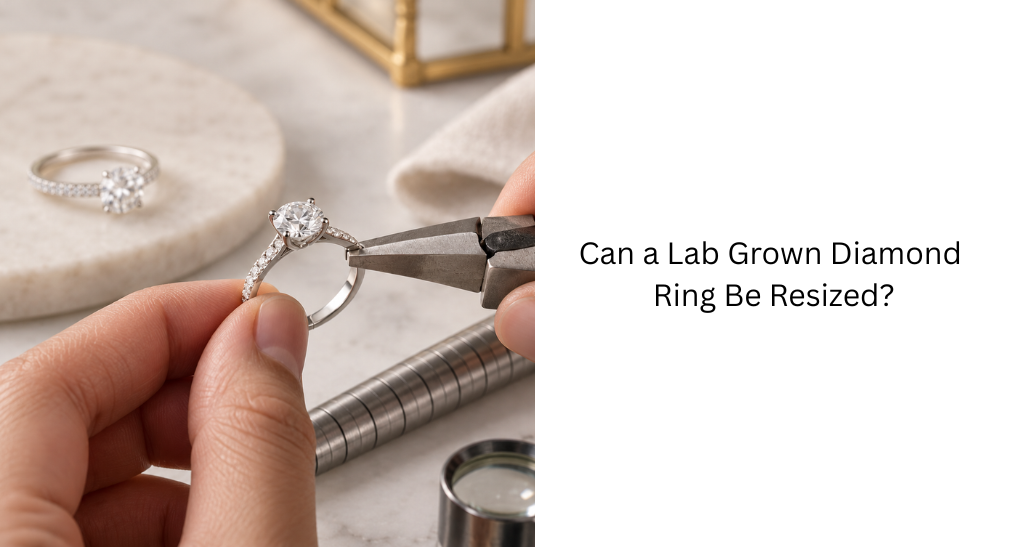
Can a Lab Grown Diamond Ring Be Resized? What Buyers Should Know
Buying a ring is exciting, but getting the right size is just as important as choosing the diamond. A ring that is too tight can feel uncomfortable, while a loose ring can move around your finger or even slip off. This is why many buyers wonder what happens if their ring does not fit perfectly, especially when buying a lab grown diamond ring.
The good news is that a lab grown diamond ring can often be resized, just like a ring set with a natural diamond. The fact that the diamond was grown in a laboratory does not make it harder to resize. What matters more is the ring's metal, setting, design, and how much the size needs to be changed.
Before buying a ring, it helps to understand when resizing is possible, when it can be difficult, and what you should check with your jeweller.
Can a Lab Grown Diamond Ring Be Resized?
Yes, in most cases, a lab grown diamond ring can be resized. A lab grown diamond has the same physical properties as a natural diamond, so the resizing process is mainly related to the ring setting and metal, not the origin of the diamond.
A jeweller usually works on the metal band rather than changing the diamond itself. If the ring needs to be made larger, a small section of metal may be cut and additional metal may be added. If it needs to be made smaller, the jeweller can remove a small section of the band and join it back together.
The process sounds simple, but the difficulty depends on the design. A plain gold band is usually much easier to resize than a detailed ring covered with diamonds.
What Determines Whether a Ring Can Be Resized?
Not every ring can be resized in the same way. Before making a purchase, look at these important factors.
The Metal Used in the Ring
The type of metal plays an important role in resizing. Gold is generally easier to resize, including 9K, 14K and 18K gold. Platinum can also be resized, but it requires a jeweller experienced in working with platinum.
Some alternative metals are much more difficult or even impossible to resize using traditional methods. This is one reason why it is important to ask about resizing before purchasing a ring rather than assuming every ring can be adjusted later.
The Ring Design
A simple solitaire ring usually offers more flexibility because most of the band is plain metal.
Rings with intricate patterns, engraving, multiple rows of diamonds, or stones placed around the entire band can be more complicated. Changing the size may affect the symmetry of the design.
This is particularly important for eternity rings, where diamonds are set around the entire circumference of the band. There may not be enough plain metal available for a jeweller to safely add or remove material.
The Diamond Setting
The setting also matters. A lab grown diamond that is securely held in a traditional solitaire setting can usually remain in place while the band is resized.
However, resizing can put pressure on the metal around the setting. A skilled jeweller should therefore inspect the prongs and diamond setting before and after the work.
This is especially important if the ring has several diamonds rather than one centre stone.
How Is a Lab Grown Diamond Ring Resized?
The actual process depends on whether the ring needs to become larger or smaller.
Making the Ring Larger
When a ring needs to be increased by a small amount, a jeweller may be able to stretch the metal slightly. This method is generally suitable only for minor adjustments and certain ring designs.
For a larger increase, the jeweller usually cuts the band and adds a small piece of matching metal. The two ends are then joined, shaped and polished so that the alteration is difficult to notice.
The jeweller should also check the setting after resizing to make sure the diamond remains secure.
Making the Ring Smaller
Making a ring smaller is often more straightforward. The jeweller removes a small section of the band and joins the remaining ends together.
The ring is then reshaped and polished to restore its original finish.
For a plain band, this can be relatively simple. For a highly detailed ring, the jeweller needs to make sure the original pattern and proportions remain intact.
How Much Can a Ring Be Resized?
There is no single answer because it depends on the ring design and metal.
A ring can usually be adjusted by a small number of sizes without major changes to its appearance. However, very large size changes can affect the shape, setting and overall balance of the ring.
For example, increasing a delicate ring by several sizes may change the proportions of the band. A ring with stones close to the shoulders may also need additional attention because changing the band can affect how those stones sit.
Your jeweller should inspect the ring and tell you how much adjustment is safe before carrying out the work.
Can All Lab Grown Diamond Rings Be Resized?
No. Some designs are difficult to resize, and a few may not be suitable for traditional resizing at all.
Eternity Rings
Eternity rings have diamonds set around most or all of the band. Since there is little or no plain metal to work with, resizing can be complicated.
In some cases, the jeweller may need to redesign part of the ring or replace sections of the band.
Full Diamond Bands
Bands covered with diamonds along the entire circumference can also be difficult to resize. Removing or adding metal can affect the alignment of the stones.
Intricate or Patterned Rings
Rings with detailed patterns, engraving or special architectural designs may lose their original appearance if the size is changed significantly.
Certain Alternative Metals
Some metals are not suitable for conventional resizing. If you are choosing something other than gold or platinum, ask the jeweller about resizing options before purchasing.
Does Resizing Damage the Lab Grown Diamond?
Properly performed resizing should not damage the lab grown diamond.
The diamond itself is not normally cut, reshaped or altered during the resizing process. The jeweller works primarily on the metal band.
However, resizing involves working close to the diamond and its setting. That is why it should always be handled by an experienced jeweller.
After resizing, the jeweller should check the prongs, setting and overall condition of the ring. This helps ensure that the diamond remains secure.
Will Resizing Affect the Ring's Appearance?
It can, depending on the design and how much the size is changed.
A small adjustment to a simple gold solitaire ring may have little to no visible effect. However, a major change to a ring with several stones or detailed design elements can affect its proportions.
For this reason, it is better to get the ring size as close as possible before the ring is made. Resizing should be considered a useful solution for a sizing issue, rather than something to plan for repeatedly.
What If You Are Between Two Ring Sizes?
If you are between sizes, do not automatically choose the larger size.
Your ideal size can depend on the width of the band, the shape of your finger and even the time of day. Fingers can swell slightly because of heat, weather, activity or other everyday factors.
A professional ring measurement is the safest option. If you are buying online, check whether the jeweller provides a ring size guide, sizing kit or exchange option before placing the order.
This is particularly useful when buying an engagement ring as a surprise, because guessing the size can be difficult.
Can You Resize a Lab Grown Diamond Engagement Ring?
Yes, many lab grown diamond engagement rings can be resized.
A classic solitaire engagement ring with a gold band is generally one of the easier designs to adjust. Three stone rings, halo rings and rings with side diamonds may also be resizable, but the jeweller needs to examine the complete setting before making changes.
If the ring has an unusual shape, diamonds along the entire band or intricate detailing, ask about resizing before purchasing.
What Should You Ask Your Jeweller Before Buying?
If you are purchasing a lab grown diamond ring, do not ask only about the diamond. Ask about the ring itself and the after sales service.
Here are some useful questions:
- Can this ring be resized later?
- How many sizes can it safely be adjusted?
- Is resizing included with the purchase?
- Is there a charge for resizing?
- Will resizing affect the diamond setting or design?
- What happens if the ring cannot be resized?
- Is there a size exchange option?
Getting clear answers before buying can save you from unnecessary costs and disappointment later.
Resizing vs Ring Exchange: Which Is Better?
Sometimes resizing is not the best solution.
If the ring is only slightly too large or small, resizing may be practical. But if you need a significant size change, or the design is difficult to resize, exchanging the ring for the correct size may be a better option.
This is why buyers should check the jeweller's exchange and resizing policies before making the purchase.
A good after sales policy can make the buying experience much easier, particularly when purchasing an engagement ring or a ring as a gift.
How to Avoid Ring Resizing Problems
The easiest way to deal with resizing is to get the correct size in the first place.
Before ordering a ring, have your finger professionally measured. If you already own a ring that fits well, you can also use it as a reference, but remember that different ring widths can fit differently.
It is also worth considering when you normally measure your finger. Your finger size can change slightly throughout the day, so avoid relying on a measurement taken when your hands are unusually cold or swollen.
If you are buying online, use the jeweller's official sizing guide rather than relying only on measurements found elsewhere.
Does Resizing Affect the Value of a Lab Grown Diamond Ring?
Resizing generally does not change the identity or quality of the lab grown diamond itself. The diamond remains the same stone.
However, the overall value and condition of a jewellery piece can depend on its craftsmanship, metal, design, diamond quality and certification. Repeated or poorly performed alterations can affect the condition of the setting.
This is another reason to have resizing carried out by a qualified jeweller.
Lab Grown Diamond Ring Resizing: What Buyers Should Remember
A lab grown diamond ring can usually be resized, but the ability to resize depends more on the ring design and metal than on the fact that the diamond is lab grown.
Before buying, pay attention to the type of metal, setting style, number of diamonds and design of the band. A simple solitaire ring usually gives you more flexibility than an eternity band or a fully diamond set design.
Most importantly, check the jeweller's resizing, exchange and after sales policies before making your purchase. A little planning at the beginning can save you from problems later.
Final Words
Choosing the right ring size is an important part of buying a lab grown diamond ring, but getting the size wrong does not always mean you have to replace the ring. In many cases, a skilled jeweller can adjust the band while keeping the diamond and original design intact.
At Lukson, lab grown diamond jewellery is designed with both quality and everyday wear in mind. If you are buying a ring and are unsure about your size, check the available sizing and after sales options before placing your order. The right guidance can help you choose a ring that feels comfortable, looks beautiful and can be enjoyed for years to come.


