






 All Earrings
 Stud Earrings
 Drop Earrings
 Solitaire
 Hoop Earrings
 Halo Earrings
 Vermeil Earrings
 Round
Round
 Oval
Oval
 Emerald
 Pear
Pear
 Princess
 Heart
Heart
 Marquise
 All Rings
 Solitaire Rings
 Band Rings
 Halo Rings
 Cocktail Rings
 Eternity Rings
 Fashion Ring
 Stack Rings
 Men's Rings
 Vermeil Rings
 All Necklaces
 Necklet
 Mangalsutra
 Solitaire
 Tennis Necklace
 Statement Necklace
 Vermeil Necklace
 Alphabets
 Solitaire Pendant
 Halo Pendant
 Vermeil Pendants
 All Bracelets
 Solitaire Bracelet
 Tennis Bracelet
 Fashion Bracelet
 Mangalsutra
 Vermeil Bracelets
 All Vermeil
 Vermeil Earring
 Vermeil Pendant
 Vermeil Ring
 Vermeil Necklace
 Vermeil Mangalsutra
 Vermeil Bracelets
 Vermeil Bangles
 Vermeil Men’s
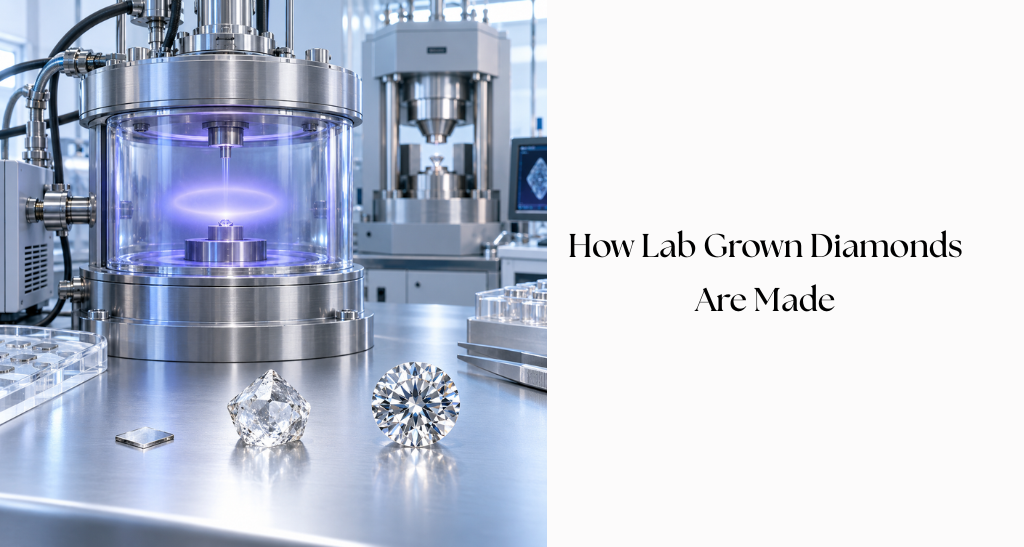
How Lab Grown Diamonds Are Made : Step-by-Step Guide
Lab grown diamonds are real diamonds created inside specialised machines instead of being taken from a mine. These machines provide the conditions in which carbon can develop into a diamond crystal.
The machine does not produce a polished, jewellery-ready diamond directly. It first grows a rough crystal, which is later checked, planned, cut, polished and graded. Here is how the process works, from the first stage of growth to the finished stone.
Before the Process: What Is a Diamond Seed?
To begin growing a diamond, manufacturers need a base on which the new crystal can form. They use a very small, flat piece of diamond called a diamond seed.
This seed already has the crystal structure that the new carbon atoms need to follow. It is carefully selected, polished and cleaned before being placed inside the growing equipment. Carbon gradually builds on it until a much larger rough diamond is formed.
The seed does not decide whether the finished diamond will be round, oval or pear shaped. That choice is made later when the rough crystal is planned and cut.
Which Methods Are Used to Grow Diamonds?
Manufacturers mainly use two methods: Chemical Vapour Deposition and High Pressure High Temperature. They create different growing conditions, but both can produce real diamonds.
| Point | CVD | HPHT |
|---|---|---|
| Full form | Chemical Vapour Deposition | High Pressure High Temperature |
| Equipment | Low-pressure chamber | High-pressure mechanical press |
| Carbon source | Carbon-rich gas | Solid carbon source |
| How growth happens | Carbon settles on the seed in layers | Carbon crystallises around the seed under heat and pressure |
| Possible growth features | Layered growth patterns or strain | Metallic inclusions may occur |
| Final material | Lab grown diamond | Lab grown diamond |
The growth method alone does not decide the final quality. Cut, colour, clarity and carat weight still need to be checked on the finished stone.
How Lab Grown Diamonds Are Made Step by Step
Step 1: Preparing the Diamond Seed
The process starts by selecting a diamond seed with the required crystal orientation. Its surface is polished and cleaned because unwanted particles can disturb the way carbon builds on it.
The prepared seed is then placed inside either a CVD chamber or an HPHT growth cell.
Step 2: Creating the Growth Environment
In the CVD method, the chamber is filled with hydrogen and a carbon-rich gas, commonly methane. Energy turns the gases into plasma, separating the carbon so that it can reach the diamond seed.
In the HPHT method, the seed is placed with a carbon source and metallic catalyst inside a small cell. The press then creates very high pressure and temperatures of roughly 1,300°C to 1,600°C.
Step 3: Carbon Builds the Diamond Crystal
During CVD growth, carbon atoms settle on the flat seed and join its crystal structure layer by layer. Hydrogen helps prevent unwanted graphite from building up with the diamond.
During HPHT growth, the heated catalyst melts and dissolves the carbon. The dissolved carbon moves towards the cooler diamond seed, where it crystallises and increases the size of the stone.
Step 4: The Crystal Grows Over Time
The diamond does not appear instantly. Many lab grown diamonds take around one to four weeks to grow, although the actual time changes with the method, equipment, desired size and growth conditions.
Temperature, gas flow and other conditions must remain controlled throughout this stage. Growing the crystal too quickly can increase the chance of unwanted colour, strain or inclusions.
Step 5: The Rough Diamond Is Removed and Checked
Once the required growth is complete, the equipment is cooled and the rough crystal is removed. At this stage, it does not look like the diamond seen in finished jewellery.
The rough diamond is checked for its usable size, colour, internal features and growth quality. Parts that are not suitable for a finished stone may be removed during planning.
Step 6: Post-Growth Treatment May Be Used
Some lab grown diamonds receive an additional treatment after growth to improve their colour. HPHT treatment, for example, may be used on certain CVD-grown diamonds.
Treatment is not required for every stone and does not change a lab grown diamond into a different material. When detected by a grading laboratory, the treatment may be mentioned on its report.
Step 7: Planning the Best Cut
Before cutting begins, the rough diamond is scanned and studied. The cutter plans how to achieve the best combination of shape, finished size and clarity while avoiding or reducing less desirable internal features.
A larger rough crystal does not always produce one large polished diamond. It may be divided into two or more stones when that gives a better result.
Step 8: Cutting and Polishing
The planned rough diamond is separated and shaped using specialised cutting equipment. Facets are then created at precise angles, and each surface is polished.
This stage has a major effect on the finished appearance. Even a good-quality crystal can look dull if its proportions and facets do not return light effectively.
This is why skilled cutting remains important for both lab grown and natural diamonds.
Step 9: Identification and Quality Assessment
After polishing, the diamond may be submitted to an independent gemological laboratory. Specialised instruments are used to confirm whether it is CVD-grown, HPHT-grown or natural.
Depending on the laboratory and report type, the document may include the diamond’s measurements, carat weight, colour, clarity, cut, polish, symmetry, growth method and detected post-growth treatment.
A report number may also be laser-inscribed on the diamond’s girdle. This number should match the grading report and can be checked on the issuing laboratory’s official website.
For more information, read our guide on lab grown diamond certification.
Step 10: Setting the Diamond into Jewellery
Once selected for a design, the polished diamond is placed into a ring, earring, pendant, bracelet or another piece. The setting must hold the stone securely without covering more of it than the design requires.
For gold jewellery in India, the diamond grading report and BIS hallmark serve different purposes. The grading report describes the diamond, while the hallmark and HUID relate to the purity and identity of the gold article.
Does the Growth Method Change the Appearance?
CVD and HPHT diamonds can have different microscopic growth patterns and inclusions. However, these features are not a reliable way for a customer to identify the growth method by looking at the jewellery.
Two diamonds grown using the same method can also receive different grades. The finished quality depends on how the crystal grew and how well it was cut, not simply whether the label says CVD or HPHT.
How Long Does the Complete Process Take?
Crystal growth often takes between one and four weeks, but that is only one part of production. Preparing the seed, checking the rough diamond, optional treatment, planning, cutting, polishing, grading and jewellery making all add time.
Therefore, the complete journey from the diamond seed to finished jewellery has no single fixed duration. A larger or more complex requirement can take longer than a smaller standard stone.
Are All Lab Grown Diamonds Identical?
No. Controlled production does not mean every diamond comes out with the same quality.
Small changes in temperature, pressure, gas flow or contamination can affect colour, inclusions and growth patterns. Cutting also creates visible differences between stones.
This is why buyers should compare the finished specifications and grading report instead of treating all diamonds of the same carat weight as equal.
FAQs About the Lab Grown Diamond Process
1. Is a Lab Grown Diamond Made from Glass?
No. It grows from carbon on a diamond seed and has essentially the same diamond crystal structure as a mined diamond. Glass, cubic zirconia and moissanite are different materials.
2. Is CVD Better Than HPHT?
Neither method is always better. Both can produce high-quality diamonds. Judge the finished stone by its cut, colour, clarity, proportions and grading report.
3. Are Post-Growth Treatments a Sign of a Fake Diamond?
No. Treatment may be used to improve the colour of a real lab grown diamond. The important point is that any detected treatment should be disclosed on the grading report.
4. Can You Identify the Growth Method with the Naked Eye?
Not reliably. A gemological laboratory uses advanced equipment to study features such as growth patterns, fluorescence and trace elements.
Final Thoughts
Making a lab grown diamond involves much more than placing carbon inside a machine. The starting diamond seed must be prepared, the growing conditions controlled and the rough crystal carefully planned before it is cut, polished and assessed.
Both CVD and HPHT can produce real diamonds suitable for fine jewellery. What matters to a buyer is the quality of the finished stone, a verifiable grading report and a secure jewellery setting.
For a broader buying overview, read A Complete Guide to Lab Grown Diamonds in India.


