




 All Earrings
 Stud Earrings
 Drop Earrings
 Solitaire
 Hoop Earrings
 Halo Earrings
 Vermeil Earrings
 Round
Round
 Oval
Oval
 Emerald
 Pear
Pear
 Princess
 Heart
Heart
 Marquise
 All Rings
 Solitaire Rings
 Band Rings
 Halo Rings
 Cocktail Rings
 Eternity Rings
 Fashion Ring
 Stack Rings
 Men's Rings
 Vermeil Rings
 All Necklaces
 Necklet
 Mangalsutra
 Solitaire
 Tennis Necklace
 Statement Necklace
 Vermeil Necklace
 Alphabets
 Solitaire Pendant
 Halo Pendant
 Vermeil Pendants
 All Bracelets
 Solitaire Bracelet
 Tennis Bracelet
 Fashion Bracelet
 Mangalsutra
 Vermeil Bracelets
 All Vermeil
 Vermeil Earring
 Vermeil Pendant
 Vermeil Ring
 Vermeil Necklace
 Vermeil Mangalsutra
 Vermeil Bracelets
 Vermeil Bangles
 Vermeil Men’s
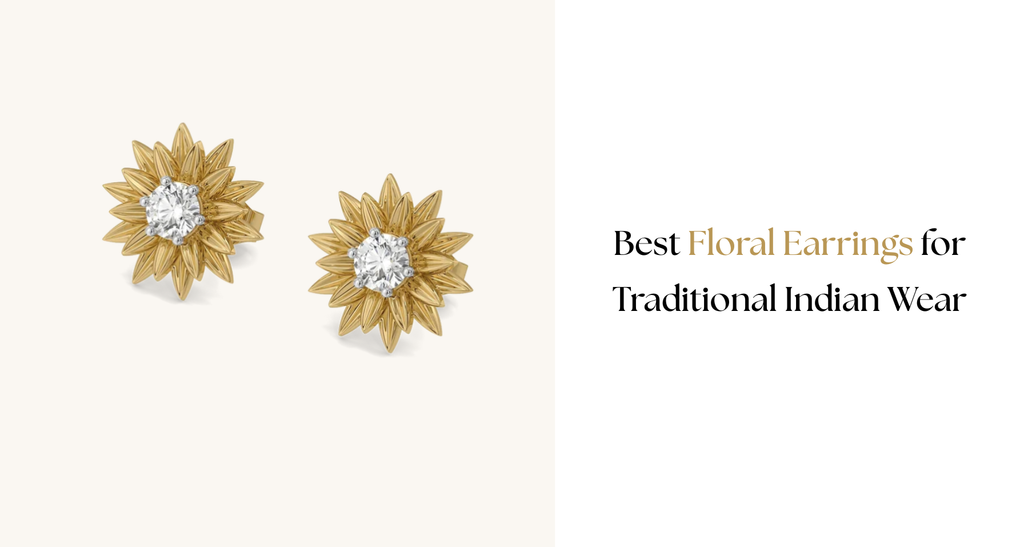
Best Floral Earrings for Traditional Indian Wear : Wedding Styles and Buying Guide
Floral earrings are often described as an easy match for Indian traditional wear. That is true, but it is also where most styling advice ends.
The real question is not whether floral earrings will suit a saree or lehenga. It is whether a particular floral design has the right scale, shape and level of detail for that outfit.
A five-petal diamond stud, a layered gold rose and a long floral drop may all be called floral earrings, but they create very different looks. One may quietly complete an outfit, while another may become the main feature around the face.
The most common mistake is choosing earrings only by colour. Pink earrings are paired with a pink lehenga, or yellow gold is selected simply because the saree has gold embroidery. A better choice considers the blouse neckline, fabric, dupatta position, necklace, hairstyle and the amount of decoration already close to the face.
This guide explains how to make that choice properly.
What Are Floral Earrings?
Floral earrings are earrings in which the main shape or arrangement is inspired by flowers, petals, buds or leaves.
Some designs show a clearly recognisable flower. Others create the impression of petals by arranging diamonds or gemstones around a centre stone.
For example, marquise-shaped diamonds naturally resemble pointed petals. Pear-shaped stones can form softer, wider petals, while round diamonds can create a compact flower cluster. A designer may also use curved gold surfaces instead of stones to build a layered rose or lotus shape.
This difference is important.
A flower made almost completely from diamonds looks light and bright. A flower made from broad gold petals appears stronger and more traditional. A gemstone-centred flower adds colour, while an open-petal design leaves more space between the stones and feels less heavy.
Floral earrings can therefore range from small everyday studs to detailed wedding earrings, even when the basic idea is the same.
Why Floral Earrings Work with Indian Traditional Wear
Floral earrings suit Indian clothing because floral forms already appear in many traditional fabrics and crafts.
You may see flowers in zari borders, chikankari, thread embroidery, brocade, meenakari, printed organza and bridal lehengas. However, the earring does not need to copy the exact flower on the outfit.
In fact, repeating the same large flower everywhere can make the styling look forced.
A better approach is to create a connection without making everything identical. A saree with fine floral embroidery may suit earrings made from delicate diamond petals. A silk outfit with bold woven motifs may need a flower with a clearer gold outline. A pastel lehenga with scattered flower work may look better with one structured floral earring than with another heavily decorated floral pattern.
Floral earrings also soften outfits that already have strong elements such as heavy borders, broad chokers or sharp necklines. Their rounded petals can make the overall look feel less rigid without taking away its traditional character.
Best Types of Floral Earrings for an Indian Wedding
The best style depends less on the name of the earring and more on where its visual weight sits.
Radial Floral Studs
Radial floral studs have a centre stone with petals spreading evenly around it.
Because the shape stays close to the ear, these earrings work well when a necklace, maang tikka or embroidered blouse is already attracting attention.
They are especially useful with:
-
Wide bridal chokers
-
High-neck blouses
-
Sarees with heavy zari
-
Layered necklaces
-
Dupattas placed over both shoulders
The important detail is the outer edge. A neat, clearly defined flower looks polished. A cluster with too many similarly sized stones may lose its floral shape from a distance and simply look like a round patch of sparkle.
Open-Petal Floral Earrings
In an open-petal design, a small space is left between the petals.
This reduces the solid appearance of the earring and allows light to pass through the design. Open-petal earrings often look better with lighter fabrics such as organza, chiffon, tissue and georgette.
They also suit outfits with delicate embroidery because they do not create another dense area around the face.
Layered Rose Earrings
Rose-inspired earrings are built with overlapping petals rather than a flat stone arrangement.
They have more depth and are usually visible from the side as well as the front. This makes them effective with a bun, ponytail or side-swept hairstyle.
However, depth also makes them look visually heavier. A large layered rose can feel crowded beside a broad necklace or blouse collar.
These earrings work best when the rose is allowed to be the main shape near the face, particularly with:
-
Plain or lightly embroidered blouses
-
Soft silk sarees
-
Pastel lehengas
-
Reception outfits
-
Outfits worn without a heavy necklace
Floral Drop Earrings
Floral drop earrings use a flower at the top and add movement below it through a diamond line, pearl, chain or second floral element.
The length creates a vertical line, which can balance wide necklines and fuller blouse shapes. It also helps the earrings remain visible when the hair is open.
The most wearable floral drops do not place all their weight at the bottom. If the lowest part is too heavy, the earring may swing excessively and pull the ear forward.
For a wedding function that lasts several hours, a controlled drop is usually more comfortable than a very long shoulder-touching design.
Floral Hoops
Floral hoops work well when the outfit is traditional but the styling is modern.
The flower may sit at the front of the hoop, repeat along its curve or appear as a detachable charm. A cleaner floral hoop can suit pre-draped sarees, corset blouses and contemporary lehengas better than a traditional chandelier earring.
The hoop should not compete with a heavily worked blouse sleeve or dupatta border. Medium hoops usually create a better balance than very wide hoops when there is already embroidery close to the shoulders.
Detachable Floral Earrings
Some floral earrings have removable drops or jackets.
They may be worn as flower studs during a daytime ceremony and changed into longer earrings for the evening. This is useful when buying fine jewellery because the same pair can be worn beyond one wedding outfit.
A detachable design should still look complete without the lower section. The stud should not appear like an unfinished connector when worn alone.
Best Floral Earrings for Sarees, Lehengas and Anarkalis
The outfit category gives only a starting point. Fabric, blouse design and draping matter more.
Floral Earrings for Silk Sarees
Kanjeevaram, Banarasi and other heavy silk sarees have a strong surface and visible borders. Very thin floral earrings can disappear beside them.
Choose a design with:
-
A defined gold outline
-
A visible centre stone
-
Medium-sized petals
-
A compact pearl or gemstone drop
-
Enough structure to match the saree’s richness
A heavy saree does not automatically require large earrings. When the saree is paired with a broad necklace, smaller structured floral earrings are usually more balanced.
With temple-style jewellery, lotus-inspired or rounded gold-petal designs can create a smoother connection than modern open hoops.
Floral Earrings for Organza, Chanderi and Tissue Sarees
These fabrics often look light even when they include embroidery or metallic shine.
Airy floral earrings generally work better than solid gold flowers. Look for visible spaces between petals, fine diamond arrangements and narrow drops.
If the saree has large printed flowers, avoid choosing another oversized flower for the ear. The outfit already provides the main floral statement. Smaller diamond or gemstone flower earrings can add sparkle without repeating the print too literally.
Tissue sarees reflect a lot of light. Earrings with too many closely placed diamonds may merge with the shine of the fabric. A clear silhouette with some visible gold can create better definition.
Floral Earrings for Bridal Lehengas
A bridal lehenga usually places detail across the blouse, dupatta, neckline and head covering. The earrings must fit into this frame.
First check how the dupatta will be worn.
When one dupatta covers the head and frames both sides of the face, very wide earrings may become partly hidden or catch on the fabric. A narrow floral drop or compact cluster can be more practical.
When the dupatta stays mainly on one shoulder, the earrings have more open space and can be slightly wider.
Next, check the blouse.
A blouse covered in stones or metallic embroidery already creates sparkle near the earrings. In this case, choose a floral design with one clear centre and fewer surrounding elements. An earring filled with many small petals, chains and pearl rows may become lost against the blouse.
For a cleaner silk or velvet blouse, fuller floral earrings can provide the missing detail.
Floral Earrings for Pastel Lehengas
Pastel outfits are often styled with rose gold or white gold, but the choice should not be automatic.
Look at the embroidery thread and metalwork. Champagne, peach and blush outfits with warm embroidery can suit rose gold. Lilac, powder blue and grey outfits with silver work may look cleaner with white gold.
Pastel does not always mean delicate. A plain pastel lehenga can support a large floral earring, while a pastel lehenga covered in three-dimensional flowers may need a much simpler pair.
Floral Earrings for Anarkalis
Anarkalis create a long shape through the body, so earrings with controlled length often suit them.
With a deep round or V-neck Anarkali, a floral drop can continue the vertical flow. With a high-neck or band-collar Anarkali, a wide earring may make the upper part feel crowded. A compact flower stud, short drop or floral ear climber is a better choice.
Also check the dupatta border. When a broad border is draped close to the neck, the earrings should be simple enough to remain separate from it.
How to Choose Floral Earrings for Indian Traditional Wear
A useful method is to check five things before buying.
1. Look at the Available Space Around the Face
A high blouse, heavy necklace, dupatta and maang tikka reduce the open space around the face.
When several elements are already present, choose earrings that stay close to the ear. When the neckline is open and the hair is tied back, a larger floral design can fill the space without looking excessive.
2. Compare the Size of the Motifs
A large floral print does not always need large floral earrings.
In most cases, contrast looks better than repetition. Large outfit motifs can be balanced with smaller earrings. Fine embroidery can support a slightly larger but clean floral shape.
3. Check Where the Metal Is Visible
Two earrings with the same number of diamonds may look completely different depending on the amount of visible gold.
More visible yellow gold creates a traditional and stronger appearance. Less visible metal makes the stones appear to form the flower on their own, giving the design a lighter and more modern finish.
4. View the Earring from the Side
Product photographs often show only the front.
A floral earring may have thick layered petals, a raised centre or a deep setting. This affects how far it sits from the ear and whether it will catch in hair or a dupatta.
The side profile is especially important for large studs.
5. Do Not Ignore the Actual Weight
The visual size of an earring does not reveal how comfortable it will be.
An open design can appear large but remain light. A small solid-gold flower may be heavier than expected. Check the product weight and whether it is mentioned for one earring or for the complete pair.
How to Match Floral Earrings with a Necklace
The earrings and necklace should not fight for the same space.
A useful rule is to select one main piece.
When the necklace is broad, layered or highly detailed, choose floral earrings with a clear shape but limited length. When the necklace is a fine chain or is not being worn, the earrings can become larger and more expressive.
An identical floral set is not always the best choice. Repeating the same flower across a choker, earrings and maang tikka can make the jewellery appear uniform rather than thoughtfully styled.
Instead, connect the pieces through one shared detail:
-
The same gold colour
-
A matching centre gemstone
-
Similar diamond shapes
-
One repeated pearl detail
-
A similar antique or polished finish
Spacing also matters. If the necklace sits very close to the jawline, long earrings may touch it when the head moves. This is uncomfortable and can damage delicate sections over time.
Best Gold Colour for Traditional Outfits
The best gold colour is usually decided by the outfit’s metallic work and the other jewellery, not simply by the fabric colour.
Yellow Gold
Yellow gold suits outfits with warm zari, antique embroidery and traditional red, maroon, green, mustard or royal blue combinations.
It also gives the flower outline more visibility, which is useful in earrings that rely on shaped gold petals.
Rose Gold
Rose gold works well when the outfit contains warm pink, peach, champagne or copper-toned detailing.
It can soften a geometric blouse or modern lehenga, but it may look disconnected when the saree border and necklace are strongly yellow gold.
White Gold
White gold allows diamonds to remain the main visual feature.
It suits silver embroidery, cool-toned outfits and contemporary wedding styling. It can also be worn with traditional clothing when the rest of the jewellery uses a clean diamond-led design.
Mixing metal colours can work, but it should appear intentional. One isolated rose gold pair with an otherwise heavy yellow gold bridal set may look accidental.
Materials Used in High-Quality Floral Earrings
Fine floral earrings may use 14KT, 18KT or 22KT gold, depending on the design.
For earrings with many small stones, the strength of the setting is important because each petal may have its own prongs. Diamond floral earrings may use round, marquise, pear or oval stones to build the flower rather than relying on one large central diamond.
Lab grown diamonds can also be used in the same kinds of floral arrangements as mined diamonds. Diamond quality should be understood through details such as cut, colour, clarity and carat weight rather than through sparkle alone. GIA describes the 4Cs as the standard framework for evaluating diamond quality.
Coloured gemstones are often used in the centre of a floral design. Emeralds create a stronger contrast, while pink sapphires, rubies and other stones can add a softer or richer colour.
Pearls are commonly added below the flower, but they should be checked for secure attachment. Enamel can introduce colour into petals or leaves without increasing the number of stones.
Fine-Jewellery Floral Earrings vs Fresh-Flower Earrings
Fresh-flower earrings and fine-jewellery floral earrings serve different purposes.
Fresh flowers are closely connected with Haldi and Mehendi styling. They create a natural, playful look and can be coordinated with floral bracelets, hair flowers and a maang tikka. However, their appearance changes with heat, moisture and wearing time. They are mainly chosen for one event.
Fine-jewellery floral earrings interpret the flower through gold, diamonds and gemstones. They can be worn again for festivals, dinners, family functions and future weddings.
A bride may choose fresh flowers when the complete function has an informal floral theme. Fine jewellery is a better choice when she wants a polished finish and long-term use.
Artificial flower earrings sit between the two. They last longer than fresh flowers but do not have the material value or durability of fine jewellery.
Floral Earrings for Different Wedding Functions
For a Haldi ceremony, the earrings should remain comfortable and easy to manage. Fresh flowers, enamel flowers, light gold studs and yellow gemstone details are practical choices.
For Mehendi, colourful floral earrings work well because the function usually allows more playful styling. Green stones, pink enamel and multi-flower drops can be worn without needing a heavy necklace.
For the engagement, one polished floral feature often looks better than a complete heavy set. Diamond flower studs, rose-inspired earrings or a refined floral drop can frame the face without making the look feel bridal too early.
For the wedding ceremony, the choice should be made after finalising the necklace, maang tikka and dupatta. Compact floral earrings may work better than long earrings when all three are already present.
For the reception, the jewellery can be cleaner and more diamond-focused. White gold floral earrings, modern hoops and sculpted rose designs work particularly well with gowns, draped sarees and contemporary lehengas.
How to Check Quality Before Buying
Start by checking whether the flower is clearly formed.
The centre stone should sit in the correct position, and the petals should appear balanced on both earrings. In deliberately asymmetric designs, the difference should still look controlled rather than accidental.
Inspect the prongs around every diamond or gemstone. They should hold the stones firmly without appearing thick, uneven or unfinished. Run a soft cloth lightly over the surface. Sharp or raised sections that catch easily may also catch on hair and dupattas.
Check the back of the earrings, not just the front. The polish should be clean, the openings behind the stones should be properly finished, and there should be no rough metal close to the skin.
For larger studs, check whether the post is positioned near the centre of balance. A poorly positioned post can cause the flower to tilt downward.
For drops and hoops, test the hinge or joint several times. It should move smoothly without feeling loose. Screw backs and push backs should hold securely.
When buying gold jewellery in India, check the hallmark and HUID details. The BIS CARE application includes a “Verify HUID” feature that consumers can use to check hallmarked gold jewellery.
Also confirm:
-
Whether the listed weight is for one earring or the pair
-
Gold purity
-
Diamond or gemstone details
-
Product dimensions
-
Certification, where offered
-
Warranty and repair support
-
Return and exchange conditions
A close-up image can show the stone setting, but it cannot tell you how large the earring will look on the ear. Always compare the written dimensions before purchasing online.
Final Thoughts
The best floral earrings are not necessarily the pair that matches the outfit colour most closely.
A good pair understands the space around the face. It has the right scale for the embroidery, enough structure for the fabric, and the correct amount of detail for the necklace and dupatta.
With a heavy silk saree, the flower may need a stronger outline. With organza, open petals may look more natural. With a bridal lehenga, compact earrings may create better balance than another large statement piece. With a simple Anarkali or reception outfit, the earrings can take the lead.
Once proportion, construction and comfort are considered, floral earrings stop looking like a basic wedding accessory. They become a deliberate part of the complete traditional look.


