








 All Earrings
 Stud Earrings
 Drop Earrings
 Solitaire
 Hoop Earrings
 Halo Earrings
 Vermeil Earrings
 Round
Round
 Oval
Oval
 Emerald
 Pear
Pear
 Princess
 Heart
Heart
 Marquise
 All Rings
 Solitaire Rings
 Band Rings
 Halo Rings
 Cocktail Rings
 Eternity Rings
 Fashion Ring
 Stack Rings
 Men's Rings
 Vermeil Rings
 All Necklaces
 Necklet
 Mangalsutra
 Solitaire
 Tennis Necklace
 Statement Necklace
 Vermeil Necklace
 Alphabets
 Solitaire Pendant
 Halo Pendant
 Vermeil Pendants
 All Bracelets
 Solitaire Bracelet
 Tennis Bracelet
 Fashion Bracelet
 Mangalsutra
 Vermeil Bracelets
 All Vermeil
 Vermeil Earring
 Vermeil Pendant
 Vermeil Ring
 Vermeil Necklace
 Vermeil Mangalsutra
 Vermeil Bracelets
 Vermeil Bangles
 Vermeil Men’s
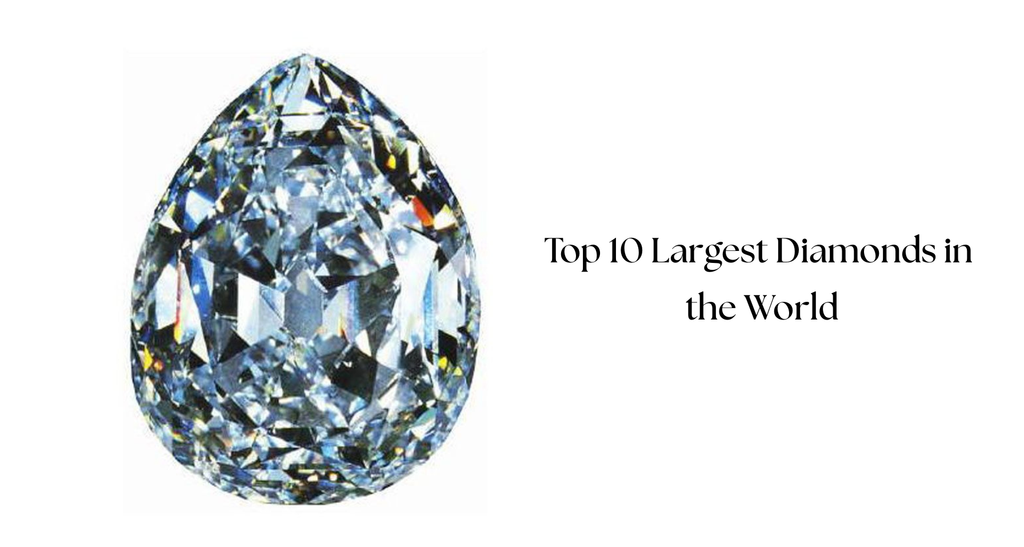
Top 10 Largest Diamonds in the World
Some diamonds are remembered for their price, colour or royal owners. Others became famous because of their extraordinary size and the stories that followed after they were found.
A large rough diamond rarely remains in its original form. Cutters may spend months or even years studying the stone before deciding how to divide it. One rough diamond may produce a single record-breaking polished stone, while another may be cut into dozens of smaller diamonds.
This article follows ten historically famous diamonds commonly included in lists of the world’s largest diamonds. They are ranked by their recorded or reported rough weight. Recent unnamed rough recoveries are not included because this list focuses on diamonds that have established names and recognised stories.
What Are the 10 Biggest Diamonds in the World?
The diamonds in this list originally weighed between approximately 770 and 3,167 carats. They were found in Brazil, South Africa, Botswana, India, Sierra Leone and the Democratic Republic of Congo. Some became part of royal collections, while others were cut into diamonds now held by jewellery houses and private collectors.
Top 10 Largest Diamonds in the World
| Rank | Diamond | Recorded or Reported Rough Weight | Year Found | Country |
|---|---|---|---|---|
| 1 | Sérgio | 3,167 carats | 1905 | Brazil |
| 2 | Cullinan Diamond | 3,106.75 carats | 1905 | South Africa |
| 3 | Lesedi La Rona | 1,109 carats | 2015 | Botswana |
| 4 | Excelsior Diamond | 995.2 carats | 1893 | South Africa |
| 5 | Star of Sierra Leone | 968.9 carats | 1972 | Sierra Leone |
| 6 | Incomparable Diamond | 890 carats | 1980 | Democratic Republic of Congo |
| 7 | Constellation Diamond | 812.77 carats | 2015 | Botswana |
| 8 | Koh-i-Noor | Reported at around 793 carats in early rough form | Historical records uncertain | India |
| 9 | Millennium Star | 777 carats | 1990 | Democratic Republic of Congo |
| 10 | Woyie River Diamond | Approximately 770 carats | 1945 | Sierra Leone |
The figures for some historic diamonds vary between records. Lesedi La Rona, for example, was initially announced at 1,111 carats and later recorded at a cleaned weight of 1,109 carats. The early rough weight of the Koh-i-Noor is also disputed, while its current polished weight is accurately recorded at 105.6 carats.
1. Sérgio: The 3,167-Carat Carbonado
Sérgio weighed approximately 3,167 carats, making it heavier than the Cullinan Diamond. It was recovered in Bahia, Brazil, and is widely described as the largest carbonado ever recorded.
Carbonado is different from a conventional transparent diamond crystal. It is a dark, porous and polycrystalline material formed from numerous small diamond crystals joined together. This is why Sérgio is normally classified separately from gem-quality diamonds such as the Cullinan.
Carbonado is known for its toughness and was historically valued for industrial cutting and drilling. Its unusual structure has also led to several theories about its formation, including possible extraterrestrial origins. However, the origin of carbonado remains unresolved, and no single theory has been conclusively accepted.
Sérgio therefore holds the record for the largest reported carbonado, while the Cullinan remains the largest gem-quality single-crystal rough diamond.
2. Cullinan Diamond: The Giant Behind the Crown Jewels
The Cullinan Diamond was found near Pretoria in South Africa on 26 January 1905. In its rough form, it weighed 3,106.75 carats and measured approximately 10.1 centimetres along its longest side.
It was named after Thomas Cullinan, chairman of the mining company that owned the Premier Mine. The Transvaal government later purchased the stone and presented it to King Edward VII in 1907.
The diamond was sent to the Asscher company in Amsterdam, where specialists spent months planning how it should be divided. Preparing the first groove alone took several days. On the first attempt to cleave it, the cutting knife reportedly broke while the diamond remained intact.
Three polishers then worked for eight months to create nine major diamonds, 97 smaller brilliants and several fragments.
- Cullinan I: 530.2 carats
- Cullinan II: 317.4 carats
Cullinan I, also known as the Great Star of Africa, is mounted in the Sovereign’s Sceptre with Cross. Cullinan II is set in the Imperial State Crown.
3. Lesedi La Rona: From 1,109-Carat Rough to a 302-Carat Diamond
Lesedi La Rona was found at the Karowe Mine in Botswana in November 2015. Its name means “our light” in Setswana.
The rough diamond was initially announced at 1,111 carats. After cleaning, its recorded weight was revised to 1,109 carats. At the time, it was the largest gem-quality rough diamond found in more than a century.
In 2016, it was offered at Sotheby’s but failed to meet its reserve price. Lucara Diamond later sold it to Graff Diamonds in 2017 for US$53 million.
Graff spent more than 18 months studying the stone. Special scanning and cutting technology was used to understand its internal structure and determine how much high-quality material could be preserved.
The main result was the 302.37-carat Graff Lesedi La Rona, a D-colour square emerald-cut diamond. Another 66 polished diamonds were created from the same rough stone.
4. Excelsior Diamond: The Record Holder Before the Cullinan
The Excelsior Diamond was found at the Jagersfontein Mine in South Africa in 1893. It weighed 995.2 carats and held the record for the world’s largest known diamond until the Cullinan was found in 1905.
The rough diamond had an unusual shape. It was flat on one side and rose towards a peak on the other, giving it the appearance of a mountain. Its name, Excelsior, means “higher”.
Although the stone was extremely large, finding a buyer was difficult. Its size made cutting expensive and risky, and a mistake could have destroyed a considerable amount of valuable material.
In 1903, the rough was sent to Amsterdam and divided into several pieces. It ultimately produced 21 polished diamonds, although the final stones were sold separately and the identity of the original Excelsior was gradually lost.
The largest polished result weighed approximately 69.68 carats. The Excelsior’s story is often viewed as a missed opportunity because it may have been possible to produce one much larger principal diamond.
5. Star of Sierra Leone: One Rough Diamond, 17 Polished Stones
The Star of Sierra Leone was found on Valentine’s Day in 1972 near Koidu, Sierra Leone. The rough diamond weighed 968.9 carats and was among the largest gem-quality diamonds known at the time.
Harry Winston purchased it later that year for just under US$2.5 million. The rough was first cut into a large emerald-shaped diamond, but an internal flaw was later noticed. It was then divided again to improve the quality and value of the resulting stones.
The original rough ultimately produced 17 polished diamonds with a combined weight of 238.48 carats. Thirteen of those diamonds were graded as flawless.
Several polished stones from the rough became known individually as members of the Star of Sierra Leone family. The story demonstrates why retaining maximum weight is not always the best decision. Removing inclusions can produce smaller but considerably finer diamonds.
6. Incomparable Diamond: Found in a Pile of Rubble
The Incomparable Diamond has one of the most unusual discovery stories on this list.
It was found in 1980 by a young girl playing near a pile of mining rubble in the Democratic Republic of Congo. The material had previously been rejected because it was considered too bulky to contain valuable diamonds.
The rough diamond weighed approximately 890 carats. Specialists spent several years studying it before choosing a final design. Rather than retaining the greatest possible weight, they removed heavily included areas to create a cleaner polished diamond.
The main stone became a 407.48-carat Fancy Deep brownish-yellow shield-shaped diamond. It was graded internally flawless, making it one of the largest internally flawless polished diamonds ever examined.
It later became the centrepiece of Mouawad’s L’Incomparable necklace, which was valued at US$55 million and recognised as the world’s most valuable necklace at the time.
7. Constellation Diamond: A Record-Breaking Rough-Diamond Sale
The Constellation was recovered at Botswana’s Karowe Mine in November 2015, during the same period as Lesedi La Rona.
It weighed 812.77 carats and was identified as a Type IIa diamond. Type IIa diamonds contain very little measurable nitrogen and may display exceptional transparency.
In May 2016, Lucara Diamond sold the rough stone to Nemesis International DMCC for US$63,111,111. At the time, it was the highest amount ever paid for a rough diamond. The price worked out to approximately US$77,649 per carat.
The rough was later divided into several polished diamonds. The largest was a colourless emerald-cut stone weighing more than 300 carats.
The Constellation’s sale showed that the value of an exceptional rough diamond depends not only on its current appearance but also on what expert cutters believe can be produced from it.
8. Koh-i-Noor: Famous for Its History, Not Just Its Size
The Koh-i-Noor is one of the most recognised diamonds in the world. Its name means “Mountain of Light” in Persian.
It probably originated from the Golconda diamond region of India. However, its earliest history and original rough weight are uncertain. Some historical accounts place its early weight at around 793 carats, but this figure cannot be treated with the same certainty as modern measured rough weights.
The diamond passed through the hands of Mughal emperors, Persian rulers, Afghan leaders and Sikh maharajas. Following the annexation of Punjab, the East India Company took the diamond from Maharaja Duleep Singh in 1849 under the terms of the Treaty of Lahore.
It was surrendered to Queen Victoria and later recut in 1852. Its present weight is 105.6 carats. It is set in the Crown of Queen Elizabeth the Queen Mother and forms part of the British Crown Jewels.
The Koh-i-Noor is therefore included because of its reported historic rough size and extraordinary history, not because it remains one of the largest polished diamonds today.
9. Millennium Star: Three Years in the Cutting Room
The rough diamond that produced the Millennium Star was found in the Mbuji-Mayi region of the Democratic Republic of Congo in 1990. It weighed 777 carats.
De Beers purchased the rough stone, and specialists from the Steinmetz Group spent more than three years cutting it. Lasers were used during the process to create the final pear-shaped diamond while preserving its exceptional quality.
The finished Millennium Star weighs 203.04 carats. It received a D colour and flawless clarity grade, meaning no internal or external imperfections were observed under standard grading conditions.
The diamond became the centrepiece of the De Beers Millennium Jewels collection, which was presented in London to mark the beginning of the year 2000.
It later became part of a widely reported attempted robbery at London’s Millennium Dome, although the attempt was stopped before the diamonds could be taken.
10. Woyie River Diamond: The Source of the Victory Diamond
The Woyie River Diamond was found near Koidu in eastern Sierra Leone on 6 January 1945.
Its rough weight is generally recorded at approximately 770 carats, although some secondary lists round or report it as 777 carats. At the time, it was the largest alluvial diamond ever found.
The rough stone was taken to England, where it was shown to Queen Mary in 1947. It was later displayed to the public at the British Industries Fair in 1949.
The diamond was cut into 30 polished stones weighing a combined 282.36 carats. Ten of the resulting diamonds weighed more than 20 carats each.
The largest was the Victory Diamond, an emerald-cut diamond weighing approximately 31.35 carats. The name referred to the Allied victory in the Second World War, which ended during the year the rough diamond was found.
Which Is the Largest Diamond in the World?
The answer depends on the type of diamond being compared.
- Largest reported carbonado: Sérgio, 3,167 carats
- Largest gem-quality single-crystal rough diamond: Cullinan, 3,106.75 carats
- Largest polished diamond: Golden Jubilee, 545.67 carats
- Largest colourless polished diamond: Cullinan I, 530.2 carats
Sérgio was heavier than the Cullinan, but it was a polycrystalline carbonado rather than a single transparent gem-quality crystal. This is why most gemological records describe the Cullinan as the world’s largest gem-quality rough diamond.
Why Do Large Rough Diamonds Lose So Much Weight?
A cutter cannot simply polish the outside of a rough diamond and keep its full weight.
The rough may contain:
- Cracks and cleavage lines
- Dark inclusions
- Cloudy sections
- Uneven growth areas
- Weak corners
- Material that must be removed to create balanced proportions
The cutter must decide whether to produce one large polished diamond or several smaller ones. Keeping more weight may result in lower clarity or an unattractive shape, while removing more material may create a smaller but more valuable diamond.
The Cullinan weighed more than 3,100 carats, but its largest polished result weighs 530.2 carats. Lesedi La Rona weighed 1,109 carats, while its principal polished diamond weighs 302.37 carats.
Are the Largest Diamonds Also the Most Expensive?
Not always.
Carat weight is important, but the value of a diamond also depends on:
- Colour
- Clarity
- Internal structure
- Rarity
- Cut potential
- Historical importance
- Ownership
- Auction demand
A smaller red, blue or pink diamond may sell for more per carat than a much larger colourless stone. Similarly, a large rough diamond containing fractures may be worth less than a smaller rough diamond capable of producing a flawless polished stone.
Also read: Top 10 World’s Most Expensive Diamond Rings
FAQs
What is the biggest diamond ever found?
Sérgio was heavier at approximately 3,167 carats, but it was a carbonado. The Cullinan, weighing 3,106.75 carats, is recognised as the largest gem-quality single-crystal rough diamond ever found.
Is the Cullinan bigger than the Koh-i-Noor?
Yes. The original Cullinan weighed 3,106.75 carats. The Koh-i-Noor currently weighs 105.6 carats after recutting.
What happened to the Cullinan Diamond?
The Cullinan was divided into nine major stones, 97 smaller brilliants and several fragments. Cullinan I and Cullinan II are now set in the British Crown Jewels.
Which diamond produced the largest square emerald-cut stone?
Lesedi La Rona produced the 302.37-carat Graff Lesedi La Rona, recognised as the world’s largest square emerald-cut diamond.
Is the Millennium Star still 777 carats?
No. The original rough weighed 777 carats. The finished pear-shaped Millennium Star weighs 203.04 carats.
Why is Sérgio different from other diamonds on the list?
Sérgio is a carbonado made from many small diamond crystals. Most other stones in the list were single diamond crystals capable of producing transparent polished gems.
Conclusion
The world’s largest diamonds are remembered for much more than their carat weight.
The Cullinan became a collection of royal jewels. Lesedi La Rona produced a 302.37-carat masterpiece. The Constellation set a rough-diamond sale record, while the Incomparable began its story in a discarded pile of rubble.
Even the stones that lost most of their weight during cutting gained something in return: improved clarity, stronger proportions and a form suitable for jewellery.
Their histories also show that “largest” can have several meanings. Sérgio is the largest recorded carbonado, the Cullinan is the largest gem-quality rough diamond, and the Golden Jubilee is the largest polished diamond.
Each record belongs to a different category, but together these diamonds remain among the most important stones ever found.


