




 All Earrings
 Stud Earrings
 Drop Earrings
 Solitaire
 Hoop Earrings
 Halo Earrings
 Vermeil Earrings
 Round
Round
 Oval
Oval
 Emerald
 Pear
Pear
 Princess
 Heart
Heart
 Marquise
 All Rings
 Solitaire Rings
 Band Rings
 Halo Rings
 Cocktail Rings
 Eternity Rings
 Fashion Ring
 Stack Rings
 Men's Rings
 Vermeil Rings
 All Necklaces
 Necklet
 Mangalsutra
 Solitaire
 Tennis Necklace
 Statement Necklace
 Vermeil Necklace
 Alphabets
 Solitaire Pendant
 Halo Pendant
 Vermeil Pendants
 All Bracelets
 Solitaire Bracelet
 Tennis Bracelet
 Fashion Bracelet
 Mangalsutra
 Vermeil Bracelets
 All Vermeil
 Vermeil Earring
 Vermeil Pendant
 Vermeil Ring
 Vermeil Necklace
 Vermeil Mangalsutra
 Vermeil Bracelets
 Vermeil Bangles
 Vermeil Men’s
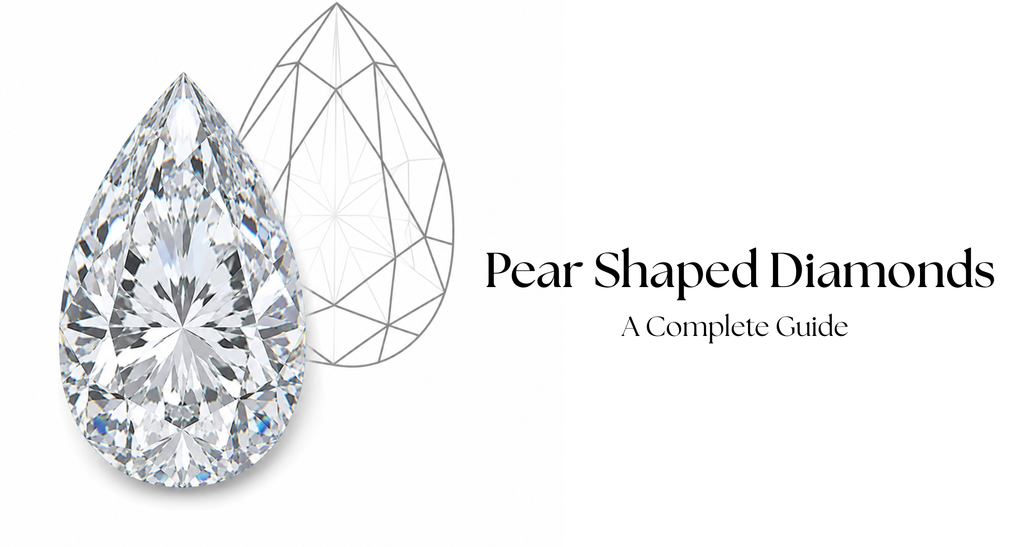
All About Pear Shaped Diamonds
Some diamond shapes have remained popular for hundreds of years, even though jewellery trends continue to change. The pear shaped diamond is one of them.
It has a look that is easy to recognise, yet no two pear shaped diamonds ever look exactly the same. A slight change in its curves, proportions or pointed tip can change its overall appearance.
This unique outline is one of the biggest reasons people are attracted to pear shaped diamonds. It looks different from traditional round or princess cut diamonds while still providing strong sparkle.
The longer shape can also create the impression of slimmer fingers, making it a popular choice for engagement rings.
But buying a pear shaped diamond is not as simple as choosing the carat weight or colour grade.
This is one of the few diamond shapes where balance matters just as much as sparkle. Two diamonds with identical grading reports can look very different if one has uneven curves, a poorly placed point or an obvious bow tie effect.
In this guide, you will learn how pear shaped diamonds were created, what makes them different from other diamond cuts, how they are evaluated and what details deserve your attention before buying one.
History of Pear Shaped Diamonds
The story of the pear shaped diamond begins during the fifteenth century, a time when diamond cutting was still developing.
Most diamonds were polished only enough to improve their natural appearance because cutters had limited tools and techniques. Jewellery was already highly valued, but creating perfectly shaped diamonds was far more difficult than it is today.
Everything began to change as craftsmen learned how to polish diamonds with greater precision.
One of the names most closely connected with this progress is Lodewyk van Bercken, a Flemish diamond cutter who introduced new polishing methods during the late 1400s. His techniques allowed cutters to create more accurate facets, improving both the beauty and brilliance of diamonds.
The pear shaped cut grew from these early innovations. By combining a rounded brilliant-style end with a pointed tip, cutters created a completely new outline that looked elegant without sacrificing light performance.
As diamond cutting continued to improve, pear shaped diamonds found their place in royal collections and fine jewellery across Europe. Their unusual outline made them stand out, while the skill required to cut them correctly made them even more desirable.
Although modern technology has transformed the way diamonds are cut today, the basic design of the pear shaped diamond has remained remarkably consistent for more than five centuries. That alone says a lot about how successful this shape has been.
What Is a Pear Shaped Diamond?


A pear shaped diamond is a fancy diamond cut that combines features of two different diamond shapes.
One end is rounded like a round brilliant diamond, while the opposite end narrows into a single point. Because of this combination, many people also describe it as a teardrop-shaped diamond.
Unlike square, cushion or princess cuts, a pear shaped diamond is not perfectly symmetrical from every direction. It has a clear top and bottom, which means the direction in which it is worn becomes part of its overall appearance.
Most people wear the pointed end facing towards the fingertip when it is set in a ring because it creates a longer and more graceful look on the hand. However, some prefer wearing it in the opposite direction because they like the style better.
This is one of the reasons pear shaped diamonds feel more expressive than many other cuts. The same diamond can look slightly different depending on how it is set and worn.
The shape also works well in pendants and earrings because its natural outline creates movement and attracts attention without looking oversized.
The Main Parts of a Pear Shaped Diamond
Understanding the basic parts of a pear shaped diamond makes it easier to judge its quality.
A pear shaped diamond may look simple from a distance, but its beauty depends on how well each part of the outline works together.

Rounded End
The rounded side forms the wider portion of the diamond.
It should appear smooth and balanced without looking too flat, too wide or uneven. If this part is not shaped properly, the diamond can lose the soft curve that makes the pear shape attractive.
A good rounded end should flow naturally into the sides of the diamond.
Pointed Tip
The pointed tip gives the diamond its unique identity.
Since this area is thinner than the rest of the stone, it is usually protected by a V-shaped prong when set into jewellery. This is not only a design choice. It also helps protect the most delicate part of the diamond from accidental impact.
Without proper protection, the pointed tip is more exposed than rounded diamond edges.
Shoulders
The shoulders connect the rounded end to the pointed tip.
Both sides should curve evenly. If one shoulder looks higher, wider or heavier than the other, the diamond may appear unbalanced.
This is one of the first things to check when comparing pear shaped diamonds.
Wings
The wings are the gently curved edges running along both sides of the diamond.
They should match each other as closely as possible. Uneven wings can make the diamond look slightly twisted, even if the difference is small.
In pear shaped diamonds, these small outline details matter because the eye naturally follows the full shape from the rounded end to the point.
How Is a Pear Shaped Diamond Cut?

Creating a beautiful pear shaped diamond requires much more than simply polishing a rough stone into a teardrop.
The cutter has to balance several factors at the same time. The outline must remain symmetrical, the facets must reflect light evenly and the proportions should create a pleasing overall shape.
Most pear shaped diamonds use brilliant-style faceting similar to round brilliant diamonds. These carefully arranged facets allow light to travel through the stone before reflecting back to the viewer, creating the sparkle people expect from a diamond.
However, the cutter also has to manage the shape carefully.
If too much weight is preserved during cutting, the diamond may look bulky or uneven. If too much material is removed, valuable carat weight is lost. Finding the right balance is one of the biggest challenges when cutting this shape.
This is why two pear shaped diamonds with the same carat weight can look very different.
One may look balanced, bright and graceful, while another may look heavy on one side or too narrow at the tip. The difference usually comes from the way the diamond was cut.
This is also why visual inspection is very important for pear shaped diamonds. A grading report can tell you the colour, clarity and carat weight, but it cannot fully show how attractive the outline looks in real life.
Why Symmetry Is So Important
When looking at a pear shaped diamond, symmetry is one of the first things your eyes notice.
Imagine folding the diamond in half from top to bottom. Both sides should appear almost identical.
The point should sit directly in the centre.
The rounded end should not lean towards either side.
The shoulders should match each other.
The wings should have similar curves.
Even small differences can affect the overall appearance. A diamond with poor symmetry may look slightly crooked, even if its colour and clarity are excellent.
This matters more in pear shaped diamonds than in many other cuts because the outline has a clear direction. The pointed tip and curved sides make imbalance easier to notice.
A buyer should never judge a pear shaped diamond only by the certificate. The certificate is useful, but the actual shape needs to be checked visually.
For this reason, many experienced buyers spend extra time checking the outline before comparing other details.
Understanding the Length-to-Width Ratio
One of the biggest reasons pear shaped diamonds look different from each other is their length-to-width ratio.
This ratio compares how long the diamond is to how wide it is.
A lower ratio creates a shorter and wider diamond.
A higher ratio creates a longer and slimmer appearance.
Many jewellers consider a ratio between 1.50 and 1.75 to be a balanced range, although some buyers may prefer a slightly fuller shape closer to 1.45.
If you prefer a fuller shape, choose a ratio closer to 1.45.
If you like a slimmer and more elongated look, a ratio closer to 1.60 or above may suit your preference better.

However, the ratio should not be the only thing you judge.
Two pear shaped diamonds can have the same length-to-width ratio and still look different if one has uneven shoulders, a flat rounded end or a point that is not centred properly.
The ratio is only a starting point. The real question is whether the diamond looks balanced to your eyes.
Since beauty is personal, the best pear shaped diamond is the one that has pleasing proportions, smooth curves and a clean overall outline.
What Is the Bow Tie Effect?

One feature that is often discussed with pear shaped diamonds is the bow tie effect.
This appears as a darker area across the centre of the diamond, resembling a small bow tie.
The effect happens because certain parts of the diamond block light instead of reflecting it back to the viewer.
A small bow tie is completely normal and is found in many well-cut pear shaped diamonds.
The problem occurs when the dark area becomes too large or too noticeable. Instead of adding contrast, it can reduce the brightness of the diamond and make the centre look dull.
This is one reason you should not rely only on grading reports when buying a pear shaped diamond rings. Most reports do not clearly explain how strong the bow tie effect is.
If the bow tie is visible only in certain lighting, it may not be a major issue. But if it looks dark in every photo or video, it is better to compare other stones before making a final decision.
Clear images, videos and real-life viewing can help you judge this much better than numbers alone.
How Brilliant Are Pear Shaped Diamonds?
Pear shaped diamonds are known for producing strong sparkle.
Because they use brilliant-style facets, they reflect light in a lively way that is similar to round brilliant diamonds.
However, sparkle depends on much more than the shape itself.
A well-cut pear shaped diamond with good symmetry will usually appear brighter than a poorly cut stone with higher colour or clarity grades.
This is one reason experienced buyers often prioritise cut quality over chasing the highest colour or clarity.
A diamond may look excellent on paper, but if its cut is weak, it may not perform well in real life. On the other hand, a well-cut pear shaped diamond can look bright and attractive even if its colour or clarity grade is not the highest available.
This is especially important for buyers who want the best visual beauty within a certain budget.
In many cases, choosing a better cut gives more visible value than paying extra for a slightly higher grade that may not be noticeable to the eye.
Advantages of Pear Shaped Diamonds
There are several reasons why this diamond shape has remained popular for centuries.
Its unique outline immediately stands out from traditional diamond shapes.
The elongated appearance can make fingers look longer and slimmer when worn as a ring.
The pointed end naturally directs attention towards the centre of the jewellery.
Pear shaped diamonds often appear slightly larger than some other diamond cuts of the same carat weight because of their longer surface area.
This can be useful for buyers who want a diamond that looks visually bigger without immediately increasing the carat weight.
They are also versatile enough to suit engagement rings, pendants and earrings.
Another advantage is that pear shaped diamonds can work well in both simple and detailed settings. A solitaire setting highlights the shape clearly, while a halo setting can make the diamond appear larger and more decorative.
For buyers looking for something distinctive without choosing an unusual design, the pear shape offers a good balance between tradition and individuality.
Are There Any Disadvantages?
Like every diamond shape, pear shaped diamonds also have a few points worth considering.
The pointed tip is more vulnerable to accidental impact than rounded edges, which is why protective settings are commonly used.
Finding excellent symmetry can also be more challenging because small differences become easier to notice.
The bow tie effect varies from one diamond to another, making it important to examine each stone carefully before purchasing.
Another point to remember is that pear shaped diamonds need careful setting work. If the diamond is not placed properly in the ring, even a well-cut stone can look slightly off-centre.
These are not reasons to avoid pear shaped diamonds. They simply mean that this shape should be selected with a little more attention.
If the symmetry, point, bow tie and proportions are checked properly, a pear shaped diamond can be a very strong choice.
Famous Pear Shaped Diamonds
Some of the world's most recognised diamonds also happen to be pear shaped.

The Taylor-Burton Diamond, weighing over 69 carats, became famous after Richard Burton purchased it for Elizabeth Taylor. It remains one of the best-known pear shaped diamonds in jewellery history.
The Cullinan III Diamond, cut from the famous Cullinan rough diamond, is part of the British Crown Jewels and is admired for its remarkable size and craftsmanship.
Another historic example is the Star of South Africa, a discovery that played an important role in establishing South Africa as one of the world's leading diamond-producing regions.
These famous stones show that the pear shape has been appreciated for centuries by collectors, royalty and jewellery lovers alike.
Their popularity also proves that pear shaped diamonds are not just a modern trend. This shape has remained important in fine jewellery for generations.
Final Thoughts
A pear shaped diamond is not chosen only for sparkle. Its real appeal comes from the way it looks different without feeling too unusual.
The rounded end gives it softness, while the pointed tip gives it direction. Together, they create the teardrop outline that makes this shape easy to recognise.
But this diamond should be chosen carefully. The point should sit in the centre, both sides should look balanced and the bow tie should not make the middle appear too dark.
Carat weight, colour and clarity matter, but with pear shaped diamonds, the overall shape and visual balance matter just as much.
When the proportions are right, a pear shaped diamond can look graceful, bright and slightly larger than many other diamonds of the same weight.


