





 All Earrings
 Stud Earrings
 Drop Earrings
 Solitaire
 Hoop Earrings
 Halo Earrings
 Vermeil Earrings
 Round
Round
 Oval
Oval
 Emerald
 Pear
Pear
 Princess
 Heart
Heart
 Marquise
 All Rings
 Solitaire Rings
 Band Rings
 Halo Rings
 Cocktail Rings
 Eternity Rings
 Fashion Ring
 Stack Rings
 Men's Rings
 Vermeil Rings
 All Necklaces
 Necklet
 Mangalsutra
 Solitaire
 Tennis Necklace
 Statement Necklace
 Vermeil Necklace
 Alphabets
 Solitaire Pendant
 Halo Pendant
 Vermeil Pendants
 All Bracelets
 Solitaire Bracelet
 Tennis Bracelet
 Fashion Bracelet
 Mangalsutra
 Vermeil Bracelets
 All Vermeil
 Vermeil Earring
 Vermeil Pendant
 Vermeil Ring
 Vermeil Necklace
 Vermeil Mangalsutra
 Vermeil Bracelets
 Vermeil Bangles
 Vermeil Men’s
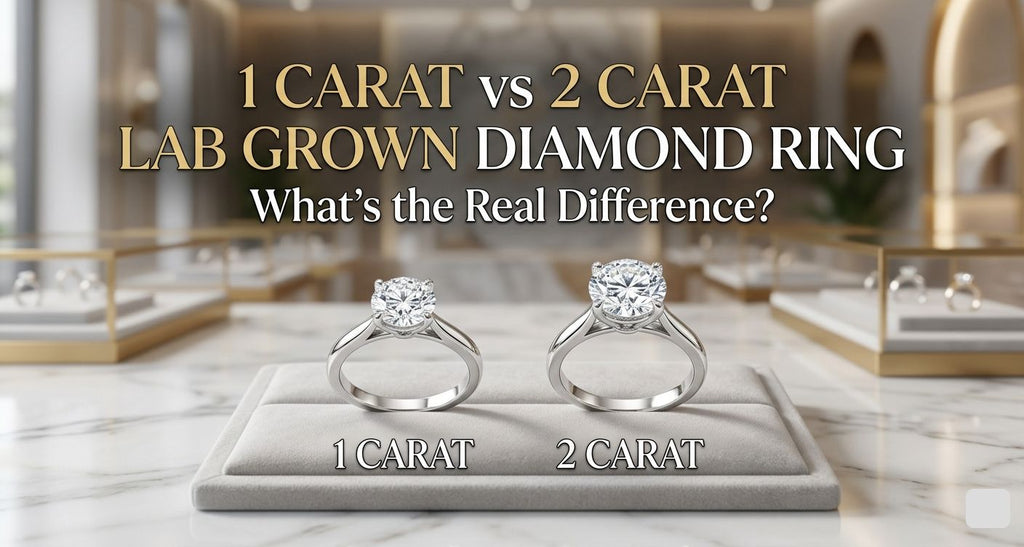
1 Carat vs 2 Carat Lab Grown Diamond Ring: What's the Real Difference?
The price difference is also not based only on weight.
In India, the approximate prices are:
| Diamond or ring | Approximate price |
|---|---|
| 1-carat loose lab grown diamond | ₹25,000–₹1,00,000+ |
| 2-carat loose lab grown diamond | ₹60,000–₹2,00,000+ |
| 1-carat lab grown diamond ring in 18KT gold | ₹65,000–₹1,10,000+ |
| 2-carat lab grown diamond ring in 18KT gold | ₹1,40,000–₹2,50,000+ |
A 2-carat diamond usually costs considerably more than a comparable 1-carat diamond. However, the price difference is not fixed because colour, clarity, cut, shape, certification and current availability all affect the cost.
A well-cut 1-carat diamond can look brighter and more attractive than a poorly proportioned 2-carat diamond. The right choice depends on your preferred appearance, ring design, lifestyle and budget.
Introduction
Choosing between a 1-carat and a 2-carat lab grown diamond ring can be difficult.
A 2-carat diamond is heavier and looks more prominent, but it is also more expensive. A 1-carat diamond costs less and may feel more comfortable for regular wear.
This creates a few common questions:
-
Is a 2-carat diamond worth the additional price?
-
Does it look twice as big as a 1-carat diamond?
-
Is 1 carat enough for an engagement ring?
-
Should you choose a larger diamond or better quality?
-
Which size is easier to wear every day?
There is no single answer for every buyer.
The right option depends on how much visible size you want, the shape you choose, your ring size, the setting and the amount you are comfortable spending.
This guide compares 1-carat and 2-carat lab grown diamond rings through their actual measurements, prices, appearance and daily-wear comfort.
What Does Carat Mean?
Carat is a measurement of diamond weight.
One carat is equal to 200 milligrams or 0.2 grams.
A 2-carat diamond therefore weighs 0.4 grams, which is twice the weight of a 1-carat diamond.
However, carat is not a direct measurement of visible size.
A diamond has length, width and depth. Some of its weight remains below the visible surface. This is why two diamonds with the same carat weight can look different when viewed from the top.
For example, one 1-carat round diamond may measure 6.5 mm across, while another may appear slightly smaller because it has greater depth or a thicker girdle.
A diamond with excessive depth may carry more weight below the setting. It can therefore weigh more without looking much larger.
A very shallow diamond may appear wider, but unsuitable proportions can affect its brightness and light return.
Always compare the diamond’s measurements and actual appearance along with its carat weight.
1 Carat vs 2 Carat: What Is the Actual Size Difference?
For a well-proportioned round brilliant diamond:
-
A 1-carat diamond is generally around 6.4 to 6.6 mm in diameter.
-
A 2-carat diamond is commonly around 8.1 to 8.2 mm in diameter.
The 2-carat diamond is approximately 26% wider.
That difference is easy to notice on the finger, especially when both stones are placed on similar bands.
However, it is important to understand that the 2-carat diamond is not twice as wide. Its weight doubles because it has additional width as well as greater depth.
How a 1-Carat Diamond Looks
A 1-carat round diamond provides a clear and noticeable centre-stone appearance.
It normally looks balanced on a wide range of finger and ring sizes. It can work well in solitaire, halo, bezel, side-stone and pavé settings.
A narrow band can make the centre diamond appear more prominent, while a wider band may give the ring a more structured appearance.
How a 2-Carat Diamond Looks
A 2-carat round diamond has a stronger presence and covers more of the finger.
It becomes the main visual focus of the ring, particularly when placed in a solitaire setting or on a thin band.
Its larger surface also makes the diamond’s colour, clarity, dark areas and cutting pattern easier to notice. This makes careful diamond selection important.
1 Carat vs 2 Carat Lab Grown Diamond Comparison
| Feature | 1-Carat Lab Grown Diamond | 2-Carat Lab Grown Diamond |
|---|---|---|
| Diamond weight | 0.2 grams | 0.4 grams |
| Approximate round diameter | 6.4–6.6 mm | 8.1–8.2 mm |
| Visible width difference | Baseline | Around 26% wider |
| Loose diamond price | ₹25,000–₹1,00,000+ | ₹60,000–₹2,00,000+ |
| Finished ring price in 18KT gold | ₹65,000–₹1,10,000+ | ₹1,40,000–₹2,50,000+ |
| Appearance | Balanced and noticeable | Larger and more prominent |
| Daily-wear comfort | Comfortable in most secure settings | Depends more on setting height |
| Best suited for | Engagements, gifting and daily wear | Engagements, anniversaries and a stronger centre-stone look |
| Setting consideration | Works with most ring designs | Secure and comfortable setting is more important |
The measurements in this table are for round brilliant diamonds. Oval, pear, marquise, emerald, radiant and other shapes have different length and width measurements.
1 Carat Lab Grown Diamond Price in India
A loose 1-carat certified lab grown diamond in India may generally cost around:
₹25,000 to ₹1,00,000 or more
The price depends on:
-
Diamond shape
-
Colour grade
-
Clarity grade
-
Cut or cutting quality
-
Measurements
-
Certification
-
Growth method and treatment disclosure
-
Current availability
-
Seller or brand pricing
A complete 1-carat lab grown diamond ring in 18KT gold may generally cost around:
₹65,000 to ₹1,10,000 or more
The final ring price also includes the gold, side diamonds, setting, making charges, taxes and design details.
A simple solitaire with a lightweight band may cost less than a halo or side-stone ring with additional diamonds.
2 Carat Lab Grown Diamond Price in India
A loose 2-carat certified lab grown diamond in India may generally cost around:
₹60,000 to ₹2,00,000 or more
A finished 2-carat lab grown diamond ring in 18KT gold may generally cost around:
₹1,40,000 to ₹2,50,000 or more
A 2-carat diamond has a larger visible surface, but its price will not increase through weight alone.
A high-colour, high-clarity, well-cut 2-carat diamond may cost much more than a diamond with lower specifications.
Similarly, a 2-carat oval, emerald or cushion diamond may have a different price from a 2-carat round brilliant.
These prices are indicative ranges. The final price should always be checked through the specifications of the selected diamond and ring.
Does a 2-Carat Diamond Cost Twice as Much?
Not necessarily.
A 2-carat diamond weighs twice as much as a 1-carat diamond, but diamond pricing is not calculated through a simple price-per-carat formula.
Two diamonds with the same carat weight can have different prices because of differences in:
-
Colour
-
Clarity
-
Cut
-
Shape
-
Measurements
-
Certification
-
Availability
A 2-carat diamond generally costs significantly more than a comparable 1-carat diamond. However, it may cost less than twice, around twice or considerably more than twice depending on the individual stones being compared.
A higher-quality 1-carat diamond can also cost more than a lower-quality 2-carat diamond.
Compare diamonds with similar colour, clarity, shape and cutting quality before judging the price difference.
Does Cut Matter More Than Carat?
Cut strongly affects how a diamond handles light, while carat tells you how much the diamond weighs.
A well-cut diamond can look bright, balanced and lively. A diamond with unsuitable proportions may show dark areas, reduced brightness or a smaller-than-expected face-up size.
However, no single quality factor is best for every buyer.
The right balance depends on whether you prefer:
-
A larger visible diamond
-
Stronger brightness
-
A higher colour grade
-
Fewer visible inclusions
-
A particular diamond shape
-
A lower final price
A well-cut 1-carat diamond can look more attractive than a poorly proportioned 2-carat diamond.
This does not mean you should always choose the smaller diamond. It means that size should not be the only factor in your decision.
To understand this in more detail, read our guide on why a diamond’s cut is so important.
Can a 1-Carat Diamond Look Bigger Than Expected?
Yes.
The visible appearance of a diamond depends on its shape and measurements.
Elongated shapes such as oval, pear and marquise can provide more visible length and finger coverage than a round diamond of the same carat weight.
A narrow band may also make the centre stone appear larger.
Halo settings surround the centre stone with smaller diamonds, increasing the ring’s overall visible spread. However, the centre diamond remains the same carat weight.
Do not assume that every 1-carat diamond will look the same. Compare its length, width and depth before buying.
Can a 2-Carat Diamond Look Smaller Than Expected?
Yes.
A deep 2-carat diamond may carry a larger part of its weight below the visible surface. This can reduce its face-up size.
A thick girdle can also hold additional weight without adding much visible width.
This is why a 2-carat label alone does not guarantee the largest-looking diamond.
Compare the actual measurements with other diamonds of the same shape and carat weight.
1 Carat vs 2 Carat: Which One Should You Choose?
Choose a 1-Carat Diamond When:
-
You want a noticeable centre stone within a controlled budget.
-
You plan to wear the ring regularly.
-
You prefer a balanced rather than highly prominent appearance.
-
You want more budget available for the setting or gold.
-
You prefer higher colour, clarity or cutting specifications within your budget.
-
You want a ring that is less likely to catch during normal activities.
A 1-carat diamond is not too small for an engagement ring. It provides a clear centre focus and works with a wide range of designs.
Choose a 2-Carat Diamond When:
-
You want a larger and more prominent centre stone.
-
Strong finger coverage is important to you.
-
Your budget comfortably allows the higher price.
-
You prefer a bold solitaire or anniversary ring.
-
The larger size suits your daily routine and personal style.
-
You are comfortable maintaining a larger centre-stone setting.
A 2-carat diamond can also be worn regularly. The setting should simply be secure, balanced and comfortable.
What Looks Better on Smaller Fingers?
There is no fixed carat weight for smaller fingers.
A diamond between 0.50 and 1 carat may look balanced on many smaller fingers, but this is not a strict rule.
The final appearance depends on:
-
Ring size
-
Finger width
-
Diamond shape
-
Diamond measurements
-
Band width
-
Setting style
-
Personal preference
An elongated oval, pear or marquise diamond may provide more length without requiring a 2-carat centre stone.
A 1-carat round diamond on a thin band can also look prominent on a smaller finger.
Try the ring physically or use an accurate hand preview before deciding.
What Looks Better on Wider Fingers?
A 1-carat diamond can still look balanced on a wider finger, particularly when used in a halo, three-stone or side-stone setting.
A 2-carat diamond naturally provides greater coverage and may create a stronger centre focus.
Elongated shapes such as oval, radiant, emerald and marquise can also cover more of the finger.
The best size depends on the overall proportions of the ring rather than finger size alone.
Centre Diamond Carat vs Total Carat Weight
Centre diamond carat and total carat weight are different measurements.
Centre diamond carat is the weight of the main diamond in the ring.
Total carat weight, commonly written as TCW or CTW, includes the combined weight of every diamond in the ring.
For example:
-
Centre diamond: 1.00 carat
-
Side diamonds: 0.30 carat
-
Total diamond weight: 1.30 carats
A ring described as having 2 carats of total diamond weight may not contain a 2-carat centre diamond. It may have a smaller centre stone with several side or accent diamonds.
Always check both the centre diamond weight and total diamond weight before comparing rings.
Best Settings for a 1-Carat Lab Grown Diamond Ring
Solitaire Setting
A solitaire keeps all attention on the centre diamond. A thin band can make a 1-carat diamond appear more prominent.
Halo Setting
A halo places smaller diamonds around the centre stone. It increases the overall visible area and adds more sparkle.
Bezel Setting
A bezel surrounds the diamond with metal. It provides additional edge protection and creates a smooth appearance.
Side-Stone Setting
Side diamonds add width and detail to the ring while keeping the centre diamond at 1 carat.
Cathedral Setting
A cathedral setting supports the centre diamond through raised metal shoulders. The exact height can vary from one design to another.
Best Settings for a 2-Carat Lab Grown Diamond Ring
Low-Profile Prong Setting
A secure low-profile prong setting reduces unnecessary height while keeping the diamond visible.
Six-Prong Setting
Six prongs provide additional contact points around a round centre diamond. The prongs should be properly aligned and checked regularly.
Bezel Setting
A bezel can protect the diamond’s outer edge and reduce snagging. It may be suitable for buyers who use their hands frequently.
Cathedral Setting
A cathedral design can support a larger centre diamond. Check the ring from the side to ensure that its height feels comfortable.
Pavé Band
A pavé band adds side sparkle without surrounding the centre diamond. The smaller diamonds may require occasional inspection.
The best setting is not decided by its name alone. Craftsmanship, setting height, prong thickness and centre-diamond shape all matter.
Can You Wear a 2-Carat Diamond Ring Every Day?
Yes, a 2-carat lab grown diamond ring can be worn every day.
However, a larger diamond may sit higher or catch more easily if the setting is raised.
For regular wear, consider:
-
A secure setting
-
A comfortable band
-
A lower profile
-
Properly finished prongs
-
Protection for pointed corners
-
Regular professional inspections
Remove the ring before gym workouts, heavy lifting, swimming, contact sports or work involving repeated impact.
Diamond is highly resistant to scratching, but it is not impossible to chip. The gold band and prongs can also bend or wear over time.
Does Diamond Shape Change the Size Difference?
Yes.
The 6.5 mm and 8.2 mm measurements mainly apply to round brilliant diamonds.
Other shapes are measured through their length and width.
For example:
-
Oval diamonds provide more visible length.
-
Marquise diamonds often offer strong finger coverage.
-
Pear diamonds combine a rounded end with an extended point.
-
Emerald and radiant diamonds can appear wider or longer depending on their ratio.
-
Cushion diamonds may carry more weight in their depth.
A 1-carat oval may look longer than a 1-carat round, but that does not mean it weighs more.
Compare diamonds of the same shape when reviewing measurements.
Does Certification Matter?
Yes.
An independent grading report helps you confirm what you are buying.
For an IGI- or SGL-certified lab grown diamond, check:
-
Laboratory-grown origin
-
Report number
-
Diamond shape
-
Cutting style
-
Measurements
-
Carat weight
-
Colour
-
Clarity
-
Cut or finish information
-
Polish
-
Symmetry
-
Laser inscription, where mentioned
The report number should match the documentation provided with the diamond.
A grading report does not tell you whether you will personally like the diamond. View clear photographs and videos before making the final choice.
How to Compare Two Diamonds Properly
When comparing a 1-carat and a 2-carat diamond, do not look only at the carat number.
Compare:
Shape
A round diamond and an oval diamond will not have the same measurements or finger coverage.
Measurements
Check the length, width and depth mentioned in the grading report.
Colour
Compare whether either diamond shows visible warmth in the selected metal.
Clarity
Check the location and visibility of inclusions rather than paying only for the highest grade.
Cutting Quality
Look for even brightness and balanced contrast. Avoid diamonds that appear dull or unusually dark.
Setting
The band width, setting height and surrounding diamonds can change the complete appearance.
Final Ring Price
Compare the centre diamond, side diamonds, gold purity, gold weight, making charges and taxes.
Why Choose Lukson for a Lab Grown Diamond Ring?
Whether you choose a 1-carat or 2-carat centre diamond, proper certification and transparent product information are important.
Lukson lab grown diamond rings are available in a range of centre-stone sizes, shapes and settings.
Depending on the selected product, buyers can receive:
-
IGI- or SGL-certified lab grown diamonds
-
BIS-hallmarked gold
-
Different gold purity options
-
Diamond and ring customisation
-
Lifetime exchange and buyback facilities
-
Support for diamond selection
-
Insured delivery
Exchange and buyback are subject to the policy terms applicable at the time of the request. Review the current policy before purchasing when future exchange or upgrade is important to you.
Frequently Asked Questions
1. What is a respectable diamond size?
There is no fixed respectable diamond size. A well-chosen diamond that suits your finger, design and budget is the right size. A 1-carat centre diamond is popular because it looks noticeable without feeling too large for regular wear.
2. Is a 1-carat diamond worth buying?
Yes. A 1-carat diamond offers a good balance of visible size, price and daily-wear comfort. Its final appearance depends on its shape, measurements and cutting quality.
3. What carat looks good on smaller fingers?
Diamonds between 0.50 and 1 carat can look balanced on many smaller fingers. Elongated oval, pear and marquise shapes can also provide more visible length.
4. What carat size is too big?
A diamond may feel too big when the ring becomes uncomfortable, catches frequently or does not suit your routine. Setting height, shape and finger size matter as much as carat weight.
5.What is the difference between centre diamond carat and total carat weight?
Centre diamond carat is the weight of the main diamond. Total carat weight includes the centre diamond and all side or accent diamonds together.
6. Is a 2-carat diamond twice as big as a 1-carat diamond?
No. A 2-carat diamond weighs twice as much, but it is not twice as wide. A typical 2-carat round is approximately 26% wider than a 1-carat round.
7. Does a 2-carat diamond cost twice as much?
Not always. The price difference depends on colour, clarity, cut, shape, measurements, certification and current availability.
8. Is a 1-carat diamond enough for an engagement ring?
Yes. A 1-carat centre diamond provides a noticeable and balanced appearance for an engagement ring. The right size depends on your design preference and budget.
9. Can a 2-carat diamond ring be worn every day?
Yes. A 2-carat ring can be worn regularly when it has a secure and comfortable setting. A lower-profile design can reduce snagging.
10. Which is better: a 1-carat or 2-carat diamond?
Choose 1 carat when you want a balanced appearance, easier daily wear and a lower price. Choose 2 carats when you want more finger coverage and a more prominent centre stone.
11. Does diamond shape affect the visible size?
Yes. Oval, pear and marquise diamonds often look larger than round diamonds of the same carat weight because their elongated shapes provide more finger coverage. Always compare the actual length and width measurements.
12. Should I choose a better-quality 1-carat or a lower-quality 2-carat diamond?
Choose the diamond that looks better to your eyes. A well-cut 1-carat diamond with balanced colour and clarity can look brighter than a poorly proportioned 2-carat diamond. Do not choose through carat weight alone.
13. Can a halo make a 1-carat diamond look bigger?
Yes. Small diamonds placed around the centre stone increase the ring’s overall visible spread. However, the centre diamond remains 1 carat, so check whether the product mentions centre carat weight or total carat weight.
Final Thoughts
The real difference between a 1-carat and a 2-carat lab grown diamond ring is not simply that one weighs twice as much.
A typical 1-carat round diamond measures around 6.4 to 6.6 mm, while a typical 2-carat round diamond measures around 8.1 to 8.2 mm. This makes the 2-carat diamond approximately 26% wider, not twice as wide.
The price difference is more noticeable:
- 1-carat loose lab grown diamond: ₹25,000–₹1,00,000+
- 2-carat loose lab grown diamond: ₹60,000–₹2,00,000+
- 1-carat ring in 18KT gold: ₹65,000–₹1,10,000+
- 2-carat ring in 18KT gold: ₹1,40,000–₹2,50,000+
A 1-carat diamond gives a balanced and noticeable appearance at a lower price. It is also easier to wear regularly in most ring settings.
A 2-carat diamond gives more finger coverage and a stronger visual presence, but it requires a higher budget and a secure, comfortable setting.
The final choice is therefore simple: choose 1 carat for balance, comfort and budget, or choose 2 carats for a larger and more prominent centre diamond. In both cases, check the diamond’s cut, measurements and grading report instead of choosing through carat weight alone.


