




 All Earrings
 Stud Earrings
 Drop Earrings
 Solitaire
 Hoop Earrings
 Halo Earrings
 Vermeil Earrings
 Round
Round
 Oval
Oval
 Emerald
 Pear
Pear
 Princess
 Heart
Heart
 Marquise
 All Rings
 Solitaire Rings
 Band Rings
 Halo Rings
 Cocktail Rings
 Eternity Rings
 Fashion Ring
 Stack Rings
 Men's Rings
 Vermeil Rings
 All Necklaces
 Necklet
 Mangalsutra
 Solitaire
 Tennis Necklace
 Statement Necklace
 Vermeil Necklace
 Alphabets
 Solitaire Pendant
 Halo Pendant
 Vermeil Pendants
 All Bracelets
 Solitaire Bracelet
 Tennis Bracelet
 Fashion Bracelet
 Mangalsutra
 Vermeil Bracelets
 All Vermeil
 Vermeil Earring
 Vermeil Pendant
 Vermeil Ring
 Vermeil Necklace
 Vermeil Mangalsutra
 Vermeil Bracelets
 Vermeil Bangles
 Vermeil Men’s
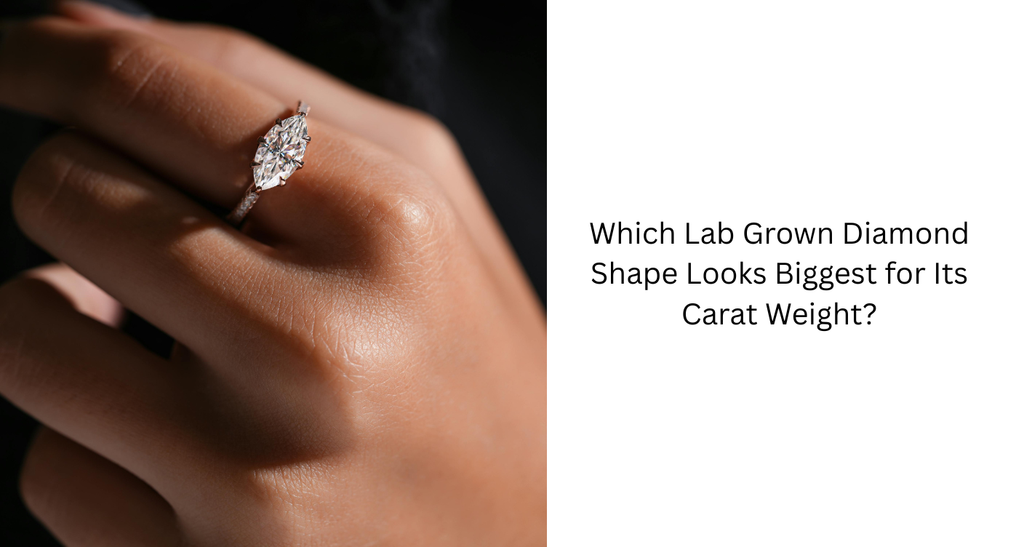
Which Lab Grown Diamond Shape Looks Biggest for Its Carat Weight?
When choosing a lab grown diamond, carat weight is usually one of the first things buyers compare. But two diamonds with the same carat weight can look quite different when set in a ring.
The reason is simple: carat measures weight, while the visible size of a diamond depends on its shape, proportions and measurements.
This is particularly important if you want your diamond ring to look larger without moving to a higher carat weight. Understanding how different diamond shapes use their weight can help you compare your options more accurately.
In this guide, we look at which lab grown diamond shapes tend to offer more visible coverage for their carat weight and what you should check before choosing one.
Why Can Two 1-Carat Diamonds Look Different?
A diamond's weight is distributed across its length, width and depth. This means two diamonds with the same carat weight can have different proportions.
A longer stone may appear larger across the finger, while a deeper stone can carry more of its weight below the surface.
This visible surface is often called the diamond's face-up size.
So when comparing diamonds online, carat weight should be considered alongside the measurements listed on the product page or certificate.
Which Lab Grown Diamond Shapes Look Biggest?
There is no fixed size ranking for every individual diamond because cutting proportions vary. However, typical 1-carat measurements show why some shapes tend to have more visible spread than others.
| Diamond Shape | Approx. 1-Carat Dimensions | General Appearance |
|---|---|---|
| Marquise | 10.0 to 10.5 × 5.0 mm | Long and narrow |
| Pear | Around 8.5 × 5.5 mm | Elongated with a pointed end |
| Oval | Around 8.0 × 5.5 mm | Long and softly rounded |
| Emerald | Around 7.0 × 5.0 mm | Rectangular and broad |
| Round | Around 6.4 to 6.5 mm diameter | Compact and symmetrical |
| Cushion | Around 6.0 to 6.5 mm | Fuller, rounded-square outline |
| Radiant | Around 6.0 × 5.0 mm | Varies from square to rectangular |
These are general figures. Individual diamonds can have different measurements at the same carat weight.
1. Marquise
Marquise diamond is one of the first shapes to consider if your goal is maximum visual length.
Its long outline can create substantial finger coverage, and the pointed ends make the stone appear even more elongated when it is set vertically.
However, proportion still matters. A very narrow marquise can have a different appearance from a wider one of the same carat weight.
2. Pear
Pear-shaped diamonds combine a rounded end with a pointed tip.
Their elongated outline can give good coverage across the finger, especially when the stone is set with the point facing towards the fingertips.
The shape also offers a different look from oval or marquise while maintaining the benefits of an elongated design.
3. Oval
Oval diamonds are a popular choice for buyers who want an elongated centre stone without moving too far from the classic look of a round diamond.
A typical 1-carat oval can measure around 8 × 5.5 mm, while a 1-carat round is generally around 6.5 mm across.
The exact appearance of an oval depends on its proportions. A longer oval will create a different look from a wider oval, even when both have the same carat weight.
What About Emerald and Radiant Shapes?
Emerald and radiant diamonds can also provide good visual coverage, particularly when they have an elongated rectangular outline.
An emerald-cut diamond has long, straight facets and a broad table, giving it a clean and open appearance.
Radiant diamonds offer more variation. Some are almost square, while others are noticeably rectangular. An elongated radiant can therefore create more length across the finger than a square radiant.
If size is your priority, check the actual measurements instead of choosing based on the shape name alone.
How Does Length-to-Width Ratio Affect the Look?
The length-to-width ratio describes how elongated a diamond appears.
For example, a longer oval will look slimmer and more elongated than a wider oval. The same principle applies to pear, marquise, emerald and radiant shapes.
There is no single ratio that everyone should choose. Some buyers prefer a long, slender look, while others like a wider and fuller appearance.
The important thing is to compare the measurements of the specific diamonds you are considering.
Does Diamond Depth Matter?
Depth affects how a diamond's weight is distributed. If more of the weight sits below the visible surface, the diamond may have less face-up spread. However, choosing the shallowest diamond is not automatically the answer.
A diamond needs balanced proportions to look attractive and perform well visually.
For fancy shapes such as oval, pear and marquise, you should also look closely at the stone itself because features such as bow-tie effects can influence its appearance.
How to Find a Bigger-Looking Lab Grown Diamond
If visible size is important to you, compare diamonds using these factors:
1. Start With the Shape
Look at elongated options such as marquise, pear and oval if you want more visual length.
2. Check the Measurements
Compare the length and width in millimetres rather than looking only at carat weight.
3. Look at the Proportions
Pay attention to how long, wide or narrow the diamond appears.
4. Check the Product Images
Images can help you understand how the stone looks once it is set in a ring.
5. Check the Certificate
For certified diamonds, the report provides important details about the stone, including its measurements.
Does a Bigger-Looking Diamond Mean a Better Diamond?
Not necessarily. Size is only one factor to consider when choosing a lab grown diamond.
Colour, clarity, cut or proportions, depending on the shape, and the overall appearance of the stone also matter.
For example, a 1-carat oval that appears larger may not automatically be the right choice if you prefer the sparkle or proportions of another stone.
Think of visible size as one buying preference rather than a measure of overall diamond quality.
So, Which Lab Grown Diamond Shape Looks Biggest?
For buyers who want the most visible size for their carat weight, marquise, pear and oval are strong options to explore.
Marquise usually creates the greatest sense of length. Pear offers an elongated look with a distinctive pointed end, while oval gives you length with a softer, rounded outline.
Elongated emerald and radiant shapes can also provide good coverage, depending on their proportions.
Round diamonds have a more compact outline. They may not provide the same visible spread as some elongated shapes, but they remain popular for their classic appearance and light performance.
The final choice should come down to the specific diamond, not just its shape name or carat weight.
Final Thought
If you want your lab grown diamond ring to look larger without simply moving to a higher carat weight, start by exploring marquise, pear and oval shapes.
Then compare the actual measurements of the diamonds you like. A small difference in proportions can change how a diamond looks on the finger, so the carat number should never be the only detail you consider.
When shopping online, look beyond "1 carat" or "2 carat" and check what the actual diamond looks like and measures in millimetres. That will give you a much better idea of the size you are getting.
-
Posted in
Diamond Shapes, Lab grown diamond ring


