










 All Earrings
 Stud Earrings
 Drop Earrings
 Solitaire
 Hoop Earrings
 Halo Earrings
 Vermeil Earrings
 Round
Round
 Oval
Oval
 Emerald
 Pear
Pear
 Princess
 Heart
Heart
 Marquise
 All Rings
 Solitaire Rings
 Band Rings
 Halo Rings
 Cocktail Rings
 Eternity Rings
 Fashion Ring
 Stack Rings
 Men's Rings
 Vermeil Rings
 All Necklaces
 Necklet
 Mangalsutra
 Solitaire
 Tennis Necklace
 Statement Necklace
 Vermeil Necklace
 Alphabets
 Solitaire Pendant
 Halo Pendant
 Vermeil Pendants
 All Bracelets
 Solitaire Bracelet
 Tennis Bracelet
 Fashion Bracelet
 Mangalsutra
 Vermeil Bracelets
 All Vermeil
 Vermeil Earring
 Vermeil Pendant
 Vermeil Ring
 Vermeil Necklace
 Vermeil Mangalsutra
 Vermeil Bracelets
 Vermeil Bangles
 Vermeil Men’s
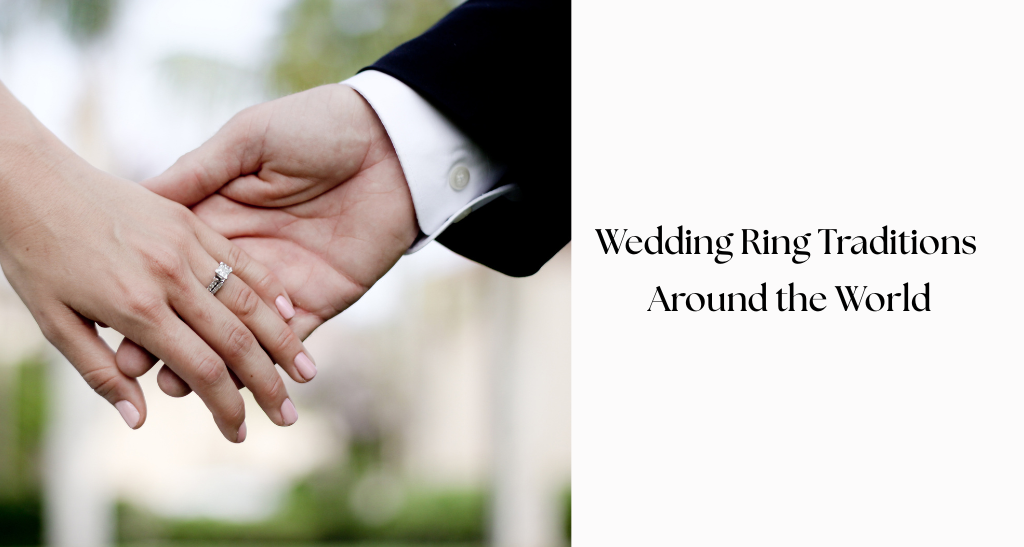
Wedding Ring Traditions Around the World
Wedding rings are often seen as a simple symbol of marriage, but the way people wear and exchange them is not the same everywhere. Different countries and cultures have their own customs around wedding rings, from which hand the ring goes on to how couples exchange them during the wedding ceremony.
Some traditions are centuries old, while others have changed with modern relationships. Looking at these customs shows how one small piece of jewellery can carry very different meanings around the world.
Why Do People Wear Wedding Rings?

The circle of a ring has long been connected with ideas of continuity because it has no beginning or end. Over time, wedding rings became a common symbol of a couple's commitment to each other.
Today, the meaning is much more personal. For many couples, the ring represents love, partnership and the decision to build a life together.
But there is no worldwide rule about which hand or finger should carry that symbol.
India Wedding Rings Traditions Vary Across Communities

In India, wedding jewellery is strongly connected with regional and community traditions, so there is no single wedding ring custom followed by everyone.
In many Hindu weddings, traditional wedding jewellery such as mangalsutras, toe rings and other ornaments may have a more important ceremonial role than a Western-style wedding ring.
However, wedding rings have become increasingly common among Indian couples, particularly in urban areas. Some couples exchange rings during the engagement or wedding ceremony, while others follow both traditional and modern customs.
The ring may be worn on the left or right hand depending on family tradition, personal preference and community practices.
United States and Canada Wedding Rings

In the United States and Canada, wedding rings are traditionally worn on the ring finger of the left hand.
Many couples exchange rings during the wedding ceremony after saying their vows. The wedding ring is often placed on the same finger where the engagement ring is worn.
After the wedding, some people wear both rings together, while others move or rearrange them depending on comfort and personal preference.
The tradition is widely recognised, although individual couples may choose something different.
United Kingdom Wedding Rings

In the United Kingdom, wedding rings are traditionally worn on the fourth finger of the left hand.
During the ceremony, couples usually exchange rings as part of their vows. The wedding ring is often worn closest to the hand, with the engagement ring placed above it.
This is why some people move their engagement ring temporarily to the right hand during the wedding ceremony before putting it back after the exchange of rings.
Like many wedding traditions, this is a custom rather than a requirement.
Germany Wedding Rings

Germany has a different tradition from countries such as the United States and the UK.
Wedding rings are traditionally worn on the right hand after marriage. Engagement rings may be worn on the left hand before the wedding and sometimes moved to the right hand after the ceremony.
This is a good example of how the same symbol can have different customs depending on where you are.
Russia and Some Eastern European Countries Wedding Rings

In Russia, wedding rings are traditionally worn on the right hand.
Similar customs can also be found in several other Eastern European countries, although practices vary between countries, religions and families.
The right hand can carry a strong cultural and religious meaning, which is one reason it is associated with marriage in these traditions.
Greece: The Right Hand Has Religious Significance

In Greek Orthodox traditions, wedding rings are traditionally worn on the right hand.
The wedding ceremony includes the exchange of rings, and the right hand has an important place in the religious tradition.
Some Greek couples may follow modern Western habits outside the ceremony, but the traditional practice remains significant for many families.
France Wedding Rings

In France, wedding rings are commonly worn on the left ring finger.
French couples may exchange rings during the wedding ceremony, although the role of rings can vary depending on whether the wedding is civil, religious or both.
Engagement rings are also commonly worn before marriage, and some couples continue to wear both rings after the wedding.
Spain Wedding Rings

In Spain, wedding rings have traditionally been worn on the right hand in many regions.
The custom can vary depending on the area and family traditions. In some places, people may follow different practices, showing once again that even within one country, wedding ring customs are not always identical.
The exchange of rings during the ceremony is an important part of many Spanish weddings.
Norway: Rings Can Be Worn Differently

Norwegian wedding ring customs are somewhat different from the familiar American tradition.
It is common for engagement and wedding rings to be worn on the right hand in Norway. Some couples may also use simple bands rather than choosing a large centre stone.
The focus is often on the ring as a symbol of marriage rather than on a particular style of engagement ring.
Sweden: Engagement and Wedding Rings Can Both Be Part of the Tradition

Swedish wedding traditions can include more than one ring.
Traditionally, women may receive a ring at engagement and another at marriage. Some modern couples also choose rings for both partners.
This means the wedding ring may be part of a larger set of rings representing different stages of the relationship.
Jewish Wedding Traditions

Jewish wedding ceremonies have their own important ring traditions.
During a traditional Jewish wedding ceremony, the groom gives the bride a ring in the presence of witnesses. The ring is traditionally a simple band without stones.
The simplicity has a practical reason as well as a symbolic one. The ring should have clear and understandable value, without anything that could complicate the meaning of the exchange.
In many traditional ceremonies, the ring is placed on the bride's right index finger during the ceremony. Afterward, she may move it to the ring finger.
Modern Jewish weddings can vary, and some couples choose to exchange rings with each other.
Muslim Wedding Ring Traditions

There is no single wedding ring tradition followed by all Muslim couples.
Practices vary significantly depending on country, culture and family. Some couples exchange rings, while others do not include rings as part of the religious marriage ceremony.
In many Muslim communities, jewellery traditions are also influenced by local customs.
This is why it is better to look at the specific culture or community rather than assuming that all Muslim weddings follow one ring tradition.
Why Do Some Countries Use the Right Hand?
The choice between the left and right hand is connected to different historical, cultural and religious traditions.
In some cultures, the right hand has been associated with honour, promises or religious significance. In others, the left hand became connected with marriage through historical beliefs and customs.
There is no universal meaning behind the two hands today. A person wearing a wedding ring on the right hand is not necessarily following the same tradition as someone in another country.
Do Couples Have to Follow Traditional Ring Customs?
Not at all. Wedding traditions have changed significantly over time, and couples often combine customs from different cultures.
A couple may choose the ring finger they find comfortable, exchange rings privately, wear matching bands or choose completely different designs.
Some couples do not wear wedding rings at all. Others wear several rings that represent different parts of their relationship.
The important thing is that the choice works for the couple.
How Wedding Ring Traditions Are Changing
Travel, international relationships and social media have made wedding traditions more flexible.
It is now common to see couples combine traditions from different countries. One partner may follow the ring tradition of their family while the other follows a different custom.
Some couples also choose alternative metals, lab-grown diamonds, gemstones or personalised designs instead of traditional wedding bands.
The meaning of the ring has not disappeared. If anything, couples now have more freedom to decide what that meaning looks like.
The Meaning Behind the Ring Matters Most
A wedding ring can be worn on the left hand, right hand or another finger depending on the culture and the couple.
It can be a plain gold band, a diamond ring or a design with personal details. There is no single style that defines a married couple around the world.
What remains common across many traditions is the idea of the ring as a visible reminder of a commitment.
The customs may change from one country to another, but the reason people choose to wear a wedding ring is often much the same: it represents a relationship and a promise that matters to them.


