





 All Earrings
 Stud Earrings
 Drop Earrings
 Solitaire
 Hoop Earrings
 Halo Earrings
 Vermeil Earrings
 Round
Round
 Oval
Oval
 Emerald
 Pear
Pear
 Princess
 Heart
Heart
 Marquise
 All Rings
 Solitaire Rings
 Band Rings
 Halo Rings
 Cocktail Rings
 Eternity Rings
 Fashion Ring
 Stack Rings
 Men's Rings
 Vermeil Rings
 All Necklaces
 Necklet
 Mangalsutra
 Solitaire
 Tennis Necklace
 Statement Necklace
 Vermeil Necklace
 Alphabets
 Solitaire Pendant
 Halo Pendant
 Vermeil Pendants
 All Bracelets
 Solitaire Bracelet
 Tennis Bracelet
 Fashion Bracelet
 Mangalsutra
 Vermeil Bracelets
 All Vermeil
 Vermeil Earring
 Vermeil Pendant
 Vermeil Ring
 Vermeil Necklace
 Vermeil Mangalsutra
 Vermeil Bracelets
 Vermeil Bangles
 Vermeil Men’s
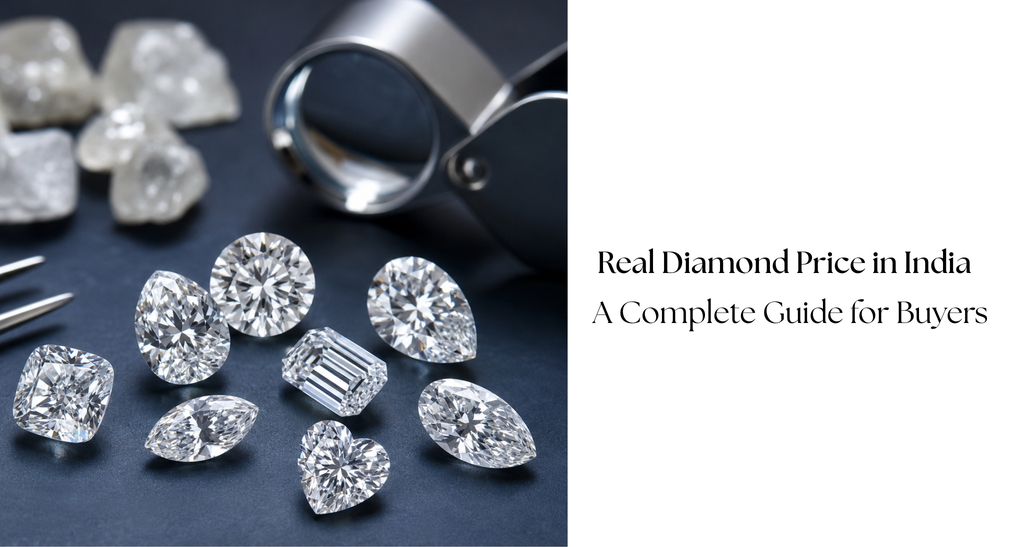
Real Diamond Price in India - A Complete Guide for Buyers
If you've ever searched for the price of a real diamond in India, you've probably noticed something confusing. Unlike gold, which has a daily market rate, diamond prices can vary dramatically. A 1-carat diamond may cost ₹2 lakh, while another 1-carat diamond can cost ₹8 lakh or more.
For many buyers, this raises an important question: How much should a real diamond actually cost?
The answer is not as straightforward as looking up a gold rate. Diamond pricing depends on multiple factors, including size, cut, colour, clarity, certification, and whether the diamond is natural or lab-grown.
Understanding how diamonds are priced can help you avoid overpaying and make a more informed purchase. Whether you're buying an engagement ring, a diamond pendant, earrings, or simply researching before making a decision, this guide explains everything you need to know about real diamond prices in India.
What Is a Real Diamond?
One of the biggest misconceptions in the jewellery industry is that only mined diamonds are real diamonds.
In reality, a real diamond is defined by its composition and properties, not where it comes from.
A diamond is made entirely of carbon atoms arranged in a crystal structure. This structure gives diamonds their incredible hardness, brilliance, and durability.
Today, real diamonds come in two forms:
Mined Diamonds
Mined diamonds formed deep within the Earth under extreme heat and pressure over billions of years. These diamonds are extracted through mining operations and then cut and polished for jewellery.
Lab Grown Diamonds
Lab-grown diamonds are created in advanced laboratories using technology that replicates the natural diamond-growing process.
Despite being created in a lab, they are real diamonds because they share the same:
-
Chemical composition
-
Physical properties
-
Optical brilliance
-
Hardness
The primary difference is origin rather than quality.
Why Diamond Prices Are Different From Gold Prices
Many buyers compare diamonds to gold when researching jewellery prices.
However, gold and diamonds are priced very differently.
Gold is a commodity with a standard market rate. Every gram of 22K gold has approximately the same value regardless of where you buy it.
Diamonds work differently.
Every diamond is unique.
Even if two diamonds weigh exactly one carat, they may differ significantly in:
-
Cut quality
-
Colour
-
Clarity
-
Shape
-
Certification
As a result, there is no universal "diamond rate" similar to the daily gold rate.
Instead, every diamond is evaluated individually.
How Diamonds Are Priced Around the World
The global diamond industry uses a pricing system based on quality characteristics.
Dealers and jewellers often reference international diamond pricing benchmarks, but the final retail price depends on multiple factors.
These include:
-
Diamond quality
-
Supply and demand
-
Certification
-
Market conditions
-
Retail margins
This is why the same diamond may be priced differently by different jewellers.
Understanding the 4Cs That Influence Diamond Price
The most important factors affecting diamond prices are known as the 4Cs.
These standards were developed by the Gemological Institute of America (GIA) and are used worldwide.
Carat Weight
Carat refers to a diamond's weight.
One carat equals 200 milligrams.
Many buyers assume that carat weight determines the entire value of a diamond. While carat is important, it is only one part of the pricing equation.
As diamonds become larger, they become significantly rarer.
For example:
-
Finding rough material suitable for a 0.50-carat diamond is relatively common.
-
Finding rough material capable of producing a high-quality 2-carat diamond is much more difficult.
This rarity causes prices to increase rapidly as size increases.
A 2-carat diamond is often much more than twice the price of a 1-carat diamond with similar quality.
Cut Quality
Many experts consider cut to be the most important of the 4Cs.
Cut determines how effectively a diamond reflects light.
A well-cut diamond appears:
-
Brighter
-
More brilliant
-
More lively
A poorly cut diamond may appear dull even if it has excellent colour and clarity.
This is why a smaller well-cut diamond often looks more attractive than a larger poorly cut stone.
Colour Grade
Most white diamonds are graded on a colour scale ranging from D to Z.
D-F: Colourless
These diamonds are exceptionally rare and command premium prices.
G-H: Near Colourless
These diamonds appear white to most people and often offer excellent value.
I-J: Slightly Tinted
A faint warmth may be visible under close inspection.
K-Z: Noticeable Colour
These diamonds display increasing levels of yellow or brown tint.
As colour becomes less noticeable, prices generally increase.
Clarity Grade
Clarity measures the presence of internal characteristics known as inclusions and external blemishes.
Common clarity grades include:
-
FL (Flawless)
-
IF (Internally Flawless)
-
VVS1-VVS2
-
VS1-VS2
-
SI1-SI2
-
I1-I3
Higher clarity diamonds are rarer and therefore more expensive.
However, many VS and SI diamonds appear perfectly clean to the naked eye.
Real Diamond Price Chart in India
The following ranges provide a general idea of diamond prices in India.
| Carat Weight | Natural Diamond Price in India | Lab Grown Diamond Price in India |
|---|---|---|
| 0.25 Carat | ₹30,000 – ₹80,000 | ₹8,000 – ₹20,000 |
| 0.50 Carat | ₹70,000 – ₹2,00,000 | ₹15,000 – ₹40,000 |
| 0.75 Carat | ₹1,20,000 – ₹3,50,000 | ₹25,000 – ₹60,000 |
| 1.00 Carat | ₹2,00,000 – ₹7,00,000+ | ₹40,000 – ₹1,00,000+ |
| 1.50 Carat | ₹4,50,000 – ₹12,00,000+ | ₹70,000 – ₹1,80,000+ |
| 2.00 Carat | ₹7,00,000 – ₹20,00,000+ | ₹1,20,000 – ₹3,00,000+ |
| 3.00 Carat+ | ₹15,00,000 and above | ₹2,50,000 and above |
Actual prices vary depending on the 4Cs and certification.
These figures represent loose diamonds and may vary significantly depending on quality.
Why Two 1-Carat Diamonds Can Have Different Prices
This is one of the most common questions buyers ask.
Imagine two diamonds:
Diamond A
-
1 Carat
-
G Colour
-
VS2 Clarity
-
Excellent Cut
Diamond B
-
1 Carat
-
D Colour
-
IF Clarity
-
Excellent Cut
Although both weigh one carat, Diamond B is significantly rarer.
As a result, it may cost several lakhs more than Diamond A.
This is why carat weight alone should never be used to compare diamond prices.
How Diamond Shape Affects Price
Many buyers are surprised to learn that diamond shape also influences cost.
Round Brilliant
The most popular and expensive shape.
Round diamonds require more rough material during cutting, increasing their cost.
Oval
Offers excellent finger coverage and often costs less than round diamonds.
Pear
A unique shape that can appear larger than its actual carat weight.
Cushion
Known for its soft corners and vintage appeal.
Emerald
Features large open facets that highlight clarity.
Marquise
Its elongated shape can create the illusion of a larger diamond.
Fancy shapes often provide better value than round diamonds.
Why Diamond Certification Matters
Certification is one of the most important aspects of buying a diamond.
A certificate provides an independent assessment of a diamond's quality.
Common laboratories include:
GIA (Gemological Institute of America)
Widely regarded as the global benchmark for diamond grading.
IGI (International Gemological Institute)
One of the most popular certifications for both natural and lab-grown diamonds.
HRD (Hoge Raad voor Diamant)
A respected European grading laboratory.
SGL (Solitaire Gemmological Laboratories)
Commonly used in India for jewellery certification.
Certification helps buyers compare diamonds accurately and purchase with confidence.
Natural Diamond vs Lab-Grown Diamond Price Comparison
One of the biggest developments in recent years has been the growth of lab-grown diamonds.
Because both natural and lab-grown diamonds are real diamonds, many buyers compare their prices.
Typical 1-Carat Diamond Prices
| Diamond Type | Approximate Price |
|---|---|
| Natural Diamond | ₹2,00,000 – ₹7,00,000+ |
| Lab-Grown Diamond | ₹25,000 – ₹1,00,000+ |
This price difference allows buyers to choose larger sizes or higher quality grades within the same budget.
Additional Costs in Diamond Jewellery
The diamond itself is not the only cost.
The final jewellery price also includes:
Gold or Platinum Cost
The metal used in the jewellery contributes significantly to the final price.
Making Charges
These cover the craftsmanship involved in creating the piece.
GST
Applicable taxes add to the overall cost.
Design Complexity
Intricate settings and custom designs often increase pricing.
Brand Premium
Established luxury brands may charge higher prices for similar specifications.
How to Get Better Value When Buying a Diamond
Many buyers focus exclusively on size.
However, value often comes from balancing the 4Cs.
Consider these strategies:
Prioritise Cut Quality
A well-cut diamond often appears more beautiful than a larger poorly cut diamond.
Choose Near-Colourless Grades
G-H colour diamonds frequently offer the best balance between appearance and price.
Consider VS or SI Clarity
Many inclusions are invisible without magnification.
Explore Fancy Shapes
Oval, pear, cushion, and marquise diamonds can provide more visual size for the money.
Always Buy Certified Diamonds
Certification provides confidence and transparency.
Common Diamond Pricing Myths
Bigger Diamonds Are Always Better
Size matters, but beauty depends on more than carat weight.
Higher Clarity Is Always Necessary
Many VS and SI diamonds appear flawless to the naked eye.
All 1-Carat Diamonds Cost the Same
Quality differences can create huge price variations.
Diamonds Have a Daily Rate Like Gold
Diamond prices are influenced by multiple quality factors rather than a single market rate.
Buyer's Checklist Before Purchasing a Diamond
Before making a purchase, ask:
-
Is the diamond certified?
-
What are the exact 4Cs?
-
Is it a natural or lab-grown diamond?
-
What shape is it?
-
What is included in the final price?
-
What is the return or exchange policy?
These questions can help you compare options more effectively.
Frequently Asked Questions
How much does a real 1-carat diamond cost in India?
A natural 1-carat diamond typically ranges from ₹2 lakh to ₹7 lakh or more, depending on quality.
Are lab-grown diamonds real diamonds?
Yes. Lab-grown diamonds are real diamonds with the same physical, chemical, and optical properties as natural diamonds.
Which diamond shape offers the best value?
Oval, pear, cushion, and marquise diamonds often provide excellent value compared to round diamonds.
Is diamond certification important?
Yes. Certification verifies quality and helps ensure transparency.
Which is more important: carat or cut?
For most buyers, cut has the greatest impact on a diamond's visual beauty.
Final Thoughts
Real diamond prices in India vary widely because every diamond is unique. Factors such as carat weight, cut, colour, clarity, shape, and certification all contribute to the final cost.
Rather than focusing only on size, buyers should consider the overall quality of the diamond and how it fits their budget and preferences. A well-chosen diamond does not have to be the most expensive option. Understanding how pricing works allows you to make a smarter purchase and find a diamond that delivers both beauty and value.
Whether you choose a natural diamond or a lab-grown diamond, the key is to buy a certified stone that meets your expectations and suits your budget.
If you've ever searched for the price of a real diamond in India, you've probably noticed something confusing. Unlike gold, which has a daily market rate, diamond prices can vary dramatically. A 1-carat diamond may cost ₹2 lakh, while another 1-carat diamond can cost ₹8 lakh or more.
For many buyers, this raises an important question: How much should a real diamond actually cost?
The answer is not as straightforward as looking up a gold rate. Diamond pricing depends on multiple factors, including size, cut, colour, clarity, certification, and whether the diamond is natural or lab-grown.
Understanding how diamonds are priced can help you avoid overpaying and make a more informed purchase. Whether you're buying an engagement ring, a diamond pendant, earrings, or simply researching before making a decision, this guide explains everything you need to know about real diamond prices in India.
What Is a Real Diamond?
One of the biggest misconceptions in the jewellery industry is that only mined diamonds are real diamonds.
In reality, a real diamond is defined by its composition and properties, not where it comes from.
A diamond is made entirely of carbon atoms arranged in a crystal structure. This structure gives diamonds their incredible hardness, brilliance, and durability.
Today, real diamonds come in two forms:
Natural Diamonds
Natural diamonds formed deep within the Earth under extreme heat and pressure over billions of years. These diamonds are extracted through mining operations and then cut and polished for jewellery.
Lab-Grown Diamonds
Lab-grown diamonds are created in advanced laboratories using technology that replicates the natural diamond-growing process.
Despite being created in a lab, they are real diamonds because they share the same:
-
Chemical composition
-
Physical properties
-
Optical brilliance
-
Hardness
The primary difference is origin rather than quality.
Why Diamond Prices Are Different From Gold Prices
Many buyers compare diamonds to gold when researching jewellery prices.
However, gold and diamonds are priced very differently.
Gold is a commodity with a standard market rate. Every gram of 22K gold has approximately the same value regardless of where you buy it.
Diamonds work differently.
Every diamond is unique.
Even if two diamonds weigh exactly one carat, they may differ significantly in:
-
Cut quality
-
Colour
-
Clarity
-
Shape
-
Certification
As a result, there is no universal "diamond rate" similar to the daily gold rate.
Instead, every diamond is evaluated individually.
How Diamonds Are Priced Around the World
The global diamond industry uses a pricing system based on quality characteristics.
Dealers and jewellers often reference international diamond pricing benchmarks, but the final retail price depends on multiple factors.
These include:
-
Diamond quality
-
Supply and demand
-
Certification
-
Market conditions
-
Retail margins
This is why the same diamond may be priced differently by different jewellers.
Understanding the 4Cs That Influence Diamond Price
The most important factors affecting diamond prices are known as the 4Cs.
These standards were developed by the Gemological Institute of America (GIA) and are used worldwide.
Carat Weight
Carat refers to a diamond's weight.
One carat equals 200 milligrams.
Many buyers assume that carat weight determines the entire value of a diamond. While carat is important, it is only one part of the pricing equation.
As diamonds become larger, they become significantly rarer.
For example:
-
Finding rough material suitable for a 0.50-carat diamond is relatively common.
-
Finding rough material capable of producing a high-quality 2-carat diamond is much more difficult.
This rarity causes prices to increase rapidly as size increases.
A 2-carat diamond is often much more than twice the price of a 1-carat diamond with similar quality.
Cut Quality
Many experts consider cut to be the most important of the 4Cs.
Cut determines how effectively a diamond reflects light.
A well-cut diamond appears:
-
Brighter
-
More brilliant
-
More lively
A poorly cut diamond may appear dull even if it has excellent colour and clarity.
This is why a smaller well-cut diamond often looks more attractive than a larger poorly cut stone.
Colour Grade
Most white diamonds are graded on a colour scale ranging from D to Z.
D-F: Colourless
These diamonds are exceptionally rare and command premium prices.
G-H: Near Colourless
These diamonds appear white to most people and often offer excellent value.
I-J: Slightly Tinted
A faint warmth may be visible under close inspection.
K-Z: Noticeable Colour
These diamonds display increasing levels of yellow or brown tint.
As colour becomes less noticeable, prices generally increase.
Clarity Grade
Clarity measures the presence of internal characteristics known as inclusions and external blemishes.
Common clarity grades include:
-
FL (Flawless)
-
IF (Internally Flawless)
-
VVS1-VVS2
-
VS1-VS2
-
SI1-SI2
-
I1-I3
Higher clarity diamonds are rarer and therefore more expensive.
However, many VS and SI diamonds appear perfectly clean to the naked eye.
Real Diamond Price Chart in India
The following ranges provide a general idea of diamond prices in India.
Actual prices vary depending on the 4Cs and certification.
| Carat Weight | Approximate Natural Diamond Price |
|---|---|
| 0.25 Carat | ₹30,000 – ₹80,000 |
| 0.50 Carat | ₹70,000 – ₹2,00,000 |
| 0.75 Carat | ₹1,20,000 – ₹3,50,000 |
| 1.00 Carat | ₹2,00,000 – ₹7,00,000+ |
| 1.50 Carat | ₹4,50,000 – ₹12,00,000+ |
| 2.00 Carat | ₹7,00,000 – ₹20,00,000+ |
| 3.00 Carat+ | ₹15,00,000 and above |
These figures represent loose diamonds and may vary significantly depending on quality.
Why Two 1-Carat Diamonds Can Have Different Prices
This is one of the most common questions buyers ask.
Imagine two diamonds:
Diamond A
-
1 Carat
-
G Colour
-
VS2 Clarity
-
Excellent Cut
Diamond B
-
1 Carat
-
D Colour
-
IF Clarity
-
Excellent Cut
Although both weigh one carat, Diamond B is significantly rarer.
As a result, it may cost several lakhs more than Diamond A.
This is why carat weight alone should never be used to compare diamond prices.
How Diamond Shape Affects Price
Many buyers are surprised to learn that diamond shape also influences cost.
Round Brilliant
The most popular and expensive shape.
Round diamonds require more rough material during cutting, increasing their cost.
Oval
Offers excellent finger coverage and often costs less than round diamonds.
Pear
A unique shape that can appear larger than its actual carat weight.
Cushion
Known for its soft corners and vintage appeal.
Emerald
Features large open facets that highlight clarity.
Marquise
Its elongated shape can create the illusion of a larger diamond.
Fancy shapes often provide better value than round diamonds.
Why Diamond Certification Matters
Certification is one of the most important aspects of buying a diamond.
A certificate provides an independent assessment of a diamond's quality.
Common laboratories include:
GIA
Widely regarded as the global benchmark for diamond grading.
IGI
One of the most popular certifications for both natural and lab-grown diamonds.
HRD
A respected European grading laboratory.
SGL
Commonly used in India for jewellery certification.
Certification helps buyers compare diamonds accurately and purchase with confidence.
Natural Diamond vs Lab-Grown Diamond Price Comparison
One of the biggest developments in recent years has been the growth of lab-grown diamonds.
Because both natural and lab-grown diamonds are real diamonds, many buyers compare their prices.
Typical 1-Carat Diamond Prices
| Diamond Type | Approximate Price |
|---|---|
| Natural Diamond | ₹2,00,000 – ₹7,00,000+ |
| Lab-Grown Diamond | ₹25,000 – ₹1,00,000+ |
This price difference allows buyers to choose larger sizes or higher quality grades within the same budget.
Additional Costs in Diamond Jewellery
The diamond itself is not the only cost.
The final jewellery price also includes:
Gold or Platinum Cost
The metal used in the jewellery contributes significantly to the final price.
Making Charges
These cover the craftsmanship involved in creating the piece.
GST
Applicable taxes add to the overall cost.
Design Complexity
Intricate settings and custom designs often increase pricing.
Brand Premium
Established luxury brands may charge higher prices for similar specifications.
How to Get Better Value When Buying a Diamond
Many buyers focus exclusively on size.
However, value often comes from balancing the 4Cs.
Consider these strategies:
Prioritise Cut Quality
A well-cut diamond often appears more beautiful than a larger poorly cut diamond.
Choose Near-Colourless Grades
G-H colour diamonds frequently offer the best balance between appearance and price.
Consider VS or SI Clarity
Many inclusions are invisible without magnification.
Explore Fancy Shapes
Oval, pear, cushion, and marquise diamonds can provide more visual size for the money.
Always Buy Certified Diamonds
Certification provides confidence and transparency.
Common Diamond Pricing Myths
Bigger Diamonds Are Always Better
Size matters, but beauty depends on more than carat weight.
Higher Clarity Is Always Necessary
Many VS and SI diamonds appear flawless to the naked eye.
All 1-Carat Diamonds Cost the Same
Quality differences can create huge price variations.
Diamonds Have a Daily Rate Like Gold
Diamond prices are influenced by multiple quality factors rather than a single market rate.
Buyer's Checklist Before Purchasing a Diamond
Before making a purchase, ask:
-
Is the diamond certified?
-
What are the exact 4Cs?
-
Is it a natural or lab-grown diamond?
-
What shape is it?
-
What is included in the final price?
-
What is the return or exchange policy?
These questions can help you compare options more effectively.
Frequently Asked Questions
How much does a real 1-carat diamond cost in India?
A natural 1-carat diamond typically ranges from ₹2 lakh to ₹7 lakh or more, depending on quality.
Are lab-grown diamonds real diamonds?
Yes. Lab-grown diamonds are real diamonds with the same physical, chemical, and optical properties as natural diamonds.
Which diamond shape offers the best value?
Oval, pear, cushion, and marquise diamonds often provide excellent value compared to round diamonds.
Is diamond certification important?
Yes. Certification verifies quality and helps ensure transparency.
Which is more important: carat or cut?
For most buyers, cut has the greatest impact on a diamond's visual beauty.
Is diamond cheaper than gold?
Diamonds and gold cannot be directly compared. Gold is priced mainly by weight and purity, while a diamond’s price depends on its carat weight, cut, colour, clarity, shape and certification. In some rings, the centre diamond costs more than the gold, while in lightweight diamond jewellery, gold may form a larger part of the price.
How much is a real diamond ring?
There is no fixed price for a real diamond ring. A simple lab grown diamond ring may cost a few tens of thousands of rupees, while a natural diamond ring or a design with a larger centre diamond may cost several lakhs. Gold weight, diamond quality, setting and making charges also affect the final amount.
Is diamond cheaper now?
Many lab grown diamonds are cheaper than they were a few years ago because production and availability have increased. Natural diamond prices have also softened in some categories, but this does not mean every diamond or ring is now cheaper. Prices still depend on quality, size, demand and the jewellery design.
What affects the price of a diamond ring?
The price of a diamond ring depends on the centre diamond’s size and quality, side diamonds, gold purity, gold weight, setting style, making charges, certification, taxes and brand pricing.
What is the difference between centre diamond carat and total carat weight?
Centre diamond carat is the weight of the main diamond in the ring. Total carat weight includes the centre diamond and all side or accent diamonds together. For example, a ring with a 0.75-carat centre diamond and 0.25 carat of side diamonds has a total carat weight of 1 carat.
Final Thoughts
Real diamond prices in India vary widely because every diamond is unique. Factors such as carat weight, cut, colour, clarity, shape, and certification all contribute to the final cost.
Rather than focusing only on size, buyers should consider the overall quality of the diamond and how it fits their budget and preferences. A well-chosen diamond does not have to be the most expensive option. Understanding how pricing works allows you to make a smarter purchase and find a diamond that delivers both beauty and value.
Whether you choose a natural diamond or a lab-grown diamond, the key is to buy a certified stone that meets your expectations and suits your budget.


