







 All Earrings
 Stud Earrings
 Drop Earrings
 Solitaire
 Hoop Earrings
 Halo Earrings
 Vermeil Earrings
 Round
Round
 Oval
Oval
 Emerald
 Pear
Pear
 Princess
 Heart
Heart
 Marquise
 All Rings
 Solitaire Rings
 Band Rings
 Halo Rings
 Cocktail Rings
 Eternity Rings
 Fashion Ring
 Stack Rings
 Men's Rings
 Vermeil Rings
 All Necklaces
 Necklet
 Mangalsutra
 Solitaire
 Tennis Necklace
 Statement Necklace
 Vermeil Necklace
 Alphabets
 Solitaire Pendant
 Halo Pendant
 Vermeil Pendants
 All Bracelets
 Solitaire Bracelet
 Tennis Bracelet
 Fashion Bracelet
 Mangalsutra
 Vermeil Bracelets
 All Vermeil
 Vermeil Earring
 Vermeil Pendant
 Vermeil Ring
 Vermeil Necklace
 Vermeil Mangalsutra
 Vermeil Bracelets
 Vermeil Bangles
 Vermeil Men’s
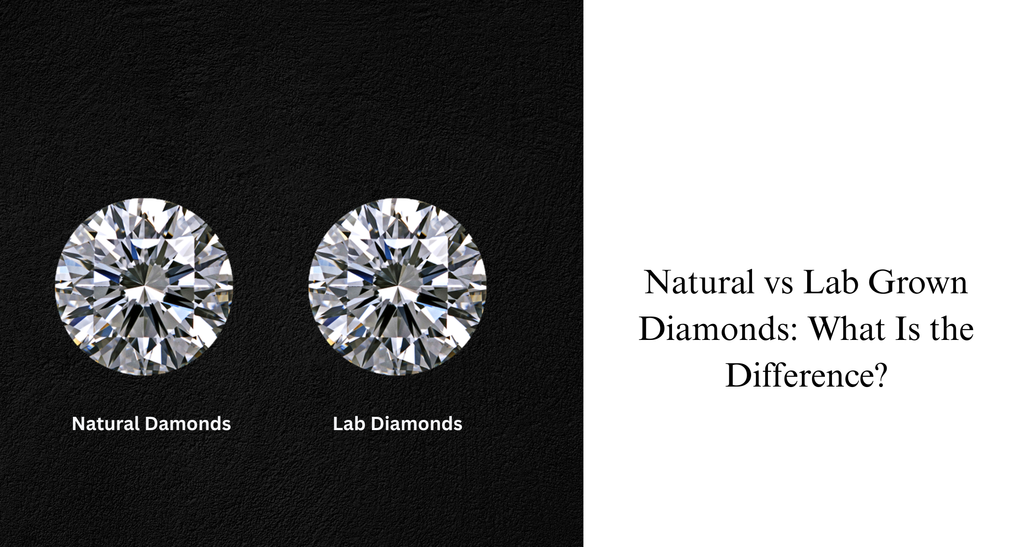
Natural vs Lab Grown Diamonds: What Is the Difference?
A decade ago, most diamond buyers had only one option: a natural diamond formed deep within the Earth over billions of years. Today, things are different. Lab grown diamonds have become a popular choice for engagement rings, wedding jewellery, and everyday diamond pieces, giving buyers more options than ever before.
As a result, one question is being asked more frequently than any other: What is the difference between a natural diamond and a lab grown diamond?
The answer is more interesting than many people expect. Both natural and lab grown diamonds are real diamonds. They have the same chemical composition, the same crystal structure, the same brilliance, and the same durability. In fact, without specialised testing equipment, even experienced jewellers cannot tell them apart simply by looking at them.
The real difference lies in how they are created, how much they cost, their rarity, and how buyers perceive their value.
Whether you are shopping for an engagement ring, upgrading your jewellery collection, or simply trying to understand the diamond market better, this guide will explain everything you need to know about natural and lab grown diamonds so you can make an informed decision with confidence.
Natural vs Lab Grown Diamonds: Quick Comparison
| Feature | Natural Diamonds | Lab Grown Diamonds |
|---|---|---|
| Origin | Formed naturally within the Earth | Created in a laboratory |
| Chemical Composition | Carbon | Carbon |
| Crystal Structure | Diamond crystal | Diamond crystal |
| Appearance | Identical | Identical |
| Hardness | 10 on Mohs Scale | 10 on Mohs Scale |
| Certification | Available | Available |
| Price | Higher | More affordable |
| Formation Time | Billions of years | A few weeks |
| Identification | Requires specialised equipment | Requires specialised equipment |
Are Lab Grown Diamonds Real Diamonds?
Yes, lab grown diamonds are real diamonds.
One of the biggest myths in the jewellery industry is that lab grown diamonds are fake diamonds or diamond simulants. This is not true. Unlike cubic zirconia or moissanite, lab grown diamonds possess the same physical, chemical, and optical properties as natural diamonds.
Both types of diamonds are made entirely of carbon atoms arranged in the same crystal structure. This is why they display the same sparkle, fire, brilliance, and durability.
Leading gemological laboratories such as IGI and GIA grade and certify lab grown diamonds using the same quality standards applied to natural diamonds.
What Is a Natural Diamond?
A natural diamond is a gemstone that formed beneath the Earth's surface through natural geological processes.
Scientists estimate that most natural diamonds formed between one and three billion years ago under extreme pressure and temperatures deep within the Earth's mantle. Volcanic activity later brought these diamonds closer to the surface, where they were eventually discovered and mined.
Each natural diamond has its own growth history, which contributes to its uniqueness.
What Is a Lab Grown Diamond?
A lab grown diamond is a diamond created in a controlled laboratory environment using advanced technology.
Instead of taking billions of years to form underground, scientists recreate the conditions needed for diamond growth within specialised facilities. Over a period of several weeks, carbon atoms build upon a diamond seed, creating a genuine diamond crystal.
The result is a diamond that is physically identical to one found in nature.
How Are Natural and Lab Grown Diamonds Created?
The biggest distinction between natural and lab grown diamonds is their origin.
Natural diamonds are formed naturally beneath the Earth's surface over billions of years through geological processes involving intense heat and pressure.
Lab grown diamonds are produced by scientists who replicate these conditions using specialised equipment. While the process is much faster, the end product remains a real diamond.
Think of it like ice. Ice created naturally outdoors and ice made in a freezer are chemically the same. The difference is how they were formed.
CVD vs HPHT Diamonds: Understanding the Two Growth Methods
Lab grown diamonds are typically created using one of two methods.
What Is HPHT?
HPHT stands for High Pressure High Temperature.
This process closely mimics the conditions under which natural diamonds form inside the Earth. Carbon is exposed to extremely high pressure and temperature, allowing a diamond crystal to grow around a seed.
HPHT technology has been used for decades and continues to produce high-quality diamonds.
What Is CVD?
CVD stands for Chemical Vapour Deposition.
In this method, a thin diamond seed is placed inside a chamber filled with carbon-rich gases. The gases are heated, causing carbon atoms to separate and gradually build onto the seed layer by layer.
This process creates a real diamond with the same properties as a natural diamond.
Is One Better Than the Other?
Not necessarily.
Both CVD and HPHT methods can produce beautiful, high-quality diamonds. What matters most is the final diamond's cut, colour, clarity, and certification rather than the growth method used.
Can You Tell the Difference Between Natural and Lab Grown Diamonds?
No, not by sight alone.
Natural and lab grown diamonds look exactly the same to the naked eye. They exhibit the same sparkle, brilliance, and light performance.
Even trained jewellers cannot reliably distinguish between them without specialised testing equipment.
Gemological laboratories use advanced instruments to identify growth patterns and trace characteristics that reveal whether a diamond formed naturally or in a laboratory.
Natural vs Lab Grown Diamonds: Appearance and Sparkle
When buyers compare natural and lab grown diamonds, appearance is often their biggest concern.
The good news is that there is no visible difference.
A well-cut natural diamond and a well-cut lab grown diamond with the same quality grades will display identical brilliance and fire. Both are available in a wide range of shapes, including round, oval, pear, emerald, cushion, and princess cuts.
The sparkle you see depends far more on the cut quality than on the diamond's origin.
Natural vs Lab Grown Diamonds: Durability and Hardness
Diamonds are known for being the hardest gemstones used in jewellery.
Both natural and lab grown diamonds score 10 on the Mohs Hardness Scale, making them highly resistant to scratching.
This means both options are suitable for everyday wear, whether you choose a diamond engagement ring, wedding band, pendant, or pair of earrings.
With proper care, both can last a lifetime and beyond.
Natural vs Lab Grown Diamonds: Price Comparison
Price is one of the most noticeable differences between the two options.
Lab grown diamonds generally cost significantly less than natural diamonds of comparable size and quality. This allows buyers to choose a larger carat weight or higher quality diamond within the same budget.
For example, the budget required for a smaller natural diamond may allow you to purchase a substantially larger lab grown diamond with similar colour and clarity grades
If you’re wondering whether this price difference makes lab-grown diamonds worth buying, read our guide on Are Lab Grown Diamonds affordable.
This affordability is one of the key reasons behind the growing popularity of lab grown diamonds.
Natural vs Lab Grown Diamonds: Rarity and Availability
Natural diamonds are considered rare because they formed under unique geological conditions over billions of years.
Their supply is limited by what nature has created and what can be economically mined.
Lab grown diamonds, on the other hand, can be produced as demand increases. While they still require advanced technology and expertise to create, they are generally more readily available than natural diamonds.
For buyers who value rarity and natural origin, this distinction may play an important role in their decision.
Natural vs Lab Grown Diamonds: Resale and Long-Term Value
Many buyers wonder whether one type of diamond retains value better than the other.
Natural diamonds have historically maintained stronger resale value due to their rarity and long-established market presence.
Lab grown diamonds are a newer category, and their market continues to evolve. As production technology advances and supply increases, resale values may differ from those of natural diamonds.
However, it is important to remember that most people purchase diamond jewellery to celebrate important life moments rather than as financial investments.
The emotional value often outweighs resale considerations.
How to Verify Whether a Diamond Is Natural or Lab Grown
The easiest way to verify a diamond's origin is through certification.
Reputable grading laboratories clearly state whether a diamond is natural or lab grown on the grading report.
When shopping for diamond jewellery, always look for certification from recognised laboratories such as:
-
IGI (International Gemological Institute)
-
GIA (Gemological Institute of America)
-
SGL (Solitaire Gemmological Laboratories)
A certification report provides valuable information about the diamond's cut, colour, clarity, and carat weight while confirming its origin.
Which Diamond Is Right for You?
There is no universal answer because every buyer has different priorities.
A natural diamond may be the right choice if:
-
You appreciate geological rarity.
-
You value the story of a gemstone formed over billions of years.
-
You prefer a traditionally sourced diamond.
A lab grown diamond may be the right choice if:
-
You want a larger diamond within your budget.
-
You prioritise value and affordability.
-
You want the same beauty, brilliance, and durability as a natural diamond.
The best choice is the one that aligns with your personal preferences, budget, and reasons for purchasing jewellery.
Final Thoughts
Natural and lab grown diamonds have far more in common than many people realise. Both are real diamonds with the same chemical composition, crystal structure, hardness, brilliance, and beauty.
The primary difference is how they are formed. Natural diamonds are created by nature over billions of years beneath the Earth, while lab grown diamonds are created using advanced technology in carefully controlled environments.
For modern jewellery buyers, the decision often comes down to personal preference. Some value the rarity and natural origin of mined diamonds, while others appreciate the affordability and accessibility of lab grown diamonds.
Whichever option you choose, focusing on quality, craftsmanship, and certification will help ensure you select a diamond that you can enjoy for years to come.


