




 All Earrings
 Stud Earrings
 Drop Earrings
 Solitaire
 Hoop Earrings
 Halo Earrings
 Vermeil Earrings
 Round
Round
 Oval
Oval
 Emerald
 Pear
Pear
 Princess
 Heart
Heart
 Marquise
 All Rings
 Solitaire Rings
 Band Rings
 Halo Rings
 Cocktail Rings
 Eternity Rings
 Fashion Ring
 Stack Rings
 Men's Rings
 Vermeil Rings
 All Necklaces
 Necklet
 Mangalsutra
 Solitaire
 Tennis Necklace
 Statement Necklace
 Vermeil Necklace
 Alphabets
 Solitaire Pendant
 Halo Pendant
 Vermeil Pendants
 All Bracelets
 Solitaire Bracelet
 Tennis Bracelet
 Fashion Bracelet
 Mangalsutra
 Vermeil Bracelets
 All Vermeil
 Vermeil Earring
 Vermeil Pendant
 Vermeil Ring
 Vermeil Necklace
 Vermeil Mangalsutra
 Vermeil Bracelets
 Vermeil Bangles
 Vermeil Men’s
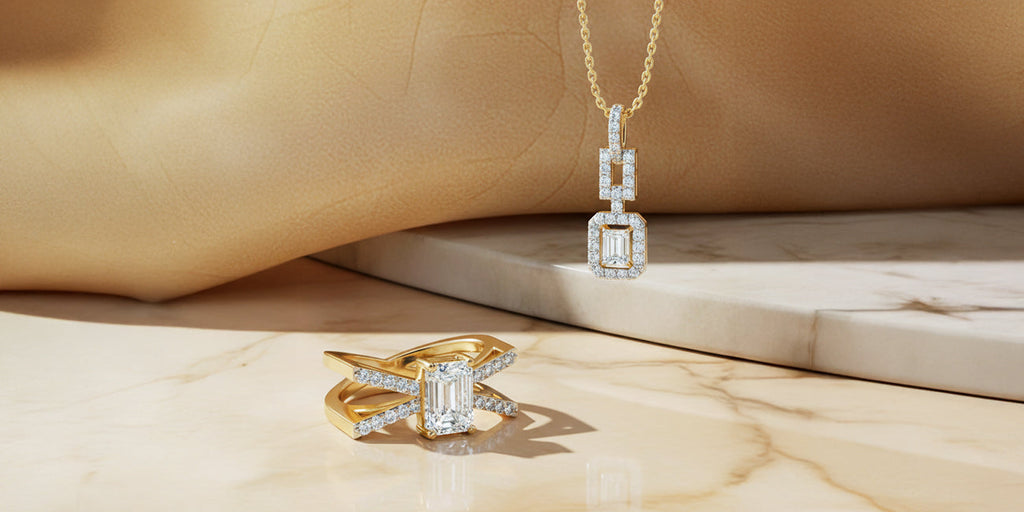
Best Lab Grown Diamond Shapes: How to Choose the Right One
A diamond shape changes more than the outline of the stone. It affects how the diamond reflects light, how large it looks on the finger and how it sits inside a ring setting.
Round, oval, pear, marquise, princess, cushion, emerald and radiant diamonds can have the same carat weight but still look very different when worn.
There is no single diamond shape that is best for everyone. The right choice depends on whether you want more sparkle, more finger coverage, a square design, an elongated stone or a particular setting style.
This guide explains the most popular lab grown diamond shapes and what you should check before choosing one.
Diamond Shape vs Diamond Cut
Diamond shape and diamond cut are related, but they do not mean the same thing.
Diamond shape means the outer outline of the stone when viewed from the top. Round, oval, square, pear and heart are examples of diamond shapes.
Diamond cut refers to the arrangement, angles and proportions of the diamond’s facets. These factors affect how light moves through the stone and how much brilliance, fire and sparkle it produces.
Two diamonds can have the same shape and carat weight but still look different because their proportions and cutting quality are different. To understand how proportions and facet arrangement affect a diamond’s brightness, read our guide on why a diamond’s cut is so important.
The shape does not affect whether a lab grown diamond is real. Lab grown diamonds have the same diamond material regardless of whether they are round, oval, emerald or another shape.
Quick Comparison of Lab Grown Diamond Shapes
| Diamond shape | Sparkle and appearance | Visible finger coverage | Important buying check |
|---|---|---|---|
| Round | Strong and balanced brilliance | Balanced | Cut and proportions |
| Oval | Bright with an elongated outline | Often high | Bow-tie effect and symmetry |
| Pear | Bright with one rounded and one pointed end | Often high | Point protection and symmetry |
| Marquise | Elongated with two pointed ends | Usually very high | Bow-tie effect and protected tips |
| Princess | Bright with a square outline | Balanced | Protection for sharp corners |
| Cushion | Soft square or rectangular outline | Can vary | Depth and face-up measurements |
| Emerald | Broad, clear flashes instead of intense sparkle | Good in elongated versions | Clarity and symmetry |
| Radiant | Strong sparkle with cropped corners | Good in rectangular versions | Length-to-width preference |
| Asscher | Square shape with broad step-cut flashes | More compact | Clarity and centred pattern |
| Heart | Recognisable romantic outline | Depends on proportions | Symmetry and point protection |
These are general tendencies. The actual appearance of a diamond depends on its measurements, proportions and how well it has been cut.
Round Brilliant Diamond
The round brilliant is known for strong and balanced sparkle. Its facet pattern is designed to return light efficiently when the diamond has suitable proportions.
A standard round brilliant generally has 57 or 58 facets. It works well in solitaire rings, halo rings, earrings, pendants and other jewellery styles.
Why Choose a Round Diamond?
Choose a round diamond when:
-
Sparkle is your first priority.
-
You want a shape that works with most ring settings.
-
You prefer a balanced outline rather than an elongated stone.
-
You want a shape that is easy to match in earrings or side-stone jewellery.
Round diamonds usually cost more than many fancy-shaped diamonds with similar carat, colour and clarity. However, the final price still depends on the complete quality of the individual diamond.
Oval Diamond
An oval diamond has curved sides and an elongated outline. It offers a sparkle pattern similar to a round brilliant but covers more length on the finger.
An oval can often look larger than a round diamond of the same carat weight because its weight is spread across a longer face-up area. Its shape can also make the finger appear longer.
What Should You Check in an Oval Diamond?
Pay attention to:
-
Whether both sides of the oval look balanced.
-
Whether the stone appears too narrow or too wide for your preference.
-
The darkness across the centre, commonly called the bow-tie effect.
-
How the diamond looks while moving, not only in a still image.
A slight bow-tie can be part of an oval diamond’s normal contrast pattern. However, a very dark or wide bow tie may distract from the rest of the stone.
Pear-Shaped Diamond
A pear-shaped diamond combines a rounded end with a pointed tip. It is also commonly called a teardrop diamond.
Its elongated outline provides good finger coverage and can make the finger appear longer. A pear diamond can be worn with the point facing towards or away from the hand, depending on the ring design.
What Should You Check in a Pear Diamond?
Look for:
-
A balanced outline on both sides.
-
Smooth and even shoulders near the rounded end.
-
A clearly defined point.
-
A bow tie that does not appear too dark.
-
A setting that protects the pointed tip.
The point is more exposed than the rounded part of the stone. A V-shaped prong or protective bezel can help reduce the chance of damage.
Marquise Diamond
A marquise diamond has a long body with pointed ends on both sides. Its extended outline can create a larger face-up appearance and provide strong finger coverage.
Among commonly available diamond shapes, marquise is often one of the shapes that appears largest for its carat weight. Its length can also make the finger look slimmer.
What Should You Check in a Marquise Diamond?
Check that:
-
Both sides match evenly.
-
The two points line up with the centre.
-
The stone does not look unusually narrow or wide.
-
The bow tie is not excessively dark.
-
Both pointed ends are protected by the setting.
Marquise diamonds commonly show some bow-tie contrast. View the actual diamond in normal lighting or request a clear movement video before making a decision.
Princess-Cut Diamond
The princess cut has a square outline, sharp corners and a brilliant-style facet pattern. It is suitable for buyers who want a square centre stone without moving to the broad flashes of a step cut.
Princess diamonds provide good sparkle but can carry more of their weight in the lower part of the stone. Because of this, some princess diamonds may look slightly smaller from the top than another square shape with the same carat weight.
What Should You Check in a Princess Diamond?
Look for:
-
A properly centred square outline.
-
Four balanced sides.
-
Even sparkle across the stone.
-
A setting that covers or protects all four corners.
The pointed corners can be vulnerable to chipping if they remain exposed. Protective prongs or a bezel setting can help.
Cushion-Cut Diamond
A cushion diamond has a square or rectangular outline with rounded corners. It gets its name from its soft, pillow-like shape.
Cushion diamonds are available in different facet patterns. Some have larger, clearer flashes, while modified cushion cuts can have a finer crushed-ice appearance.
Cushion diamonds may have deeper proportions, which can make some stones appear smaller from the top than other shapes of the same carat weight. They often cost less per carat than comparable round brilliant diamonds.
What Should You Check in a Cushion Diamond?
Compare:
-
The actual length and width measurements.
-
Square and rectangular cushion options.
-
The amount and pattern of sparkle.
-
Whether the stone carries too much weight below the visible surface.
Do not compare cushion diamonds by carat weight alone. Two one-carat cushions can have noticeably different face-up dimensions.
Emerald-Cut Diamond
An emerald-cut diamond usually has a rectangular outline, cropped corners and long step-cut facets.
It does not produce the same type of continuous sparkle as a round or radiant diamond. Instead, it creates broad flashes of light, often described as a hall-of-mirrors effect.
The large open facets make the internal appearance of the diamond easier to see. Clarity, symmetry and the position of inclusions therefore require more attention in an emerald cut.
Why Choose an Emerald-Cut Diamond?
Choose it when:
-
You prefer clean lines and broad flashes.
-
You want a rectangular centre stone.
-
You do not need maximum sparkle.
-
You like a diamond whose internal pattern is clearly visible.
View emerald diamonds in normal lighting and compare more than one stone. A grading report alone cannot show exactly how its steps and contrast will appear to your eyes.
Radiant-Cut Diamond
The radiant cut is available in square and rectangular versions. It has cropped corners and a brilliant-style facet arrangement.
A radiant gives stronger sparkle than an emerald or Asscher cut while retaining a structured square or rectangular outline. Its cropped corners also make it easier to protect than a square diamond with sharp points.
Radiant diamonds often cost less per carat than comparable round brilliants, although prices depend on the complete specifications of each stone.
What Should You Check in a Radiant Diamond?
Decide whether you prefer:
-
A square radiant.
-
A slightly rectangular shape.
-
A clearly elongated radiant.
-
Larger flashes or a finer crushed-ice pattern.
Compare the diamond’s length and width rather than relying only on its carat weight.
Asscher-Cut Diamond
An Asscher diamond has a square outline with cropped corners and step-cut facets. When viewed from the top, it may appear slightly octagonal.
Like an emerald cut, the Asscher produces broad flashes instead of intense brilliant-style sparkle. Its layered facets often create a clear geometric pattern towards the centre.
Because an Asscher has open facets and a relatively deep pavilion, clarity and symmetry can be easier to notice.
What Should You Check in an Asscher Diamond?
Check:
-
Whether the central pattern looks properly aligned.
-
Whether the corners are even.
-
Whether any inclusions are easy to see.
-
The face-up measurements in comparison with its carat weight.
Asscher cuts can look more compact than elongated shapes, so compare their actual dimensions before deciding.
Heart-Shaped Diamond
A heart-shaped diamond has two rounded lobes, a centre cleft and a pointed lower end.
Symmetry is particularly important in this shape. Both halves should look balanced, and the heart outline should be easy to recognise when viewed from the top.
In very small diamonds, the heart outline may not appear as clearly once prongs are added. The setting should protect the lower point without covering too much of the shape.
Heart diamonds can work in rings, pendants and other jewellery where the shape itself is an important part of the design.
Which Diamond Shape Looks Biggest?
Marquise, oval and pear diamonds often look bigger than round diamonds of the same carat weight because their elongated outlines cover more visible surface area.
Marquise commonly provides strong face-up length, while oval gives a more balanced curved outline. Pear provides a combination of length and a noticeable pointed end.
However, shape alone does not determine visible size. The exact length, width, depth and proportions of the individual stone also matter.
Which Diamond Shape Provides More Finger Coverage?
Elongated shapes generally provide more finger coverage than compact shapes.
These include:
-
Marquise
-
Oval
-
Pear
-
Elongated radiant
-
Emerald
-
Rectangular cushion
Marquise usually provides more length, while wider oval and radiant diamonds may cover more of the finger from side to side.
The best option depends on whether you want vertical length, overall width or a balance of both.
Which Diamond Shape Usually Costs Less Than Round?
Fancy shapes such as oval, cushion, princess, radiant, pear and marquise can often cost less than a round brilliant with similar carat, colour and clarity.
Round diamonds remain in high demand, and some fancy shapes allow more of the rough diamond to be retained during cutting. However, no shape is always cheaper.
A high-quality oval or radiant can cost more than a lower-quality round. Final pricing also depends on:
-
Carat weight
-
Colour
-
Clarity
-
Cutting quality
-
Measurements
-
Certification
-
Availability
Compare diamonds with similar specifications rather than comparing shape names alone.
Does an Oval Diamond Look Bigger Than a Round Diamond?
An oval diamond can often look bigger than a round diamond with the same carat weight.
This happens because the oval’s weight is spread across a longer surface. The elongated outline also covers more of the finger, creating a larger visual appearance.
However, not every oval will look bigger. A deep oval may carry more weight below the visible surface, while a well-proportioned round may look wider and brighter than expected.
Always compare the measurements and the actual face-up appearance.
Does Cut Affect the Visible Size of a Diamond?
Yes. Cutting proportions affect how much of the diamond’s weight can be seen from the top.
A diamond with excessive depth or a very thick girdle may hide more weight below the setting. It can therefore weigh more without looking noticeably larger.
A very shallow diamond may appear wider, but poor proportions can reduce its brightness and overall appearance. The aim is not simply to find the widest stone. The diamond should provide a good balance of visible size and light performance.
Carat is a measurement of weight, not an exact measurement of visible size.
How to Choose a Lab Grown Diamond Shape
Start With the Appearance You Prefer
Choose a shape category before comparing small quality differences.
-
For balanced sparkle: Round
-
For an elongated brilliant shape: Oval
-
For a teardrop outline: Pear
-
For maximum visible length: Marquise
-
For a square brilliant shape: Princess
-
For rounded corners: Cushion
-
For broad step-cut flashes: Emerald or Asscher
-
For a rectangular shape with strong sparkle: Radiant
-
For a recognisable love symbol: Heart
Compare Actual Measurements
Do not assume two diamonds with the same carat weight will look the same size.
Check the length, width and depth provided in the grading report. These measurements give a clearer idea of how much surface area will be visible.
View the Diamond in Motion
A still photograph may hide:
-
A strong bow tie
-
Uneven sparkle
-
Dark areas
-
Poor symmetry
-
A crushed-ice pattern you may or may not like
Ask for a clear video under normal lighting, particularly when buying oval, pear, marquise, cushion or radiant diamonds.
Consider the Ring Setting
Pointed shapes need suitable protection.
Pear, marquise, princess and heart diamonds should have prongs or a bezel that protects their exposed points and corners. A secure setting matters even though diamond is highly resistant to scratching.
Check the Grading Report
For a significant purchase, choose a diamond with an independent grading report that clearly identifies its laboratory-grown origin.
For an IGI-certified lab grown diamond, check:
-
Report number
-
Shape and cutting style
-
Measurements
-
Carat weight
-
Colour
-
Clarity
-
Cut or finish details
-
Polish
-
Symmetry
-
Laser inscription, where mentioned
IGI evaluates fancy-shaped diamonds through shape-specific requirements, proportions, finish and light-return assessment. Polish and symmetry are also recorded on the report.
Final Thoughts
The best lab grown diamond shape is the one that matches the appearance, finger coverage and ring setting you want.
Choose round for balanced brilliance, oval or marquise for more visible length, radiant or princess for a structured shape with sparkle, and emerald or Asscher for broad step-cut flashes.
Do not make the decision through carat weight alone. Compare the diamond’s measurements, proportions, symmetry and actual movement under normal lighting.
A properly selected shape should not only look good in a product image. It should also sit securely in the jewellery, suit your preferred design and provide the visible size and sparkle expected from your budget.


