




 All Earrings
 Stud Earrings
 Drop Earrings
 Solitaire
 Hoop Earrings
 Halo Earrings
 Vermeil Earrings
 Round
Round
 Oval
Oval
 Emerald
 Pear
Pear
 Princess
 Heart
Heart
 Marquise
 All Rings
 Solitaire Rings
 Band Rings
 Halo Rings
 Cocktail Rings
 Eternity Rings
 Fashion Ring
 Stack Rings
 Men's Rings
 Vermeil Rings
 All Necklaces
 Necklet
 Mangalsutra
 Solitaire
 Tennis Necklace
 Statement Necklace
 Vermeil Necklace
 Alphabets
 Solitaire Pendant
 Halo Pendant
 Vermeil Pendants
 All Bracelets
 Solitaire Bracelet
 Tennis Bracelet
 Fashion Bracelet
 Mangalsutra
 Vermeil Bracelets
 All Vermeil
 Vermeil Earring
 Vermeil Pendant
 Vermeil Ring
 Vermeil Necklace
 Vermeil Mangalsutra
 Vermeil Bracelets
 Vermeil Bangles
 Vermeil Men’s
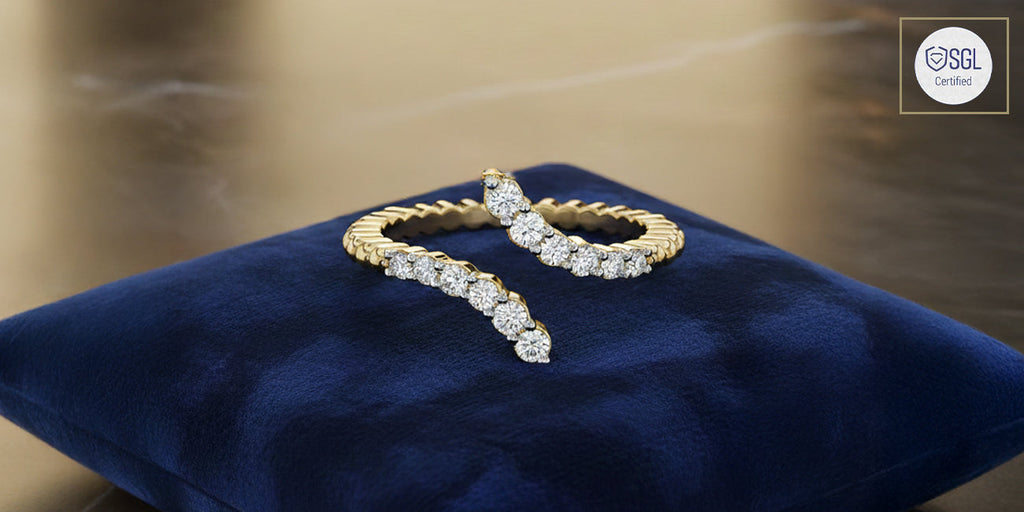
Why Lab Grown Diamond Certification Matters: A Buyer’s Guide
People often start with the sparkle. That’s natural — jewellery is emotional before it is technical. But the moment you scratch beneath the surface of lab grown diamond jewellery, you realise something important: appearances don’t tell the full story. And that’s exactly where lab grown diamond certification steps in.
In my experience, especially when speaking with buyers who are exploring lab grown diamond earrings or a solitaire for engagement, the biggest misconception is that “all lab grown diamonds look the same.” They don’t. And even if two stones look similar, their value and quality may be quite different. Certification is what separates a well-informed purchase from an optimistic guess.

What Certification Actually Is | Lab Grown Diamond Jewellery & Certified Diamonds in India
Certification is simply the formal documentation of what a diamond actually is — not what it appears to be under showroom lighting. It’s the gem industry’s way of saying, “Here’s the truth behind this stone, measured in a controlled environment, not estimated.”
Labs like IGI, GIA, SGL and GCAL evaluate diamonds using tools that most buyers will never encounter day-to-day. Spectrometers. High-magnification microscopes. Growth-pattern detectors. It's not romantic, but it’s necessary.
A proper certificate will outline:
-
Carat weight
-
Clarity grade
-
Cut grade (this one matters more than people admit)
-
Colour
-
Growth method (CVD or HPHT — useful to know, even if not essential)
-
Fluorescence
-
Treatments (if any)
-
A unique inscription number
In India, where certified diamonds in India increasingly shape buyer expectations, certification has become less of a “premium add-on” and more of a baseline requirement.

Why Buyers Should Care Before Falling for a Design | Lukson Diamonds & Lab Grown Diamond Earrings
A lot of people fall in love with jewellery before they ask technical questions — and I get why. But if you’re looking at premium pieces from brands like Lukson diamonds, the certification is the part that confirms whether the piece remains valuable long after the initial excitement.
For example, two stones may look identical in a pair of lab grown diamond earrings, but under grading:
-
One may be VS1
-
One may be SI2
-
One may have an excellent cut
-
Another may have a noticeable growth pattern under magnification
If you’re paying for “premium,” certification ensures you’re not paying premium pricing for average characteristics. It keeps both buyers and sellers honest.
Certified vs Non-Certified: The Differences People Don’t Realise | Lab Grown Diamond Necklace
Buyers sometimes ask if non-certified diamonds are “fine.” They can be. But you’re buying without knowing what you’re really getting. And that’s the problem.
Below is a simplified comparison I use often when explaining to clients:
|
Factor |
Certified Diamonds |
Non-Certified Diamonds |
|
Accuracy |
Verified by a lab |
Seller’s opinion |
|
Price Justification |
Clear and defensible |
Often inflated |
|
Long-Term Value |
Strong (appraisable) |
Weak |
|
Transparency |
High |
Depends entirely on seller |
|
Risk |
Low |
Considerably higher |
So, whether we’re talking about a lab grown diamond necklace or a solitaire ring, the presence (or absence) of certification changes the entire experience.

Which Certifications Are Worth Paying Attention To | Lab Grown Diamond Rings & Certified Diamond Jewellery
There are many labs, but only a few that industry professionals consistently rely on.
1. IGI
IGI is extremely common for lab grown diamonds, especially in India. Their reports are clear and usually easy for buyers to follow. For most people, especially those evaluating lab grown diamond rings, IGI strikes the right balance of detail and accessibility.
2. GIA
GIA is a global authority. Their standards for natural diamonds set the benchmark, but their lab grown grading has become equally respected. GIA certificates carry strong weight in markets where buyers want the highest perceived credibility.
3. SGL
Often used for smaller stones and multi-stone jewellery. Reliable enough for fine jewellery, especially when certification is needed more for transparency than resale.
4. GCAL
GCAL is strict — sometimes more strict than buyers expect. For those who want guaranteed consistency, GCAL is a great option.
Premium-forward labels like Lukson lab grown diamonds often rely on IGI due to its familiarity and consumer trust.

How Certification Influences Pricing | Diamond Jewellery in Gold
A lot of people think certification “makes diamonds more expensive.” The opposite is true. Certification prevents overpricing.
When you see an expensive piece of diamond jewellery in gold, the price isn’t arbitrary. It’s built around measurable characteristics on a certificate:
-
A better cut grade will increase sparkle, and yes, the price.
-
Better colour gradings (like D–F) raise the value.
-
Higher clarity reduces visible imperfections.
Certification removes ambiguity and standardises the criteria. You’re not guessing. And neither is the seller.
How to Read a Certificate Without Feeling Intimidated | Lab Grown Diamond Jewellery
A lot of buyers get nervous when looking at diamond reports because they think they need technical expertise. You don’t. You just need to know where to focus.
Here’s what matters most:
-
Cut: If you remember nothing else, remember this. Cut affects brilliance more than any other factor.
-
Colour: D–F is colourless; G–H is still excellent for most jewellery.
-
Clarity: VS and SI clarify most daily-wear needs.
-
Growth Method: CVD is appreciated for consistency; HPHT has its fans too.
-
Inscription: This must match the certificate — non-negotiable.
Once you get familiar with these items, browsing lab grown diamond rings or solitaires becomes much easier and far more objective.
Read more: 1 Carat Lab Grown Diamond Price in India
Certification and the Online Shopping Landscape | Lukson Lab Grown Diamonds
Buying jewellery online has changed the way people evaluate diamonds. In-store lighting can make almost any stone sparkle; online, you need data and documentation to make an informed judgment.
Certification helps bridge that gap.
It becomes the factual backbone behind product photos. A brand showing certification upfront is signalling integrity. A brand avoiding it… well, that tells its own story.
When you’re comparing higher-end pieces like lab grown diamond earrings, certification ensures you don’t have to rely purely on images.
How to Verify That a Certificate Is Real | Certified Diamonds in India
Verifying a certificate is simple, and honestly, there’s no reason not to do it.
Here’s the quick method:
1. Check the certificate number.
2. Enter it on the official IGI, GIA, GCAL, or SGL website.
3. Compare the digital record with the physical certificate.
4. Match the inscription on your diamond.
If anything feels off — mismatched numbers, missing details — walk away. The luxury space for certified diamonds in India is too competitive to settle for uncertainty.
Also read: How to Identify Real 14K Gold Jewelry
A Practical Checklist Before You Buy | Lab Grown Diamond Rings & Certified Diamond Jewellery
Here’s a compact version of what I tell clients:
-
Stick to IGI or GIA for solitaires.
-
Prioritise cut above everything else.
-
Colour grades D–H work beautifully in most gold settings.
-
VS1–SI1 clarity offers the best balance of beauty and value.
-
Inscription must match the certificate.
Avoid uncertified stones, even if they seem “like a great deal.”
This holds true whether you’re browsing lab grown diamond earrings, lab grown diamond rings, or certified diamond jewellery.


