










 All Earrings
 Stud Earrings
 Drop Earrings
 Solitaire
 Hoop Earrings
 Halo Earrings
 Vermeil Earrings
 Round
Round
 Oval
Oval
 Emerald
 Pear
Pear
 Princess
 Heart
Heart
 Marquise
 All Rings
 Solitaire Rings
 Band Rings
 Halo Rings
 Cocktail Rings
 Eternity Rings
 Fashion Ring
 Stack Rings
 Men's Rings
 Vermeil Rings
 All Necklaces
 Necklet
 Mangalsutra
 Solitaire
 Tennis Necklace
 Statement Necklace
 Vermeil Necklace
 Alphabets
 Solitaire Pendant
 Halo Pendant
 Vermeil Pendants
 All Bracelets
 Solitaire Bracelet
 Tennis Bracelet
 Fashion Bracelet
 Mangalsutra
 Vermeil Bracelets
 All Vermeil
 Vermeil Earring
 Vermeil Pendant
 Vermeil Ring
 Vermeil Necklace
 Vermeil Mangalsutra
 Vermeil Bracelets
 Vermeil Bangles
 Vermeil Men’s
How to Check Gold Jewellery Purity: BIS Hallmark, Purity Marks & Karat Explained
Buying gold jewellery is not only about choosing a design you love. Before making a purchase, it is equally important to understand what you are paying for. One of the simplest ways to do this is by checking the gold purity and hallmark on the jewellery.
You may have noticed numbers such as 916, 750 or 585 stamped on gold rings, earrings, pendants and other jewellery. These numbers indicate the fineness of the gold. You may also see the BIS Standard Mark and a unique HUID number on hallmarked gold jewellery in India.
But what do these marks actually mean? How can you check them? And what is the difference between 22KT, 18KT and 14KT gold? Here is everything you need to know before buying gold jewellery.
What Is Gold Purity?
Gold purity tells you how much pure gold is present in a jewellery alloy.
Pure gold is considered 24 karat, but it is relatively soft. Jewellery is therefore generally made by combining gold with other metals to achieve the required strength, durability and appearance.
The proportion of pure gold is represented by its karat and fineness.
For example, 18KT gold is 75% pure gold, which is represented by the fineness number 750.
The higher the fineness number, the greater the proportion of pure gold in the alloy.
Understanding Gold Karat and Fineness
The numbers stamped on gold jewellery can look confusing at first, but they are quite straightforward once you know what they represent.
| Gold Purity | Fineness | Pure Gold Content |
|---|---|---|
| 22KT | 916 | 91.6% |
| 18KT | 750 | 75% |
| 14KT | 585 | 58.5% |
| 9KT | 375 | 37.5% |
For example, 750 means that 750 parts out of 1,000 are pure gold, making it 18KT gold.
It is worth noting that BIS's current standard permits hallmarking for six gold grades: 14K (585), 18K (750), 20K (833), 22K (916), 23K (958) and 24KS (995).
So, when you see a number such as 750 on a piece of jewellery, you can immediately understand its gold content.
What Is a BIS Hallmark?
A BIS hallmark is an official indication of the purity or fineness of precious metal jewellery under India's hallmarking system.
BIS, or the Bureau of Indian Standards, operates the hallmarking scheme for gold and silver in India. The purpose of hallmarking is to help protect consumers against incorrect purity claims and provide assurance about the precious metal content of jewellery.
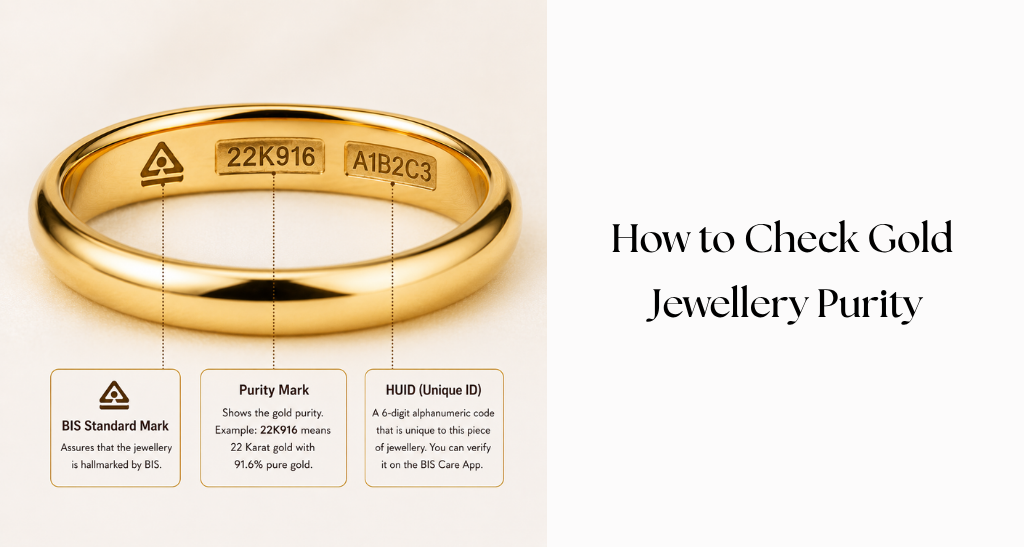
For current hallmarked gold jewellery, the hallmark consists of three key components:
- BIS Standard Mark
- Purity in karat and fineness
- Six-digit alphanumeric HUID
This means that checking only one mark is not enough. You should understand what each component tells you.
What Are the Two Important Marks on Gold Jewellery?
When buying gold jewellery, two of the most important things to understand are the BIS Standard Mark and the purity mark.
1. BIS Standard Mark
The BIS Standard Mark identifies jewellery that has been hallmarked under the BIS system.
When purchasing hallmarked jewellery, you can ask the jeweller to show you the hallmark on the actual piece. BIS also states that registered jewellers should display their BIS registration certificate at the sales outlet and provide a magnifying glass of at least 10X magnification for customers to view the hallmark.
2. Purity Mark
The purity mark tells you the karat and fineness of the gold.
For example:
22K916 = 22KT gold with 916 fineness
18K750 = 18KT gold with 750 fineness
14K585 = 14KT gold with 585 fineness
This is one of the easiest ways to understand the gold content of a jewellery piece.
What Is HUID in Gold Jewellery?
HUID stands for Hallmark Unique Identification.
It is a six-digit alphanumeric number assigned uniquely to each hallmarked gold jewellery item. According to BIS, consumers can use the Verify HUID feature in the official BIS Care App to verify information associated with a hallmarked item.
This adds another layer of traceability to the hallmarking process.
When checking a piece of hallmarked gold jewellery, therefore, look for the BIS mark, the purity information and the HUID.
How to Check Gold Jewellery Purity Before Buying
Checking gold jewellery does not have to be complicated. Follow these simple steps before completing your purchase.
Check the Hallmark on the Jewellery
Ask the jeweller to show you the hallmark on the actual piece.
For smaller jewellery such as rings and earrings, the marking may be tiny, which is why a magnifying glass may be needed.
If you are buying a pair of earrings, BIS states that each article in the pair should have a hallmark. Detachable parts should also carry the relevant hallmark details.
Check the Purity Number
Look for the karat and fineness marking.
For example, if you are buying 18KT gold, you should look for 18K750 or the applicable current hallmark representation showing 18KT and 750 fineness.
Knowing these numbers makes it easier to understand exactly what type of gold you are purchasing.
Verify the HUID
If the jewellery carries a HUID, you can use the Verify HUID feature on the BIS Care App.
BIS specifically provides this facility so consumers can verify hallmarked gold jewellery bearing a HUID number.
Check Your Invoice
Do not leave the store without a proper invoice.
BIS states that the bill for hallmarked jewellery should include details such as the article description, net precious metal weight, purity in karat and fineness, and hallmarking charges.
Keep the invoice safely as proof of your purchase.
22KT vs 18KT & 14KT Gold Gold: What Is the Difference?
The choice between 22KT and 18KT gold depends on what you want from your jewellery.
22KT Gold
22KT gold contains approximately 91.6% pure gold and has a fineness of 916.
It has a higher gold content and is often chosen for traditional jewellery and pieces where a rich gold appearance is preferred.
18KT Gold
18KT gold contains 75% pure gold and has a fineness of 750.
Because it contains a greater proportion of other metals than 22KT gold, it can offer a useful balance between gold content, strength and design flexibility.
For contemporary jewellery, rings and pieces designed for regular wear, 18KT gold is a popular choice.
14KT Gold
14KT gold contains 58.5% pure gold and has a fineness of 585.
It contains a higher proportion of other metals and can be considered when durability and a different price point are priorities.
The best choice depends on your budget, preferred design, intended use, and the gold purity you prefer. You can also browse our 14kt Gold rings collection to compare different styles and find one that fits your preference.
Why Should You Buy Hallmarked Gold Jewellery?
Hallmarking gives buyers an additional level of assurance about the declared precious metal purity.
According to BIS, hallmarked jewellery provides third-party assurance that the customer receives the stated purity of gold for the value paid.
It also makes it easier for buyers to understand and compare jewellery based on its stated gold content.
In addition, BIS provides consumer protection provisions for hallmarked articles that are found to have lower purity than the marked purity.
That is why checking the hallmark should be a normal part of buying gold jewellery, just like checking the size, weight and price.
What Should You Check on Your Gold Jewellery Bill?
Your jewellery purchase should come with a proper invoice containing important details.
Before leaving the store, check:
- Description of the jewellery
- Net precious metal weight
- Gold purity
- Karat and fineness
- Hallmarking charges
- Total purchase value
Keeping the invoice is important because it provides a record of what you purchased and can be useful if there is ever a dispute regarding the jewellery. BIS specifically advises consumers to take an authentic bill or invoice for hallmarked articles.
Can Gold Purity Be Tested?
Yes. Consumers can have gold jewellery or samples tested at a BIS-recognised Assaying and Hallmarking Centre on a chargeable basis.
BIS states that these centres can test jewellery for consumers and issue an assay report identifying the article and its test results.
For most buyers, however, checking the hallmark, purity marking, HUID and purchase invoice is a good starting point.
A Simple Gold Jewellery Buying Checklist
Before you buy, remember these points:
✔ Look for the BIS Standard Mark
✔ Check the karat and fineness
✔ Understand numbers such as 916, 750 and 585
✔ Check the HUID on hallmarked jewellery
✔ Verify the HUID through the BIS Care App
✔ Check that the purity details are mentioned on the invoice
✔ Check the net gold weight
✔ Buy from a registered and trustworthy jeweller
These simple checks can help you understand your purchase better and avoid relying only on verbal claims about gold purity.
Final Thoughts
Buying gold jewellery becomes much easier when you know what to look for.
The next time you shop for a gold ring, pendant, bracelet or pair of earrings, do not focus only on the design. Take a moment to check the BIS Standard Mark, purity marking and HUID. Numbers such as 916, 750 and 585 can tell you the fineness of the gold, while the HUID provides a unique identification for the hallmarked item.
Understanding these marks gives you greater clarity about your jewellery and helps you make a more informed purchase.
At Lukson, we believe that buying gold should be backed by clarity, quality and confidence.


