




 All Earrings
 Stud Earrings
 Drop Earrings
 Solitaire
 Hoop Earrings
 Halo Earrings
 Vermeil Earrings
 Round
Round
 Oval
Oval
 Emerald
 Pear
Pear
 Princess
 Heart
Heart
 Marquise
 All Rings
 Solitaire Rings
 Band Rings
 Halo Rings
 Cocktail Rings
 Eternity Rings
 Fashion Ring
 Stack Rings
 Men's Rings
 Vermeil Rings
 All Necklaces
 Necklet
 Mangalsutra
 Solitaire
 Tennis Necklace
 Statement Necklace
 Vermeil Necklace
 Alphabets
 Solitaire Pendant
 Halo Pendant
 Vermeil Pendants
 All Bracelets
 Solitaire Bracelet
 Tennis Bracelet
 Fashion Bracelet
 Mangalsutra
 Vermeil Bracelets
 All Vermeil
 Vermeil Earring
 Vermeil Pendant
 Vermeil Ring
 Vermeil Necklace
 Vermeil Mangalsutra
 Vermeil Bracelets
 Vermeil Bangles
 Vermeil Men’s
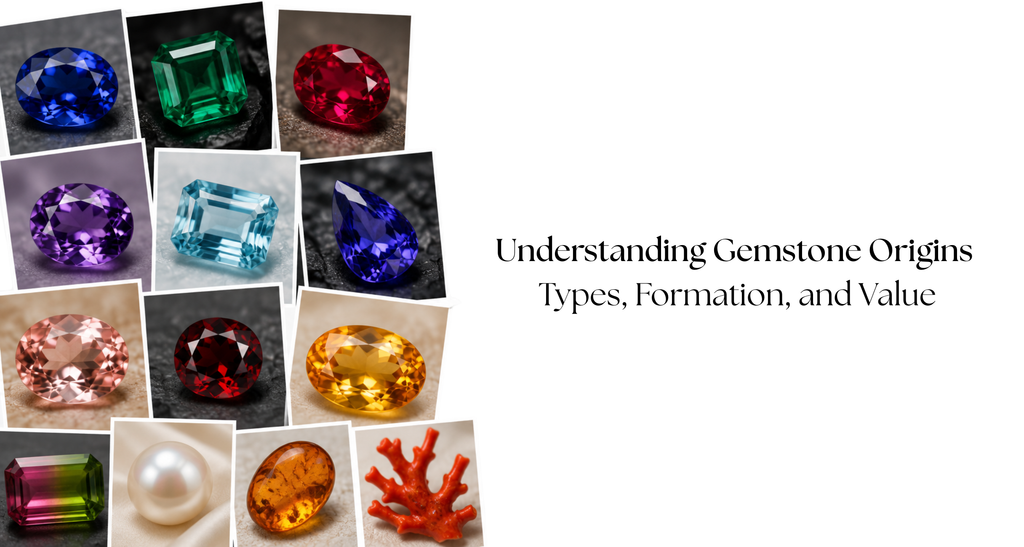
Understanding Gemstone Origins: Types, Formation, and Value
Gemstones have fascinated people for centuries with their vibrant colours, unique patterns, and timeless beauty. From royal crowns to modern jewellery collections, these precious and semi-precious stones continue to hold both emotional and financial value. But beyond their sparkle lies an interesting story of how they are formed, where they come from, and what makes one gemstone more valuable than another.
Whether you're buying gemstone jewellery for yourself or as a meaningful gift, understanding gemstone origins can help you make a more informed choice. In this guide, we'll explore the different types of gemstones, how they are formed, and the factors that influence their value.
What Are Gemstones?
Gemstones are naturally occurring minerals or organic materials that are cut and polished for use in jewellery and decorative items. They are valued for their beauty, rarity, durability, and colour.
Most gemstones form deep within the Earth's crust over millions of years under intense heat and pressure. Others develop through volcanic activity or are created from organic sources such as pearls and amber.
Today, alongside natural gemstones, lab-created gemstones have also become a popular choice, offering the same appearance and physical properties as their natural counterparts while being more affordable.
How Are Gemstones Formed?
Every gemstone has its own geological journey. The conditions under which a gemstone forms determine its colour, clarity, and overall quality.
Igneous Formation
Some gemstones form when molten rock, known as magma, cools beneath the Earth's surface. As minerals crystallise over time, gemstones such as topaz, zircon, and certain garnets are created.
Metamorphic Formation
High heat and pressure deep inside the Earth transform existing rocks into new mineral structures. This process produces gemstones like rubies, sapphires, emeralds, and jade.
Sedimentary Formation
Some gemstones develop when minerals settle in layers over time or are deposited by water. Opal and malachite are examples of gemstones formed through sedimentary processes.
Organic Formation
Not all gemstones come from rocks. Pearls are created inside oysters, while amber forms from fossilised tree resin over millions of years.
Lab Created Gemstones
Lab-created gemstones are grown in controlled environments using advanced technology that replicates the natural formation process.
They have the same chemical composition, crystal structure, and optical properties as natural gemstones but are produced in significantly less time.
Many buyers choose lab-created gemstones because they offer excellent quality, consistent colour, and greater affordability while reducing the environmental impact associated with mining.
Organic Gemstones
Organic gemstones are formed from living organisms rather than minerals.
Examples include:

Pearls
Pearls are unique because they are formed inside oysters and mussels rather than beneath the Earth's surface. When a small irritant enters the shell, the mollusc coats it with layers of nacre over time, eventually creating a pearl. Available in white, cream, pink, black, and golden shades, pearls are admired for their soft lustre elegance
Amber
Amber is not a mineral but fossilised tree resin that has hardened over millions of years. Its warm golden, honey, and reddish-brown tones often contain tiny inclusions, such as ancient plant material or insects, making each piece unique. Lightweight and naturally beautiful, amber is commonly used in pendants, bracelets, and statement jewellery.
Coral
Coral is an organic gemstone formed from the skeletons of tiny marine organisms called coral polyps. Over time, these colonies create solid structures beneath the ocean, which are carefully harvested and polished for jewellery. Found in shades of red, pink, white, and orange, coral has been used in jewellery for centuries and is valued for its smooth texture and vibrant colour. Due to conservation efforts, responsibly sourced coral is increasingly important today.
These gemstones require different care compared to mineral gemstones because they are generally softer and more delicate.
Types of Gemstones
Gemstones are available in a wide variety of colours, compositions, and origins. While each gemstone is unique, they are generally classified into three main categories: natural gemstones, lab-created gemstones, and organic gemstones. Understanding these categories can help you choose the right gemstone based on your preferences, budget, and purpose.
Natural Gemstones
Natural gemstones are formed deep within the Earth over millions of years through geological processes involving heat, pressure, and mineral-rich environments. Since they are created by nature without human intervention, no two natural gemstones are exactly alike. Each stone has its own unique colour, inclusions, and characteristics, making it one of a kind.
Many people choose natural gemstones because of their rarity, history, and individuality. Their beauty lies not only in their appearance but also in the incredible journey they have taken over millions of years before becoming part of a piece of jewellery.
Some of the most popular natural gemstones include:

Sapphire
Known for its deep blue colour, sapphire symbolises wisdom, loyalty, and sincerity. Besides blue, sapphires are also available in pink, yellow, green, white, and other attractive colours.
Emerald
Emerald is admired for its rich green hue and is often associated with growth, prosperity, and renewal. It has been treasured by royalty and jewellery lovers for centuries.
Ruby
Ruby stands out for its vibrant red colour and is considered a symbol of love, passion, and courage. It is one of the most valuable coloured gemstones in the world.
Amethyst
Amethyst is a beautiful purple gemstone that represents peace, balance, and clarity. Its elegant appearance and affordability make it a popular choice for everyday jewellery.
Aquamarine
With its calming blue colour, aquamarine is associated with serenity, honesty, and good fortune. It is especially popular in rings, pendants, and earrings.
Tanzanite
Found only in Tanzania, tanzanite is known for its striking blue-violet colour. Its rarity makes it highly desirable among gemstone collectors and jewellery enthusiasts.
Morganite
Morganite features soft pink to peach tones and is often chosen for engagement rings and romantic jewellery. It symbolises compassion, love, and emotional healing.
Garnet
Although commonly recognised for its deep red colour, garnet is available in several shades, including green and orange. It is known for representing strength, protection, and commitment.
Citrine
Citrine's warm golden-yellow colour is associated with happiness, positivity, and success. It is a durable gemstone suitable for daily wear.
Tourmaline
Tourmaline is one of the most colourful gemstones, naturally occurring in shades of pink, green, blue, black, and even multicoloured varieties. Its versatility makes it a favourite for contemporary jewellery designs.
What Determines a Gemstone's Value?
Several factors influence the price and value of a gemstone.
Colour
Colour is often the most important factor. Stones with rich, vibrant, and evenly distributed colour are generally more valuable.
For example, a vivid royal blue sapphire or a deep green emerald commands a higher price than stones with pale or uneven colour.
Clarity
Clarity refers to the number of internal inclusions and external blemishes.
While some gemstones naturally contain inclusions, stones with fewer visible imperfections are generally more desirable.
Interestingly, certain inclusions can also confirm that a gemstone is natural.
Cut
A well-cut gemstone reflects light beautifully and enhances its brilliance.
The quality of the cut can significantly influence both appearance and value, regardless of the gemstone's size.
Carat Weight
Carat measures a gemstone's weight rather than its physical dimensions.
Larger gemstones are often rarer, making them more valuable, especially when combined with excellent colour and clarity.
Rarity
Some gemstones are naturally rarer than others.
For example, fine-quality emeralds and rubies are considerably rarer than amethyst or citrine, which contributes to their higher value.
Origin
The geographic origin of a gemstone can also affect its market value.
For example:
- Kashmir is famous for exceptional sapphires.
- Colombia is renowned for premium emeralds.
- Myanmar has long been associated with high-quality rubies.
While origin can influence value, quality remains the most important factor.
Natural vs Lab Created Gemstones
Many buyers wonder whether they should choose natural or lab-created gemstones.
Natural gemstones are valued for their rarity and unique characteristics, while lab-created gemstones offer excellent quality at a more accessible price point.
Both options are beautiful and suitable for fine jewellery. The right choice depends on your budget, preferences, and what matters most to you.
Tips for Buying Gemstone Jewellery
Before purchasing gemstone jewellery, keep these tips in mind:
- Buy from a trusted jeweller.
- Ask for gemstone certification whenever available.
- Check the quality of the metal used in the jewellery.
- Understand the gemstone's care requirements.
- Choose a gemstone that suits your style and lifestyle.
- Compare colour, cut, and clarity rather than focusing only on size.
Taking these steps can help you make a confident and informed purchase.
Why Choose Gemstone Jewellery from Lukson?
At Lukson, we believe every gemstone has a story to tell. That's why we carefully select each stone for its natural beauty, vibrant colour, and quality before it becomes part of our jewellery collection. Whether you're drawn to the rich blue of sapphire, the vibrant green of emerald, or the timeless charm of ruby, you'll find designs that suit both everyday wear and special occasions.
Our gemstone collection includes gemstone earrings, rings, pendants, bracelets, and necklaces with carefully selected gemstones and expert craftsmanship to help you celebrate life's special moments with jewellery that is both beautiful and meaningful.
Final Thoughts
Every gemstone carries a unique story shaped by nature over millions of years. Understanding how gemstones are formed, where they come from, and what influences their value helps you appreciate them beyond their appearance.
Whether you choose a natural gemstone for its rarity or a lab-created gemstone for its affordability and consistency, the most important factor is selecting a piece that reflects your personal style and holds meaning for you.
With the right knowledge, you can invest in gemstone jewellery that you'll enjoy wearing for years to come.


