






 All Earrings
 Stud Earrings
 Drop Earrings
 Solitaire
 Hoop Earrings
 Halo Earrings
 Vermeil Earrings
 Round
Round
 Oval
Oval
 Emerald
 Pear
Pear
 Princess
 Heart
Heart
 Marquise
 All Rings
 Solitaire Rings
 Band Rings
 Halo Rings
 Cocktail Rings
 Eternity Rings
 Fashion Ring
 Stack Rings
 Men's Rings
 Vermeil Rings
 All Necklaces
 Necklet
 Mangalsutra
 Solitaire
 Tennis Necklace
 Statement Necklace
 Vermeil Necklace
 Alphabets
 Solitaire Pendant
 Halo Pendant
 Vermeil Pendants
 All Bracelets
 Solitaire Bracelet
 Tennis Bracelet
 Fashion Bracelet
 Mangalsutra
 Vermeil Bracelets
 All Vermeil
 Vermeil Earring
 Vermeil Pendant
 Vermeil Ring
 Vermeil Necklace
 Vermeil Mangalsutra
 Vermeil Bracelets
 Vermeil Bangles
 Vermeil Men’s
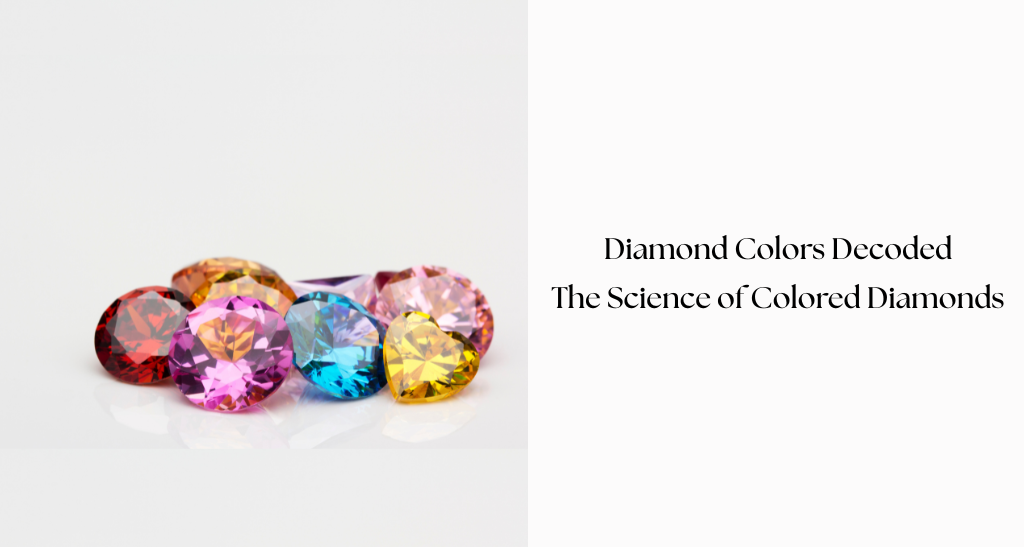
Diamond Colors Decoded: The Science of Colored Diamonds
When we think of diamonds, the first image that usually comes to mind is a bright, colorless stone. But diamonds can naturally occur in many colors, including yellow, blue, pink, green, orange, red, purple, brown, gray and black.
These colors are not simply present on the surface. They are connected to changes inside the diamond, such as trace elements, defects in the crystal structure, natural radiation and structural deformation.
These changes affect how the diamond absorbs light, creating the color we see.
What Are Colored Diamonds?
Diamonds are mainly made of carbon atoms arranged in a repeating crystal structure called a lattice.
A diamond with very few color-causing impurities or structural changes can appear colorless. But natural diamonds do not always form under perfectly uniform conditions.
During formation, other elements can enter the crystal or the arrangement of carbon atoms can change. These microscopic differences affect which parts of visible light the diamond absorbs.
The light that is not absorbed reaches our eyes and creates the visible color.
In simple terms:
Changes inside the diamond → changes in light absorption → visible color
What Causes Color in a Diamond?
There is no single reason why diamonds develop color.
Different colors can be caused by:
-
Trace elements, such as nitrogen and boron
-
Changes or deformation in the crystal structure
-
Defects or missing atoms within the crystal lattice
-
Natural radiation
-
Mineral inclusions
-
A combination of several factors
For example, nitrogen-related defects can produce yellow, boron is responsible for the color in many natural blue diamonds, and structural deformation is strongly associated with pink and red diamonds.
Diamond Color vs the D-to-Z Color Scale
Not every diamond with a visible yellow or brown tint is considered a fancy-color diamond.
Traditional colorless diamonds are graded using the D-to-Z color scale.
A D-grade diamond is at the colorless end of the scale, while diamonds closer to Z show increasingly noticeable yellow or brown tones.
When the natural color becomes strong enough to fall outside the normal D-to-Z range, the diamond may be graded as a fancy-color diamond.
Fancy-color diamonds are evaluated differently, with greater attention given to the strength and appearance of their color.
The Science Behind Different Diamond Colors
Yellow Diamonds: Nitrogen-Related Defects
Yellow is one of the more common natural fancy colors found in diamonds.
Nitrogen is one of the most common non-carbon elements found in natural diamonds. When nitrogen occurs in particular arrangements within the crystal, it can absorb parts of visible light.
This causes the diamond to appear yellow.
A small amount of color-causing nitrogen may produce only a slight warm tint. Stronger coloration can result in a diamond being graded within the fancy-yellow range.
Blue Diamonds: Often Linked to Boron
Many natural blue diamonds get their color from boron atoms present within the diamond's crystal structure.
Boron changes the way the diamond absorbs visible light, allowing the stone to develop a blue appearance.
However, boron is not the only possible cause of blue or blue-gray color. Other structural defects and impurities can also contribute to the appearance of some diamonds.
Natural blue diamonds are extremely rare.
Some blue diamonds also form much deeper inside the Earth than many other diamonds. Scientists believe materials carrying elements such as boron may be transported deep into the mantle through geological processes such as subduction.
Pink Diamonds: Changes in the Crystal Structure
Pink diamonds are different because their color is usually not caused by a simple trace element such as nitrogen or boron.
Instead, most natural pink diamonds are associated with deformation within the diamond's crystal structure.
Extreme geological forces can distort the arrangement of atoms in the crystal. These changes affect how light passes through the diamond and can create a pink appearance.
The amount and type of deformation can influence the strength of the color, producing shades ranging from pale pink to much deeper tones.
Red Diamonds: An Extreme Form of Rarity
Natural red diamonds are among the rarest colored diamonds.
Their color is also linked to structural deformation within the diamond crystal, similar to the process associated with many pink diamonds.
The conditions needed to produce a strong red appearance are extremely unusual, which is why natural red diamonds are encountered so rarely.
Green Diamonds: Natural Radiation
Many natural green diamonds develop their color after exposure to natural radiation within the Earth.
Radiation can disturb carbon atoms inside the diamond and create defects in the crystal structure. These defects change the way the stone absorbs visible light, producing a green appearance.
In some natural green diamonds, the color is concentrated mainly near the surface.
Other defects can also contribute to green coloration, which is why determining whether the color is natural may require detailed laboratory testing.
Orange Diamonds: Nitrogen-Related Defects
Natural orange diamonds are unusual and much less common than yellow diamonds.
Their color is often linked to specific nitrogen-related defects within the crystal structure.
Different arrangements of these defects can affect the exact hue, producing colors ranging from yellow-orange to strong orange.
Pure orange diamonds without noticeable secondary colors are particularly rare.
Brown Diamonds: Structural Deformation
Brown is one of the more commonly seen natural diamond colors.
Brown coloration is often associated with deformation and structural changes within the diamond lattice.
These changes affect how light travels through the crystal and can produce shades ranging from light champagne tones to deep brown.
Purple and Violet Diamonds
Purple and violet diamonds are much less common than yellow or brown diamonds.
Their color can be associated with a combination of structural defects and impurities, including hydrogen-related features.
The exact cause can differ between individual stones, which is why purple and violet diamonds can show a wide variety of shades and secondary colors.
Gray Diamonds
Gray diamonds can develop their appearance through several different causes.
Structural defects, hydrogen-related features and certain types of inclusions can all contribute to gray coloration.
Some gray diamonds also show secondary blue, green or violet tones depending on the defects or impurities present.
Black Diamonds: Inclusions and Internal Features
Black diamonds are different from many other colored diamonds.
Their dark appearance is often caused by large concentrations of microscopic mineral inclusions, such as graphite, along with internal fractures and graphitized areas.
These features can make the diamond appear opaque or almost completely black.
Rather than getting their appearance from one simple trace element, black diamonds often owe their color to the way these internal features absorb and block light.
Diamond Color Chart: What Causes Each Color?
| Diamond Color | Main Color-Causing Factor |
|---|---|
| Yellow | Nitrogen-related defects |
| Blue | Often boron; other defects may also contribute |
| Pink | Crystal lattice deformation |
| Red | Crystal lattice deformation |
| Green | Commonly radiation-related defects |
| Orange | Nitrogen-related defects |
| Purple/Violet | Hydrogen and structural defects |
| Brown | Structural deformation |
| Gray | Structural defects, hydrogen or inclusions |
| Black | Dark mineral inclusions and graphitized areas |
These are the main known causes, but the exact color mechanism can vary from one diamond to another.
Why Are Some Colored Diamonds So Rare?
The rarity of a colored diamond depends partly on how often the conditions needed to create that color occur in nature.
Nitrogen is relatively common in natural diamonds, which is one reason yellow diamonds are encountered more often than colors such as red, blue or green.
By comparison, the specific structural changes or geological conditions needed to produce strong pink, red, green or blue colors occur much less frequently.
Rarity also depends on more than just the basic color.
A large diamond with a strong and evenly distributed rare color can be considerably harder to find than a smaller or lighter-colored stone.
Does Stronger Color Mean a More Valuable Diamond?
Not always.
Color is extremely important in fancy-color diamonds, but value depends on several factors together.
These include:
-
Hue
-
Tone
-
Saturation
-
Color distribution
-
Carat weight
-
Clarity
-
Cut
-
Overall appearance
-
Whether the color is natural or treated
Terms such as Fancy Light, Fancy, Fancy Intense, Fancy Deep and Fancy Vivid are used to describe different levels of color strength.
A larger diamond with weaker or less desirable color is not automatically more valuable than a smaller diamond with a rare and highly attractive color.
How Does Cut Affect a Colored Diamond?
Cut influences how light travels through a diamond and can also affect how strongly its color appears.
With traditional colorless diamonds, cutting is often focused heavily on brightness, fire and light return.
With fancy-color diamonds, cutters may also consider how the shape and facet arrangement can retain or enhance the appearance of the diamond's natural body color.
This means the cutting approach used for a colored diamond may differ from the approach used for a colorless stone.
Natural vs Treated Colored Diamonds
When buying a colored diamond, it is important to know whether the color is natural or treated.
Natural-color diamonds develop their color through geological processes inside the Earth.
Treated diamonds have undergone processes designed to create, change or strengthen their color.
Treatments can produce attractive diamonds, but natural and treated colors are very different in terms of rarity and market value.
A professional gemological laboratory can examine a diamond and, in many cases, determine whether its color is natural or the result of treatment.
What About Lab Grown Colored Diamonds?
Lab-grown diamonds can also be produced in many colors.
Like natural diamonds, they have a crystal structure made of carbon. However, their colors can develop through controlled growth conditions or through treatments carried out after the diamond has grown.
Specific impurities can be introduced during growth, while processes such as irradiation and heat treatment may also be used to create or modify color.
Because of this, it is useful to separate two questions:
Is the stone a diamond?
and
How was its color produced?
A laboratory-grown colored diamond is still a diamond, but the process behind its color may be very different from the geological process that created the color in a natural stone.
Final Thoughts
The colors found in diamonds begin with changes that are far too small to see with the naked eye.
Nitrogen-related defects can produce yellow and orange colors. Boron is responsible for the blue appearance of many natural blue diamonds. Structural deformation can create pink, red and brown shades, while natural radiation is responsible for the color of many green diamonds.
Other impurities, defects and inclusions can produce purple, violet, gray and black stones.
Understanding these processes makes colored diamonds more interesting than simply looking at their appearance. Each natural colored diamond carries information about the conditions, materials and geological events that affected the crystal during its formation and journey through the Earth.


